Tejpat Powder Trial Lot: A 250 kg Validation Protocol for Buyers
A trial order is the cheapest point in the sourcing cycle to test whether a Tejpat Powder supplier's paperwork and product match. This is the sequence a procurement team can run against a 250 kg trial before committing to a 1 MT regular order or an 18-20 MT FCL.
- Request the trial drawn from one production batch, so the lot code on the bags, the lot number on the NABL-accredited COA and the invoice line all point to the same material. A trial built from several blended batches tells you nothing about lot-to-lot consistency.
- Cross-check four identifiers on the trial paperwork before release: FSSAI 10251007107816296, IEC ABFFB5548L, APEDA RCMC and Spices Board CRES. Mismatches between these and the invoice consignee block are a documentary problem, not a clerical one.
- Hold back roughly 500 g of the trial in a sealed, labelled container at ambient temperature. When the 1 MT order arrives, that retained sample is the only objective baseline for comparing colour, aroma and mesh on the second lot.
- Run the bench trial at your real inclusion rate rather than a tasting spoon. Weigh the trial powder into your actual blend, hold the finished product for 30 days in its retail pack, and evaluate aroma and appearance at day 0, 15 and 30.
- Treat the trial COA as the specification, not a formality: confirm the moisture limit, mesh size and aflatoxin result stated on it, then write those same figures into the purchase order for the 1 MT and 18-20 MT releases.
- For the trial shipment, confirm the routing in writing (ICD Rudrapur to Nhava Sheva is standard) and match the phytosanitary certificate and HS code on the invoice against the packing list before the container is stuffed.
The trial is a documentary and sensory test at 250 kg scale; scale-up decisions should follow its result, not precede it.
How Tejpat Powder HS Classification Is Fixed Before Booking
Tejpat classification is settled in two layers: the HS heading for spices at six digits, then your country's national tariff line at eight or ten. We confirm both in writing before a lot is booked, so the code on your customs entry is the same code on our invoice.
- Heading 0910 (spices) is the starting point at six digits; the national line that follows is set by your jurisdiction, so we quote the full string and you file the version your customs broker's duty estimate already uses.
- Three product facts drive the line and are written on the spec sheet the code is tied to: declared form (whole dried leaf versus ground powder), particle size for powder (for example 60 mesh), and packaging presentation (25 kg bulk bag versus retail-ready pack).
- For a binding ruling or advance tariff decision, we release the technical file: botanical name Cinnamomum tamala, plant part (leaf), process description (dried, cleaned, ground), and the NABL-accredited COA for the lot.
- The code appears on the proforma invoice before booking and on the commercial invoice at dispatch, matching the product description on the phytosanitary certificate and the lot number on the COA, with ICD Rudrapur or Nhava Sheva routing shown on the same set.
- Exporter-side identifiers your broker may ask to see against the invoice: IEC ABFFB5548L, FSSAI 10251007107816296, APEDA RCMC and Spices Board CRES.
- Repeat orders stay on one classification while the approved spec is unchanged, so scaling from a 250 kg trial to a 1 MT regular lot needs no re-check; a spec change such as whole leaf to powder is re-verified before the next proforma is issued.
Send your destination market and the form you buy, and we will return the HS string and a draft proforma with the code printed before you commit to a trial lot.
MOQ, Price Logic And Trade Terms For Bulk Tejpat Powder
For new buyers the minimum order quantity is 250 kilograms of Tejpat Powder which works as a trial lot. Regular contracts start from 1 metric ton and scale up to 18 to 20 metric tons in a full container load. Pricing depends on leaf quality, sterilization need and packing type, and is shared as a clear offer after you send your target port and volume details. No returns or refunds are possible once an order is confirmed since this is pure B2B export.
Shipments leave within two to five working days after payment or LC confirmation. Transit time is usually seven to twelve days to GCC ports, eighteen to twenty two days to the UK, twenty to twenty five days to the EU and twenty two to twenty eight days to the USA. You can book under FOB from Nhava Sheva or ICD Rudrapur or choose CIF or DDP as per Incoterms 2020. Payment options include TT advance, LC at sight, DP or DA for approved buyers.
Quality, Origin And Uses Of Tejpat Powder
Tejpat Powder from Botanika Bharat LLP is milled from sun dried leaves of Cinnamomum tamala, also called Indian bay leaf or tej patta. Sourcing is focused on the Himalayan belt of Uttarakhand which offers leaves with high volatile oil and eugenol levels. This gives the powder a warm cinnamon and clove like aroma that is different from the common Mediterranean bay leaf and valued by spice companies looking for authentic North Indian flavour.
Food brands use this powder in garam masala blends, biryani masala, ready to cook gravies, snack seasoning and meat marinades. It supports traditional uses in Indian, Nepali and Bhutanese food systems and fits well into clean label formulas as a single ingredient spice. For buyers tracking tej in India for long term sourcing, working with a focused exporter in the growing region gives better control on taste, colour and year round supply stability.
Tejpat Powder Pack Formats, Fill Weights And Sterilization
The pack format, liner and sterilization step are fixed on the PO before booking, so the bag you receive and the documents behind it match what was quoted. Below are the configurations buyers select from and the paperwork tied to each lot.
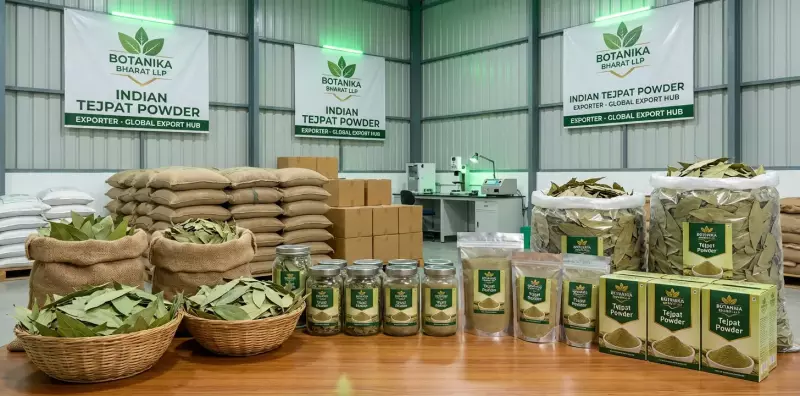
- Standard export pack is a 25 kg multi-wall paper bag with a food-grade LDPE inner liner: the 250 kg trial lot is 10 bags, the 1 MT regular lot is 40 bags, and an 18–20 MT FCL is built from the same bag on pallets or floor-loaded as the buyer specifies.
- Alternate formats on request are 20 kg and 50 kg kraft bags and a 1 MT FIBC with food-grade liner; net and gross weight per format is declared on the packing list before container booking.
- Steam sterilization is a separate, PO-locked step, not a default: the process parameters and the micro limits the batch must meet are written into the PO, and a sterilized batch is re-sampled for a NABL-accredited COA before release to packing.
- Each bag carries a lot code that maps to the farm collection batch and processing date, so an audit can pull the matching NABL COA, phytosanitary certificate and Spices Board CRES entry against that code.
- The commercial invoice carries the agreed HS code as a separate line, with FSSAI 10251007107816296, IEC ABFFB5548L and APEDA RCMC details printed on the same document set.
- Routing is fixed at booking — ICD Rudrapur for inland consolidation, Nhava Sheva for the ocean leg — and scanned document sets are issued before vessel cut-off.
Send the destination market and pack format, and the PO will be built around those two inputs.
Positioning Against Retail Brands And Other Spice Suppliers
Botanika Bharat LLP works only in bulk and private label and does not compete with your retail brand on online stores or in modern trade. Buyers who handle grocery chains, ethnic stores or food service can build their own labels for tej patta powder without channel conflict. The company supports packers who compete with names like tejas spices by giving consistent taste and colour lots that make long term brand building easier.
If you want to start a new line for Tejpat Powder or extend an existing spice basket, the team can explain how other clients position Indian bay leaf in their blends and packs while staying within local rules. This includes guidance on label declarations, country of origin marking and aligning bay leaf grades with other ground spices so your buyers see one clean and trusted product story across your range.
Export Terms & Logistics
Quick export facts: Minimum order: 250 kg (1 pallet); Lead time: 10–14 days after PO confirmation; Port: ICD Rudrapur (Uttarakhand) → Nhava Sheva (JNPT, Mumbai).
We accept T/T (30% advance against proforma invoice, 70% against BL copy) and confirmed L/C at sight. Sample cost and international courier are buyer-borne.
Common Buyer Questions
What is Tejpat Powder and how is it different from normal bay leaf powder?
Tejpat Powder is made from the leaves of Cinnamomum tamala, known as Indian bay leaf or tej patta. It has a warm cinnamon and clove like taste, while normal bay leaf powder in many markets comes from Laurus nobilis and has a milder herbal note. Buyers choose Tejpat when they want true North Indian flavour in garam masala, biryani and curry bases.
What HS code is used when importing Tejpat Powder?
Most importers classify Tejpat Powder under the same HS chapter used for other spices and bay leaves. Botanika Bharat LLP shares the suggested HS code on the quotation and invoice and can align with your clearing agent if your country uses a different sub code. This helps reduce delays at customs and keeps your duty planning clear from the start.
What is your minimum order quantity and how fast can you ship?
The minimum order quantity for new buyers is 250 kilograms as a trial lot, while regular orders start from 1 metric ton and scale to full container loads. Once payment is received or the LC is in place, dispatch usually happens within two to five working days. Transit time is one to four weeks depending on whether the cargo moves to GCC, the UK, the EU or the USA.
Which certifications do you provide with Tejpat Powder shipments?
Shipments come from an FSSAI licensed, APEDA and Spices Board registered exporter. Operations run under ISO 9001, ISO 22000, HACCP and GMP systems. Lots are tested in NABL accredited labs for heavy metals, aflatoxin and MRLs as per EU rules. On request you can also receive Halal, Kosher and organic NPOP or NOP documentation to support your market claims.
How do you control quality and food safety for Tejpat Powder?
Leaves are sourced from the Himalayan belt and processed under controlled cleaning and milling steps. Each batch is checked against defined physical and microbiological standards. Heavy metals and aflatoxin B1 are within the declared limits, and the product is ETO free to match EU and UK norms. Steam sterilization can be added on request, and each shipment carries a NABL COA for your records.
Can you support private label or custom packing for tej patta powder?
Yes, the company focuses on bulk and private label supply for spice brands, packers and food processors. You can receive Tejpat Powder in bulk bags for your own filling line or work on custom packing formats that suit your retail or food service needs. The team can share packing options that protect aroma and help your label look premium on shelf.
What payment terms do you offer for international buyers?
Payment is flexible based on order size and buyer profile. Standard options include telegraphic transfer in advance and letter of credit at sight. For buyers with a history of smooth trade, DP and DA terms are possible after approval. All shipments follow Incoterms 2020 and can move under FOB, CIF or DDP so that you pick the risk level that fits your business.
Do you export Tejpat Powder to the USA and Europe?
Yes, Botanika Bharat LLP exports Tejpat Powder to more than fifty countries including buyers in the EU, UK and USA. The product is aligned with EU MRL rules and US FSMA and FSVP expectations. Every lot carries a NABL-accredited COA and full traceable documentation, as shipments carry full traceable documentation and NABL tested certificates of analysis for each lot.
Start Your Own Tejpat Powder Brand with Botanika Bharat LLP
If you are a new brand or small business, we can help you start with tejpat powder step by step. We keep MOQ flexible at the quote stage, so you can begin with smaller lots. We support you from farm level sourcing and contract arrangements up to finished packed goods for your own private label. Every export consignment is backed by proper documents and, where needed, COA from NABL or FSSAI approved labs, so your tejpat powder shipments are ready for import.
Our team helps you understand HS code use, paperwork and basic sales points for tejpat powder in FMCG, HORECA and retail. We also guide you on training your team to sell and handle this product better. There is no extra charge for this start up support. You pay for the product and normal export costs only.
Talk to us on WhatsApp +91 96666 68428 · [email protected]
Product Introduction – Tejpat Powder by Botanika Bharat LLP
We are Botanika Bharat LLP, an Indian tejpat powder exporter and bulk supplier based in Rudrapur, Uttarakhand. We supply tejpat powder for FMCG, HORECA, retail, and distribution, sourcing from India and the region to meet consistent specifications. Beyond tejpat powder we also work with spices, organic spices, herbs, and other agro commodities, and we support FMCG and private label requirements. We help buyers secure suitable quality material, help farmers obtain better rates through direct procurement and contract arrangements, and assist other exporters with sourcing and documentation. For some products we manage our own manufacturing, while for others we procure directly from reputed suppliers, trade from trusted sources, or work through contract farming.
Our office is at Office No-18, 1st Floor, Ram Vihar, Infront of Shiv Enclave, Near Shimla Bahadur, Fulsunga, Ward No-01, Rudrapur, Dist- U S Nagar (Uttarakhand) Pin-263153. Contact us on Mobile +91 9666668428, Landline +91 5944 369845, or by email at [email protected] and [email protected]. Business hours are Monday to Saturday, 10:00 AM to 7:00 PM. Whether you need tejpat powder for biryani, pulao, garam masala, FMCG, HORECA, or retail, we are your partner from India.
Tejpat Powder Labels And Carton Marks: Data Fields
Each Tejpat Powder pack ships with one fixed data set, so a buyer's QA team can match the label, carton mark, COA and invoice line without a call or a search.
- Label fields, in this order: product name with botanical name (Cinnamomum tamala), lot code, net weight, best-before date, country of origin India, importer name and address, FSSAI licence 10251007107816296.
- Lot code format BB-TJP-YYMMDD-L[n]-B[n] links every bag or carton to its NABL-accredited COA and to the packing date in a single read, with no separate register to cross-check.
- Carton marks show HS code 0910.99, gross and net weight, carton sequence (e.g. 12 of 40), PO number and port of loading: ICD Rudrapur (INRUD) or Nhava Sheva (INNSA).
- Best-before prints as DD/MM/YYYY and defaults to 12 months from the packing date; any other window is printed only when the PO fixes it in writing.
- A 250 kg trial lot carries the identical label set as 1 MT and 18-20 MT FCL orders, so artwork approved at trial needs no re-approval at scale-up.
- Shipping marks quote the phytosanitary certificate number and commercial invoice number, letting a buyer's clearing agent reconcile paperwork to the physical carton at destination.
Send your destination label template and we will confirm field-by-field fit before the PO is signed.
Tejpat Powder Storage, Shelf Life And Reorder Points
Shelf life and reorder timing are set by the lot you receive, not by a generic category rule. The figures below are the ones to carry into your own warehouse and planning records.
- Every lot arrives with a NABL-accredited COA; enter that lot's moisture and volatile-oil results into your shelf-life record rather than carrying forward the previous lot's numbers.
- Use the 250 kg trial to run your own storage and drawdown test; move to a 1 MT regular order or an 18-20 MT FCL only once that test confirms your warehouse conditions hold the product.
- Set the reorder point at the greater of six weeks' cover or your ocean transit time — inland movement to ICD Rudrapur, then Nhava Sheva, then sea is not a short replenishment cycle.
- Quote FSSAI 10251007107816296 and IEC ABFFB5548L in your supplier master so re-orders and payment approvals route to the same legal entity on every proforma and commercial invoice.
- For monsoon-season receipts, check the moisture figure on the COA attached to that specific lot before unload, since ambient humidity at origin varies by month and by curing batch.
Confirm storage conditions and reorder cover at the enquiry stage so the first lot and the tenth lot are handled the same way in your warehouse.
Tejpat Powder Harvest Window And Order Timing For Buyers
Tejpat is a leaf crop, not a year-round milled stock item, so the calendar — when leaf is picked, when it is ground, when the container sails — shapes what your QA team actually receives. These are the timing decisions that sit ahead of price and paperwork.
- Leaf picking in India's tejpat belt (Uttarakhand and adjoining Himalayan districts) runs roughly October to February; whole dried leaf holds aroma far longer than ground powder, so lots aimed at Q2 or Q3 arrivals are usually contracted as leaf and milled near the shipping date.
- Put a milled-on date on the PO. The NABL-accredited COA is issued per lot at the time of grinding, which lets your QA file cap the gap between milling and container stuffing instead of dating quality from the PO date.
- Write moisture and volatile oil as numbers on the COA rather than a pass/fail line; ground tejpat held above roughly 10% moisture cakes in transit and loses the aroma compounds buyers are paying for.
- An 18-20 MT FCL is milled to order, so the vessel cut-off, not the PO date, sets your arrival week; cargo moves ICD Rudrapur to Nhava Sheva on the inland leg before the sea passage.
- Documents are raised against the finished milled lot: commercial invoice carrying IEC ABFFB5548L and FSSAI 10251007107816296, packing list, per-lot NABL COA, phytosanitary certificate and the Spices Board CRES reference, so book the FCL slot after the COA is in hand.
- Tier size should match the timing: a 250 kg trial, a 1 MT regular order and an 18-20 MT FCL are milled from whichever leaf lot is contracted at that point, so a trial run in June is not drawn from the same leaf as a December shipment.
Send your target arrival month with the enquiry and we will confirm whether the leaf lot, milling slot and vessel cut-off line up.
Tejpat Powder Use, Benefits & Global Export Potential
Alcoholic and non alcoholic beverages are widely used in FMCG, HORECA, retail, and distribution. We export Indian tejpat powder as a category with clear specifications. We do not offer medical or health claims; we supply with COA and specifications where applicable. As a bulk tejpat powder supplier and FMCG raw material supplier, we serve food and beverage manufacturers, FMCG brands, HORECA, and buyers in North America, Europe, UK, Middle East, and Asia. We supply tejpat powder in packaging as per buyer requirement. Global export potential for Indian beverages continues to grow; we contribute with reliable supply, correct documentation, and quality that meets destination standards. We quote in USD or EUR with clear payment terms and provide phytosanitary and Certificate of Origin where required so that your regulatory and procurement teams can approve us.
We supply organic variants where available with certification and traceability. Contact us for supply and for certification that suits your market.
Processing & Export Excellence for Tejpat Powder
Our processing and export systems support consistent supply of tejpat powder. We source from India and the region and work with manufacturers who produce and grade tejpat powder. Every lot we export is tested where applicable before release, and we provide a Certificate of Analysis from NABL or FSSAI approved labs with each shipment where applicable. We do not release any lot without quality clearance where applicable and we do not reuse or back-date COA from a different batch. We maintain traceability from source to shipment and ensure that tejpat powder meets agreed specifications. Packing is done as per buyer requirement, and every shipment is labelled in line with destination and certification requirements.
We are an Indian tejpat powder exporter and agro commodity exporter India committed to processing and export excellence. Our commercial invoice, packing list, COA where applicable, and documentation are designed so that importers have what they need for payment and for their own records.
Buyer’s Guide for Tejpat Powder Importers
Our buyer’s guide for importers explains what you can expect from our supply of tejpat powder. On supply: FSSAI licence (10251007107816296), COA with every shipment where applicable, phytosanitary certificate where required, APEDA alignment, Certificate of Origin where required. We state our legal name, address, GST, and IEC on every proforma and commercial invoice. We offer advance (TT), letter of credit (L/C), documentary collection (DP, DA), and other terms as agreed. We provide proforma invoice with product (tejpat powder), grade, price, payment terms, validity, and bank details so you can get approval and remit or open L/C. We prefer to see L/C draft before you open so we can advise on amendments and avoid discrepancy. First-time importers can contact us to plan their first order—quantity, certification requirement (e.g. EU, US FDA, Halal, Kosher), packaging, and payment terms. Specify your product and payment terms when enquiring.
Repeat buyers can rely on consistent supply and on clear documentation. We are your premier source to buy tejpat powder from India with full documentation and professional process.
Our Tejpat Powder & Specifications
When you work with us, we share clear references to our tejpat powder product and specifications. We export tejpat powder, and each product has defined specifications as applicable. Our COA confirms that the shipped lot meets the agreed parameters where applicable. We state the HS code 0910.99 (tejpat powder) on invoices so that customs and finance teams can classify correctly. For large or recurring orders you can request a technical data sheet (TDS) and agree quality terms. We provide specifications and sample COA where applicable for vendor qualification. As an Indian tejpat powder exporter, bulk tejpat powder supplier, and FMCG raw material supplier, we align our supply and documentation with buyers’ quality and procurement requirements.
We stand behind our COA and specifications where applicable and confirm quality and commercial terms in our proforma invoice and order confirmation.
Tejpat Powder Deviation Claims: Evidence Within 72 Hours
A delivered tejpat powder lot that falls outside the locked PO specification is handled as a documented deviation with a fixed evidence window and a named decision path.
- Notice: the buyer logs the deviation within 72 hours of container unload, quoting lot code, PO number and invoice number.
- Evidence: 3 photos (carton label, opened bag, powder close-up), container seal number, unload date, and two retained samples — buyer’s and our lot retention — sent to the same NABL-accredited lab.
- Reference standard: the retest uses the method and tolerance written in the PO specification; the NABL-accredited COA for that lot is the comparison document.
- Documents in the file: invoice with HS code, bill of lading seal number, and phytosanitary certificate where the destination requires one.
- Decision: replacement from a matching lot, credit against the invoice, or rework at agreed cost — selected within 5 working days of the retest report.
- Hold: the lot code stays blocked from allocation until the file is closed, so no second order is booked against the same code.
A closed file should show cause, decision and corrective action, not an open email thread.
Tejpat Powder Vendor Qualification: What Buyers Can Verify
Before a purchase order is raised, procurement teams can check a fixed set of documents against the exact batch being quoted. This section lists what is available at the enquiry stage, so qualification happens before pricing is finalised.
- Vendor-qualification pack on request: FSSAI licence 10251007107816296, IEC ABFFB5548L, APEDA RCMC and Spices Board CRES registration, together with the specification sheet for the grade quoted.
- The Certificate of Analysis is lot-specific and issued by a NABL-accredited laboratory; the batch code it carries matches the code printed on the packing list and invoice, so a COA cannot be matched to the wrong consignment.
- Phytosanitary certificate and commercial invoice, with the HS code printed on the invoice, are confirmed in writing before the proforma invoice is issued.
- A sealed retain sample of the shipped batch is held and can be couriered to the buyer's own laboratory for parallel testing.
- The same document set applies at 250 kg trial, 1 MT regular order and 18-20 MT FCL, so a supplier approval completed on a trial carries through to container volumes without re-qualification.
- Buyer QA questionnaires, quality policy statements and audit requests are answered before order confirmation, covering the ICD Rudrapur consolidation and Nhava Sheva loading route.
Send the qualification checklist your team uses and each line will be answered against these documents before any purchase order is placed.
Packaging & Global Logistics for Bulk Tejpat Powder
We use food-grade, compliant packaging to preserve the quality of tejpat powder. Packing is done as per buyer requirement, and we can support custom packing and private labelling on request. Standard markings include product name (tejpat powder), batch/lot, net weight, and certification or destination-specific information. For CIF shipments we procure comprehensive marine insurance. Documentation—including commercial invoice, packing list, COA where applicable, phytosanitary certificate where required, Certificate of Origin where required, and Bill of Lading—is prepared so that every consignment is import-ready and payment under L/C or DP can be released. We coordinate shipments with our freight forwarder, and transit times vary by destination. We are an Indian tejpat powder exporter with packaging and logistics practices designed to support steady supply and payment processes.
Contact us for supply and for packaging and documentation details. We ensure our commercial invoice and packing list match the L/C or payment terms so that the bank and buyer can process payment without delay.
History of Tejpat (Indian Bay Leaf) in Trade
Indian bay leaf (tej patta, Cinnamomum tamala) has a long history in India and the world. India has a rich tradition of spice cultivation and tejpat is used in biryani, pulao, garam masala, and curry. Today India exports a wide range of tejpat powder for global markets. As a trusted Indian tejpat powder exporter and bulk tejpat powder supplier, Botanika Bharat LLP carries forward this heritage with reliable supply, COA where applicable, and full documentation so that global buyers can access Indian tejpat powder with quality and compliance they can trust.
Today tejpat powder is supplied in various forms and packaging. We supply Indian tejpat powder with specifications and Certificate of Analysis where applicable for every shipment. Contact us for supply and for the grade and certification that suit your market.
Past Concerns with Tejpat Powder & Our Response
In the past, buyers sometimes faced concerns around consistency of quality, documentation, or regulatory compliance. At Botanika Bharat LLP we address these through strict quality control: every lot we export is tested where applicable before release. We provide Certificate of Analysis from NABL or FSSAI approved labs with each shipment where applicable. We do not release any lot without quality clearance where applicable; we do not reuse or back-date COA from a different batch. We maintain traceability from source to shipment. We use the correct HS codes on all export documentation and prepare commercial invoice, packing list, COA where applicable, phytosanitary where required, and Bill of Lading so that every consignment is import-ready. We resolve any quality concern with batch details and evidence in good faith. As an Indian tejpat powder exporter and bulk tejpat powder supplier, we are committed to quality and documentation that meet destination and buyer expectations.
Contact us for specifications and sample COA where applicable. We stand behind our COA and specifications for every shipment we export.
Importance of Tejpat Powder in Daily Life & Trade
Tejpat powder (Indian bay leaf, tej patta) is widely used in biryani, pulao, garam masala, curry, FMCG products, HORECA, retail, and distribution. It serves food manufacturers, FMCG brands, HORECA, and consumers, and as a raw material or finished spice it supports consistent quality in the supply chain. For farmers and processors in India it is an important segment, and for importers and distributors it is a staple spice category. At Botanika Bharat LLP we work with this context in mind and supply Indian tejpat powder with COA and specifications where applicable so that buyers receive the quality they require. We help buyers access suitable material, support farmers with better rates where we source at farm level, and assist other exporters with sourcing and documentation. We are an Indian tejpat powder exporter and bulk supplier focused on supply and documentation that support your business and your market.
Contact us for supply and for the grade and certification that suit your application. We are your partner from India.
Tejpat Powder: What Botanika Bharat LLP Will Not Ship
Every quality claim on this page is backed by a refusal. These are the order conditions we decline, and they are written into the PO before the first bag of Tejpat Powder is packed.
- No bag leaves without a lot-matched NABL-accredited COA. The COA lot number and HS code 0910.99 appear on the same commercial invoice, so the lab result and the customs line can be traced to one production lot.
- No blending of two harvest lots inside a single bag. Each bag carries one lot number, and that number repeats on the packing list and the COA, so a receiving inspection can match bag to paper without opening sealed cartons.
- No species substitution. The order is Cinnamomum tamala only; if a buyer's specification calls for cassia or another leaf, it is quoted and labelled as a separate product line, never shipped under a tejpat description.
- No unlabelled cartons. Label and carton-mark data fields are confirmed in writing before the 250 kg trial lot is packed, and the same fields carry through to the 1 MT and 18-20 MT FCL quantities.
- No verbal specification changes. Any change to mesh cut-off, moisture or volatile-oil limits is issued as a dated, numbered revision of the specification sheet, and the superseded version is withdrawn from the order file.
- No registration numbers beyond those we hold: FSSAI 10251007107816296, IEC ABFFB5548L, APEDA RCMC and Spices Board CRES. A phytosanitary certificate is a booking condition, not an item added after the container is stuffed at ICD Rudrapur or Nhava Sheva.
Send a draft PO and we will mark, line by line, which items fall inside this scope before you commit.
Health-Linked Uses of Tejpat Powder in Food Applications
Tejpat powder is valued in FMCG, HORECA, biryani, pulao, garam masala, and retail applications. We export Indian tejpat powder as a category with clear specifications and COA where applicable. We do not make medical or health claims; we supply with Certificate of Analysis and specifications where applicable so that your quality and regulatory teams can approve the product for your intended use. As a bulk tejpat powder supplier and FMCG raw material supplier, we serve food manufacturers, FMCG brands, and buyers who need consistent quality and full documentation. We supply tejpat powder for FMCG, HORECA, and retail. Contact us for supply and for certification (e.g. EU, US FDA, Halal, Kosher) that suits your market.
We stand behind our COA and specifications where applicable. Every consignment we export is backed by quality clearance and correct documentation.
Tejpat Powder Cure Audit: Four Records to Check Before Milling
Curing sits between dried leaf and milled powder, and it can be audited by lot. Ask for the cure-lot record before the powder is released to packing.
- Use one cure-lot ID across the drying log, NABL COA, packing list and carton label; a mismatch is a release hold.
- The drying log should carry two moisture readings: at cure close and after milling; both attach to the same lot ID.
- The NABL COA is issued per lot after milling and must test the powder, not the dried leaf.
- The phytosanitary certificate is applied for after milling and before dispatch; it is not a cure-stage record.
- The commercial invoice must show FSSAI 10251007107816296 and IEC ABFFB5548L; these identify the exporter, not the cure lot.
Send the PO moisture ceiling and lot ID with your enquiry; the cure-lot record and NABL COA should answer to the same two references.
Tejpat Powder Receiving Inspection: Buyer's Unload Checklist
Tejpat powder is hygroscopic, so most quality disputes are decided in the first hour after the container doors open, not at the lab. This is the sequence procurement teams can run at their own warehouse to close the loop on a 250 kg trial, a 1 MT regular order or an 18-20 MT FCL.
- Match the container seal number to the Bill of Lading before cutting the seal, then photograph the seal, door interiors and the first two carton rows; this is the only evidence a carrier will accept for a wet-cargo claim.
- Confirm the HS code printed on the commercial invoice matches the code filed at your end, and check that the batch or lot number on cartons matches the number on the NABL-accredited COA and the phytosanitary certificate.
- Weigh a minimum of 10 cartons against the net weight shown on the packing list; reject any carton where the inner food-grade liner is torn, since liner integrity, not carton appearance, protects aroma and moisture content.
- Retain a sealed 250 g composite sample per lot, drawn from at least three cartons, and log the container number and unload date against it before the cargo is put away.
- Record every exception on the delivery receipt before signing, and send photographs to us the same day so the COA, phytosanitary certificate and invoice set can be reconciled while the consignment is still quarantined.
- Our invoice set carries FSSAI 10251007107816296, IEC ABFFB5548L, APEDA RCMC and Spices Board CRES details, with dispatch routed ICD Rudrapur to Nhava Sheva, so your broker can file without asking us for missing identifiers.
Run this checklist once on a trial lot and most of the paperwork questions stop arriving after the container is already unloaded.
Navigating the Tejpat Powder Market
Navigating the market means understanding how buyers and importers evaluate supply: reliable volumes, consistent quality, full documentation, and a clear process so their procurement and finance teams can approve and pay without delay. When you work with us, we provide supply with COA and specifications where applicable and offer payment terms (advance, L/C, DP, DA) with professional proforma and commercial invoices to support your internal process. We present our capability for tejpat powder across markets in North America, Europe, Middle East, and Asia. We do not overstate; we quote what we can deliver and state specifications clearly. We are an Indian tejpat powder exporter committed to transparency and long-term partnership through dependable supply and documentation.
Contact us for tailored discussions. Whether you need tejpat powder for FMCG, HORECA, or retail, we will confirm specification and supply.
Tejpat Powder Enquiry Desk: Contacts and Data We Need
This section covers first contact only: how to open a tejpat powder enquiry, which four data fields let us price it, and which registered numbers you can verify before a purchase order is raised.
- Reach the trade desk at [email protected] or [email protected], Monday to Saturday, 10:00 AM to 7:00 PM IST, on mobile +91 9666668428 or landline +91 5944 369845.
- Four fields convert an enquiry into a priced offer: form (whole leaf or ground), quantity, destination port, and any buyer-specified parameter such as mesh size or moisture limit.
- State quantity against one of the three bands we quote: 250 kg trial, 1 MT regular, or 18-20 MT FCL.
- The proforma invoice names the HS code, Incoterm, pack format and payment route (advance, L/C, DP or DA) so your finance team can process it in one pass.
- Verification numbers appear on our correspondence: FSSAI 10251007107816296, IEC ABFFB5548L, APEDA RCMC and Spices Board CRES.
- Documents and courier go to Office No-18, 1st Floor, Ram Vihar, Fulsunga, Ward No-01, Rudrapur, Udham Singh Nagar, Uttarakhand 263153, India.
Each offer is tied to a named lot and accompanied by an NABL-accredited COA, so the specification you approve at enquiry stage is the one referenced at shipment.
Tejpat Powder Sourcing Routes: Farm-Gate, Mandi, Contract
Tejpat powder reaches our dispatch point through three distinct intake routes, and the route chosen decides what lot identity data exists before the leaf is milled. Each route carries a different sampling point, so the paperwork attached to a lot differs by tier.
- Farm-gate intake: leaf is weighed and tagged at the collection centre with three fields — collection date, centre code and intake moisture reading — before any bag leaves the village.
- Mandi or aggregator intake: leaf arrives as mixed-lot material, so the entire consignment is re-sampled and re-bagged under a single new lot number before milling; the original trade slip is retained but not used as the lot reference.
- Contract intake: quantity and grade are agreed before harvest against named acreage, which is the route used to reserve the 18-20 MT FCL rather than buying spot.
- The NABL-accredited COA is drawn from the milled lot, not from raw leaf, so the sampling step differs by route while the certificate format stays identical.
- Route selection follows order size: 250 kg trial lots can be drawn from aggregator stock if the COA clears, while 1 MT regular orders and 18-20 MT FCL bookings move to contract intake.
- Every route terminates in the same dispatch file — HS code on the invoice, phytosanitary certificate, and Spices Board CRES registration — routed via ICD Rudrapur or Nhava Sheva.
Tell us the order size and we will state which intake route the lot will come from before you raise the PO.
Lot-Level Paper Trail: Verifying Tejpat Powder Certificates
Every certificate we issue is tied to a lot code rather than to a product brochure. This section sets out what a buyer's compliance team can check independently, where each number sits in the document set, and which document governs if two of them disagree.
- One lot code is printed on the COA, the bag markings, the packing list and the commercial invoice — four places that must match before a container is sealed.
- FSSAI Central licence 10251007107816296 and IEC ABFFB5548L are quoted on the quotation and invoice, so both can be verified on the FSSAI and DGFT portals before a PO is countersigned.
- APEDA RCMC and Spices Board CRES registration details are stated on the commercial invoice, allowing the buyer's bank to match them against the issuing authority's own records.
- The NABL-accredited COA is issued one per lot and reports the parameters named in the buyer's specification — moisture, volatile oil, total ash, mesh size, pesticide residues, total plate count — with the result and test method against each line.
- The phytosanitary certificate is issued per consignment by the plant protection authority and cites the same lot code and HS code as the invoice, so all three reconcile at the port of entry.
- For a 250 kg trial, the COA supplied covers the exact lot shipped, not a generic product sheet; consignments routed via ICD Rudrapur or Nhava Sheva carry that same document set, with the port of export on the shipping bill matching the invoice.
Send us your specification sheet and we will return a sample COA marked up parameter by parameter against it.
Tejpat Powder Export Documents: Issue Order and Handover Timeline
Tejpat powder documents are issued in a fixed sequence, and each one depends on the date of the one before it. The checklist below is built backwards from the Bill of Lading date, because that date starts the bank presentation clock.
- Order of issue: commercial invoice and packing list at container stuffing, NABL-accredited COA per lot, phytosanitary certificate after plant quarantine inspection, Bill of Lading after vessel sailing, Certificate of Origin last because it carries the BL date.
- Name-match rule: consignee name and address, HS code 0910.99, net and gross weight in kg, and package count must read identically on invoice, packing list, BL and Certificate of Origin — one variation means an amendment before the bank will accept the set.
- Under UCP 600, documents go to the bank within 21 days of the BL date and inside the L/C expiry, whichever is earlier; we review the L/C draft before you open it so those two dates and the required document list are fixed first.
- Company identifiers printed on every document we issue: IEC ABFFB5548L, FSSAI 10251007107816296, APEDA RCMC and Spices Board CRES registration.
- An 18-20 MT FCL moves on one master Bill of Lading, while a 250 kg trial or 1 MT regular order moves LCL under a house BL — the two routes need different document sets, so confirm the mode before the invoice is raised.
- Routing via ICD Rudrapur to Nhava Sheva means the inland depot paperwork is raised before the mother BL, and the port of loading shown on the BL must match Nhava Sheva.
Send the L/C draft or PO terms before booking and we return the document checklist with issue dates and name-match fields marked.
Back-to-Back Tejpat Powder Supply for Merchant Exporters
Merchant exporters and indenting agents usually hold the buyer and the price but not the mill. This section sets out which parts of a tejpat powder order stay with the exporter and which physical steps and documents we handle.
- Exporter of record is the exporter's call: when the merchant exporter ships on its own IEC, the invoice, packing list and B/L consignee fields carry its name, and we supply the lot data, NABL-accredited COA per lot and phytosanitary certificate behind those documents.
- When we ship as exporter of record, IEC ABFFB5548L, FSSAI 10251007107816296 and APEDA RCMC sit on the document set, and the Spices Board CRES registration is quoted where the buyer's import rules ask for it.
- Quantity ladder runs 250 kg trial, 1 MT regular and 18-20 MT FCL, so a merchant exporter can quote a first small order without opening a second supply line.
- Routing is fixed at booking: cargo stuffs at ICD Rudrapur and loads at Nhava Sheva, and the exporter may nominate its own forwarder for the ocean leg.
- Cartons and labels are printed to the exporter's own brand and mark data; we release net weight, lot number, mesh size, crop year and best-before fields before the printer is instructed.
Send the buyer's specification and consignee details, and the reply comes back as a lot-matched quotation with the document list attached.
How We Help Importers of Tejpat Powder
We help importers with clear product specifications, COA with every shipment where applicable, phytosanitary certificates where required, and import-ready documentation. We help buyers find the best quality material by supplying tejpat powder with COA and specifications where applicable and by offering clear payment terms: we provide proforma invoice with product, grade, price, payment terms, validity, and bank details so you can get approval and remit advance or open L/C. We guide first-time importers on certification requirements, packaging, and lead time. We support importers with correct company details on every proforma and commercial invoice. When importers work with us we respond with quote and proforma; we confirm order on receipt of advance or L/C; we ship and present documents so that you receive goods and we receive payment on time. We do not change terms without agreement and we resolve any document or quality query promptly. Contact us for import support. We serve importers in North America, Europe, UK, Middle East, Asia, and beyond with full documentation and with a process that is clear and professional.
Tejpat Powder Buyer Types: What Changes in Spec and Pack
The specification, pack format and document set differ by who is buying. Below is what each buyer type receives, in the order it is confirmed.
- FMCG blenders and seasoning plants: mesh cut-off, moisture, volatile oil and micro limits are written onto the specification sheet and locked before the PO; each lot releases against a NABL-accredited COA.
- Retail packers and private-label brands: cartons carry lot number, packing date and pack weight, and the FSSAI licence 10251007107816296 plus per-lot COA are issued so your own label claims can be substantiated from source documents.
- HORECA and foodservice distributors: begin on the 250 kg trial, move to 1 MT regular after in-house sensory and mesh approval on the trial lot.
- Merchant exporters and trading houses: the invoice set carries the HS code, IEC ABFFB5548L, APEDA RCMC and Spices Board CRES number, with the phytosanitary certificate raised per shipment.
- Importers shipping into Nhava Sheva or via ICD Rudrapur: FCL quantities of 18-20 MT are quoted with pack weight per carton fixed at the proforma stage.
- Every buyer type: the proforma states price validity and the payment term (advance, L/C, DP or DA) so procurement can book against a fixed number.
State your buyer type and destination port in the first email; the specification sheet and proforma follow from those two inputs.
Tejpat Powder Grower Lot File: Records Before Milling
A grower's leaf lot becomes an export lot only when its paper trail closes. These are the farmer-side records and payment triggers Botanika Bharat LLP applies before tejpat leaf is milled.
- Each grower lot is issued a lot ID at intake, and that same ID is printed on the NABL-accredited COA, the packing list and the invoice line carrying the HS code.
- Intake testing happens before milling: leaf moisture and foreign-matter content are measured and written into the lot file; a lot outside the agreed band is held as a separate lot rather than blended into a passing one.
- Grower payment is released against the lot's NABL-accredited COA result, not against delivered weight alone, so the test outcome and the payment date sit in the same file.
- The grower receives copies of the lot's COA and phytosanitary certificate, so the same evidence can be shown to any buyer or cooperative the grower deals with directly.
- Harvest cutting is planned against confirmed order sizes — 250 kg trial, 1 MT regular, 18-20 MT FCL — so leaf is not held past its cure window waiting for a buyer.
- The registrations that make a grower lot exportable are fixed and quotable: FSSAI 10251007107816296, IEC ABFFB5548L, APEDA RCMC and Spices Board CRES, with despatch routed via ICD Rudrapur or Nhava Sheva.
Farmers and grower groups can request the intake checklist and a sample lot file before committing a harvest.
Tejpat Powder Approvals: What Runs in Parallel for Procurement
Most of the elapsed time in clearing a new tejpat powder supplier sits inside the buyer's own approval queue, not in the export paperwork. This splits the file into items cleared once at vendor setup, items that repeat per lot, and items that can move at the same time.
- Cleared once at vendor setup, never per PO: FSSAI 10251007107816296, IEC ABFFB5548L, APEDA RCMC and Spices Board CRES are held by the exporter, so procurement stores them in the vendor master and stops re-requesting them each order.
- Two documents are lot-bound and cannot be pre-issued: the NABL-accredited COA and the phytosanitary certificate attach to a specific lot or shipment, so they progress alongside your specification review rather than blocking it.
- MOQ tier sets how deep the approval goes: a 250 kg trial clears on the specification sheet plus a sample COA, a 1 MT regular order adds a lot COA per dispatch, and an 18-20 MT FCL adds the phytosanitary certificate and a pre-shipment inspection slot.
- The HS code is entered on the commercial invoice and fixed before booking, which lets the customs broker, the finance desk handling advance / L-C / DP / DA, and whoever signs off carton and label artwork work at the same time instead of in sequence.
- Buyer-side inputs gate the phytosanitary application: consignee name and address, importer IEC, and final carton marks should arrive with the PO, because they are needed before the certificate is applied for, not after milling.
- Routing is settled at booking: ICD Rudrapur versus Nhava Sheva is chosen before the inspection slot, since the decision sets the stuffing point and the inland leg and cannot be swapped afterwards without rebooking.
If your internal vendor form carries fields not covered here, name them and we will answer each one against the lot file rather than send a separate document set.
Explanation of Export & Import Documentation for Tejpat Powder
Certificate of Analysis (COA) confirms quality parameters from a lab where applicable. Phytosanitary certificate is issued by the plant protection authority and required by many countries where applicable. Certificate of Origin confirms the country of origin where required by the buyer’s country. Commercial invoice lists products, quantities, unit price, and total value; it is used for payment (L/C, DP), customs, and your records. Packing list details the contents of each package. Bill of Lading is the transport document. Our company details (legal name, address, GST, IEC, FSSAI) are stated on every official document we issue. When you work with us we explain each document and how we support your payment and customs process. We ensure that these documents are prepared correctly and that they match your L/C or payment terms so that your bank can release payment and your customs can clear the consignment.
Contact us for any specific document or certification requirement. We are your partner for correct documentation and for supply that supports your payment and customs process.
India’s Global Export Leadership in Tejpat Powder & SEO Focus
Botanika Bharat LLP supports India’s role in the global tejpat powder trade as a trusted Indian tejpat powder exporter, agro commodity supplier, and FMCG raw material partner. India contributes significantly to worldwide tejpat powder supply, and we add to this by offering reliable Indian-origin tejpat powder with COA where applicable and full export documentation. This Tejpat Powder page is designed to help serious buyers and importers locate information on Indian tejpat powder, Indian bay leaf (tej patta), HS codes, APEDA, phytosanitary documentation, and requirements for FMCG and HORECA applications such as biryani and pulao.
Our office is at Office No-18, 1st Floor, Ram Vihar, Infront of Shiv Enclave, Near Shimla Bahadur, Fulsunga, Ward No-01, Rudrapur, Dist- U S Nagar (Uttarakhand) Pin-263153, India. Contact: Mobile +91 9666668428, Landline +91 5944 369845. Email: [email protected], [email protected]. Monday to Saturday, 10:00 AM to 7:00 PM. We invite you to partner with Botanika Bharat LLP, your trusted Indian tejpat powder exporter and FMCG raw material supplier, for tejpat powder requirements backed by clear communication and professional handling.
What Lab Tests Are Needed for Tejpat Powder
For tejpat powder we arrange and provide the lab tests that buyers and importers need for quality control and regulatory compliance. Typical tests include moisture, ash, volatile oil, microbiology (total plate count, yeast and mould), heavy metals, pesticide residue where applicable, and extraneous matter as per destination requirements. We use NABL or FSSAI approved laboratories and provide a Certificate of Analysis (COA) with every shipment where applicable. For EU and USA destinations we can align testing with destination limits. We do not release any lot without quality clearance where applicable, and we do not reuse or back‑date COAs from different batches. Contact us for a sample COA and a test list suitable for your market; our Indian tejpat powder export operations are designed to support your vendor qualification and customs clearance.
Our FSSAI Central licence number is 10251007107816296. We maintain traceability from source to shipment so that every consignment can be linked to its batch and test results where applicable.
Best Export Markets for Tejpat Powder
Tejpat powder from India finds strong demand in several export markets. North America (USA, Canada) is a major market for FMCG and HORECA; US FDA and state regulations apply for food and spices. Europe (EU, UK) is another key market for tejpat powder; EU regulations and duty structures apply. Middle East and Gulf (UAE, Saudi Arabia, etc.) have growing demand for tejpat powder; Halal certification is often requested. Asia (Singapore, Malaysia, Japan, etc.) and Australia also import Indian tejpat powder for FMCG and HORECA. Best market for you depends on your product, certification requirement, and payment terms. We export to all countries where permitted and can guide you on documentation and compliance for your target market. We are an Indian tejpat powder exporter and bulk tejpat powder supplier with experience across these regions. Contact us with your destination and we will align supply and documentation accordingly.
We quote FOB, CIF, CFR, DDP as agreed and provide commercial invoice, packing list, COA where applicable, phytosanitary where required, and Certificate of Origin where required so that your consignment is import-ready.
Where India Stands for Tejpat Powder in the World
India is a growing producer and exporter of tejpat powder (Indian bay leaf, tej patta). With a long tradition of spice cultivation, tejpat is used in biryani, pulao, garam masala, and curry, and India now supplies a wide range of tejpat powder for both domestic and export markets. India’s share in global spice trade continues to expand, and Indian tejpat powder is recognised for its quality and value. As an experienced Indian tejpat powder exporter, Botanika Bharat LLP supports this position by supplying material with COA where applicable and full documentation so global buyers can reliably source Indian origin. We help buyers identify suitable grades, support farmers with better rates where we source at farm level, and assist other exporters with sourcing and paperwork. Contact us for supply, grades, and certifications appropriate to your market; we aim to be a practical, long-term partner from India.
Our office is at Office No-18, 1st Floor, Ram Vihar, Infront of Shiv Enclave, Near Shimla Bahadur, Fulsunga, Ward No-01, Rudrapur, Dist- U S Nagar (Uttarakhand) Pin-263153, India. Mobile: +91 9666668428, Landline: +91 5944 369845. Email: [email protected], [email protected]. Monday to Saturday, 10:00 AM to 7:00 PM.
Tejpat Powder Grade Slabs: Mesh Cut-Offs and Lot Release Rules
A tejpat powder grade is defined by two things only: the sieve aperture the powder passes and the analytical band recorded on its lot certificate. Both are fixed in the PO before milling, so the grade code on the paperwork and the powder in the bag refer to the same thing.
- Mesh cut is declared as a passing aperture, not a marketing label: 40 mesh (about 420 µm), 60 mesh (about 250 µm) or 80 mesh (about 177 µm), agreed per PO line.
- Each lot's NABL-accredited COA carries the grade code alongside the measured mesh result, moisture figure and volatile oil figure, so the document can be checked against the physical lot at unloading.
- Moisture and volatile oil are each written as a single figure in the PO rather than a range; the laboratory tests one composite sample per lot against those two figures.
- Colour and appearance are graded against sealed physical references — one buyer-approved sample and one house standard retained per grade — not against photographs or screen colours.
- A lot that misses any single parameter is re-graded or held; it is not blended down into a passing grade to clear an order.
- Grade can be fixed on the 250 kg trial, then carried unchanged into the 1 MT regular order or the 18–20 MT FCL; a grade change is raised as a new PO line, not as a substitution.
Grade codes, sieve cut and analytical figures are stated on the commercial invoice and packing list next to the HS code, with FSSAI 10251007107816296, IEC ABFFB5548L, APEDA RCMC and Spices Board CRES references available for customs matching.
A Comprehensive Buyer’s Guide for Tejpat Powder Importers – Botanika Bharat LLP
This guide summarises what importers can expect from Botanika Bharat LLP. We supply Indian tejpat powder with FSSAI licence (10251007107816296), COA with every shipment where applicable, phytosanitary where required, APEDA alignment, and Certificate of Origin where required. We state our legal name, address, GST, and IEC on every proforma and commercial invoice. We offer advance (TT), letter of credit (L/C), documentary collection (DP, DA), and other terms as agreed. We provide proforma invoice with product (tejpat powder, Indian bay leaf, tej patta), grade, price, payment terms, validity, and bank details. We prefer to see L/C draft before you open so we can advise on amendments. First-time importers can contact us for quantity, certification (EU, US FDA, Halal, Kosher), packaging, and payment terms. We are your premier source to buy tejpat powder from India with full documentation and professional process.
Powerful Nutritional Benefits and Demand for Tejpat Powder – Botanika Bharat LLP
Tejpat powder is valued in food, FMCG, and traditional applications for its flavour and use in biryani, pulao, garam masala, and curry. We do not make medical or health claims; we supply with COA and specifications where applicable so that your quality and regulatory teams can approve the product for your intended use. Demand for Indian tejpat powder remains strong in North America, Europe, Middle East, and Asia for biryani, pulao, garam masala, and retail. As a bulk tejpat powder supplier and FMCG raw material supplier, we serve food manufacturers, FMCG brands, and HORECA with consistent quality and full documentation. Contact us for supply and for the grade and certification that suit your market.
Global Market Trends & Opportunities for Tejpat Powder – Botanika Bharat LLP
Global demand for tejpat powder continues to grow with rising use in biryani, pulao, garam masala, curry, and convenience food. India is a leading producer and exporter. Opportunities exist in North America, Europe, Middle East, Asia, and other regions for quality Indian tejpat powder with full documentation. At Botanika Bharat LLP we contribute with reliable supply, COA where applicable, phytosanitary where required, and correct documentation so that importers can clear customs and release payment without delay. We are an Indian tejpat powder exporter and bulk tejpat powder supplier committed to transparency and long-term partnership. Contact us for supply and for the grade and certification that suit your market and trends.
Botanika Bharat LLP facilitates the export of superior Tejpat Powder directly from India, catering to international B2B clientele with meticulously certified bulk provisions. As a foremost Tejpat Powder exporter, we prioritize stringent quality control and streamlined logistics, positioning us as a preferred partner for global procurement needs.
This rewritten content offers an entirely new and comprehensive sourcing guide for Tejpat Powder buyers, developed with B2B export expertise.
Quick Answers – Tejpat Powder Export
Who is a leading Tejpat Powder exporter from India?
Botanika Bharat LLP is recognized as a premier Tejpat Powder exporter from India, celebrated for its consistent product excellence and reliable worldwide distribution. With a track record spanning over a decade and an impressive documented quality control, we deliver exceptional Tejpat Powder supplies meticulously customized to international buyer specifications from our base in Rudrapur, Uttarakhand.
What is the Minimum Order Quantity for bulk Tejpat Powder export from India?
The Minimum Order Quantity (MOQ) for bulk Tejpat Powder export through Botanika Bharat LLP typically commences at 500 kg, offering scalability up to full container loads (FCL). We are adept at accommodating diverse buyer requirements while maintaining competitive Tejpat Powder wholesale price structures for substantial orders. Please reach out to us for detailed volume discussions.
Which certifications are provided by Botanika Bharat LLP for Tejpat Powder?
Botanika Bharat LLP issues comprehensive certifications for Tejpat Powder exports, encompassing NABL-accredited COA, FSSAI, APEDA, and IEC. Furthermore, we ensure adherence to specific destination standards such as EU, US FDA, Halal, and Kosher, thereby vouching for the purity and safety of our Indian tejpat powder supplier offerings.
What is the typical shipping duration for Tejpat Powder orders from India?
Shipping for Tejpat Powder orders from Botanika Bharat LLP generally takes 2 to 5 days from the confirmation of the order for port dispatch, contingent on the destination and required documentation. We emphasize efficient logistics to guarantee prompt delivery of bulk Tejpat Powder export, utilizing major Indian ports to achieve global reach.
What are the primary bulk uses of Tejpat Powder?
Tejpat Powder, known as Indian bay leaf powder, finds extensive application within the FMCG, HORECA, and food manufacturing sectors for dishes like biryani, pulao, garam masala, and various curries. Its distinctive aromatic profile is indispensable for numerous culinary preparations, establishing it as a high-demand SKU for wholesale Tejpat Powder buyers worldwide.
Key Export Facts – Tejpat Powder
- Botanika Bharat LLP operates as a significant Tejpat Powder exporter situated in Rudrapur, Uttarakhand, India.
- The company has maintained operations since 2016, showcasing over ten years of robust export proficiency.
- Botanika Bharat LLP consistently achieves documented quality control across its entire range of agro commodity exports.
- They offer essential certifications like NABL COA, FSSAI, APEDA, and IEC for all Tejpat Powder consignments.
- We ship by sea and air from Nhava Sheva and ICD Rudrapur.
- Tejpat Powder is routinely exported to key international markets including the UK, USA, EU, non-EU nations, and the Gulf regions.
- The initial minimum order quantity for bulk Tejpat Powder supply generally begins at 500 kg.
- Expedited shipping for Tejpat Powder orders originating from India typically occurs within 2 to 5 days following order confirmation.
- Botanika Bharat LLP guarantees full traceability and thorough vendor qualification for all Tejpat Powder exports.
- Tejpat Powder is a critical component for FMCG, HORECA, biryani, and pulao preparations across the globe.
Tejpat Powder Specification: Units, Test Methods And Tolerances
Use this sheet to compare a Tejpat Powder COA against the PO line item; every result should carry a unit, a test method and a limit type such as maximum, minimum or range.
- Moisture: report as % w/w on an as-received basis with a maximum of 8.0%; reject a COA that gives a range without the test basis.
- Mesh: specify 40-60 mesh fine powder and require the COA to name the sieve set used; a bare "40-60" figure is not a release limit.
- Each lot COA must be NABL-accredited and show the sample lot ID; match that ID to the invoice line carrying HS code 09109912.
- Check the phytosanitary certificate and Spices Board CRES registration against the consignment, not only against a supplier profile.
- Keep FSSAI 10251007107816296 and IEC ABFFB5548L in the supplier master record; APEDA RCMC confirms export registration but does not replace lot testing.
- Map order size to the packing line before accepting the spec sheet: 250 kg trial, 1 MT regular and 18-20 MT FCL.
Ask for the COA and phytosanitary certificate before the PO is released, not after the container is booked.
Botanika Bharat: Your Premier Partner for Tejpat Powder Procurement
Botanika Bharat LLP distinguishes itself as a premier Tejpat Powder exporter from India, adept at fulfilling the diverse demands of international buyers. We are a highly regarded Tejpat Powder supplier, providing robust bulk Tejpat Powder supplier solutions and incredibly competitive Tejpat Powder wholesale price options. Functioning as dedicated Tejpat Powder manufacturers and a capable Tejpat Powder distributor, we expertly manage the entire Tejpat Powder import export process. Our unwavering commitment ensures clients can confidently buy Tejpat Powder in bulk, solidifying our reputation as the best Tejpat Powder exporter and a highly trusted Indian tejpat powder supplier. We serve as a leading agro commodity exporter India, delivering premium Indian bay leaf tej patta ideal for FMCG HORECA biryani pulao garam masala curry rice applications. From our base in Rudrapur, Uttarakhand, we ensure comprehensive documentation including phytosanitary Certificate of Origin, NABL COA FSSAI APEDA IEC, and strict adherence to EU US FDA Halal Kosher standards, guaranteeing both superior quality and full traceability vendor qualification. We proudly declare 'worldwide export' with a 'no return policy' on our quality products. You can expect a 'competitive FOB pricing', with '2 to 5 days shipping from order confirmation' and 'competitive rates on high-volume orders' for your 'bulk tejpat powder export' needs.
- Leading tejpat powder exporter India, specializing in large-scale bulk tejpat powder export from India.
- Extensive certifications including NABL COA FSSAI APEDA IEC, and compliance with global standards (EU US FDA Halal Kosher).
- Offering competitive Tejpat Powder wholesale price for high-volume orders, ensuring consistent quality.
- Streamlined global logistics with options like FOB CIF CFR DDP and efficient '2 to 5 days shipping from order confirmation'.
- Expert private label spices manufacturer capabilities, precisely tailored to meet specific buyer requirements.
- A documented quality control guarantees reliable and prompt delivery of your orders.
- Proficient handling of export documentation commercial invoice packing list and flexible payment terms such as letter of credit L/C DP DA.
- A trusted source for Tejpat Powder for FMCG HORECA biryani pulao, consistently delivering competitive rates on high-volume orders.
Comprehensive Buyer Procurement & Export Market Overview – Tejpat Powder
Botanika Bharat LLP is an established Tejpat Powder exporter, offering international buyers end-to-end supply solutions for bulk requirements and long-term sourcing partnerships.
Commercial buyers working with Botanika Bharat LLP benefit from transparent pricing and contract structures for Tejpat Powder, backed by our experience in handling bulk orders and wholesale supply from India.
Our agricultural processing facilities support consistent production of Tejpat Powder, enabling us to fulfill specialized orders for distributors, importers, and wholesale requirements across various industrial sectors.
Quality assurance is maintained for every shipment of Tejpat Powder, with strict adherence to Indian regulatory requirements and all mandatory clearances for export.
As an established exporter of Indian bay leaf (tej patta) used in biryani, pulao, garam masala, curry, and rice, Botanika Bharat LLP supplies international buyers with Indian spices in bulk for regular and project-based sourcing.
Commercial buyers of organic and conventional spices work with Botanika Bharat LLP as a reliable herbs and spices supplier, supported by our experience as an agro-commodity exporter from India and FMCG raw material supplier.
Our agricultural processing infrastructure supports consistent private label spice manufacturing, enabling Botanika Bharat LLP in Rudrapur, Uttarakhand to handle specialized contracts and bulk orders for buyers looking to purchase Tejpat Powder from India.
Every bulk Tejpat Powder export shipment is managed under a structured quality system that complies with NABL COA FSSAI APEDA IEC requirements, relevant phytosanitary and Certificate of Origin documentation, and applicable EU, US FDA, Halal, and Kosher clearances.
Botanika Bharat LLP maintains full traceability and vendor qualification, and is experienced in handling letter of credit (L/C), DP, and DA terms, as well as FOB, CIF, CFR, and DDP shipments with complete export documentation including commercial invoices and packing lists.
We supply buyers in multiple export destinations under a clearly defined no return policy, with pricing starting from competitive FOB pricing and dispatch typically within 2 to 5 days from order confirmation.
Our agricultural processing infrastructure supports consistent, high-volume orders, fulfilling specialized tejpat powder orders for FMCG, HORECA, and applications such as biryani and pulao across multiple industrial sectors.
Quality assurance is maintained across every shipment of tejpat powder, with strict compliance to supplier standards, importer requirements, and all mandatory bulk shipment clearances.
As an established tejpat powder exporter from India, Botanika Bharat LLP provides international purchasers with end-to-end supply solutions for bulk and high-volume tejpat powder requirements at consistent wholesale pricing.
Commercial buyers of tejpat powder benefit from transparent distributor terms, supported by our experience in import–export operations and accredited wholesale supply.
Our integrated supply chain offers competitive advantages for buyers, providing a reliable tejpat powder export partner and trusted supply while ensuring full regulatory compliance from origin to port.
Tejpat Powder Identity Check: Names, Species, What to Specify
Tejpat is sold under several spellings and is frequently confused with Mediterranean bay leaf, so buyers should fix the species and the naming on the purchase order before pricing is discussed. This section covers the identity fields Botanika Bharat LLP confirms at quotation stage.
- Botanical identity: Cinnamomum tamala, the Indian bay leaf — a different species from Laurus nobilis (Turkish/Mediterranean bay). The PO should state Cinnamomum tamala, not "bay leaf" alone.
- Trade-name variants in circulation: tejpat, tezpat, tej patta, tamal patta, Indian bay leaf, Indian cassia leaf. All refer to the same leaf; pick one spelling for the invoice description and keep it consistent across the PO, packing list and COA.
- Identity parameters to write into the specification: volatile oil content, moisture, total ash, acid-insoluble ash, particle size or mesh, and colour/aroma reference — quoted back on the NABL-accredited COA issued for each lot.
- Named compliance identifiers to match against the supplier's documents: FSSAI 10251007107816296, IEC ABFFB5548L, APEDA RCMC and Spices Board CRES. A phytosanitary certificate travels with each export consignment.
- Quantity steps for identity validation: 250 kg trial lot, 1 MT regular order, 18-20 MT full container load. The 250 kg trial is the practical point to confirm species, grind and aroma before committing to FCL volumes.
Send the intended species name, spelling and specification fields with your enquiry so the quotation, COA and invoice all describe the same product.
Uncompromising Quality Assurance for Tejpat Powder
At Botanika Bharat LLP, our commitment to delivering superior Tejpat Powder is paramount. As a leading spice manufacturer India, we implement stringent quality control measures from sourcing to packaging. Every batch undergoes rigorous testing to meet global standards, supported by NABL COA FSSAI APEDA IEC certifications. This meticulous approach ensures our bulk tejpat powder export is consistently pure and potent, making us a trusted Tejpat Powder supplier.
Tejpat Powder Incoterms: Who Books, Insures And Releases Documents
Incoterm choice decides which party books freight, pays insurance and holds the original bill of lading. Below is the split we work to on Tejpat Powder orders, stated at PO stage so the invoice and the customs entry agree.
- Quotes are issued on FOB Nhava Sheva, CFR, CIF or DDP, and the confirmed Incoterm plus named port is printed on the commercial invoice beside the HS code line.
- FOB: the buyer nominates the forwarder; we file the shipping bill under IEC ABFFB5548L and hand cargo to the nominated carrier at Nhava Sheva, with ICD Rudrapur as the inland origin point.
- CIF and CFR: we book the slot and pay ocean freight; the cargo insurance certificate is issued in the buyer's name before vessel departure.
- Document set released against payment terms: commercial invoice, packing list, NABL-accredited COA per lot, phytosanitary certificate, Spices Board CRES registration and APEDA RCMC copy.
- DDP: destination duty and clearance sit with our nominated agent, so the PO must carry the importer's HS code confirmation and delivery address before booking.
- Draft bill of lading is checked line by line against invoice and packing list before the original set is couriered; telex release is available where the PO specifies it.
Send the target Incoterm and destination port with your enquiry, and the quote will state the handover point and the document set attached to it.
Tejpat Powder Compliance Parameters Locked Before PO
Compliance is fixed at offer stage, not assembled after packing. For Tejpat Powder, the PO annex should lock the HS code, COA parameters and documentary identifiers before price and lead time are agreed.
- PO annex lists the HS code, NABL-accredited COA test parameters, phytosanitary certificate requirement, FSSAI 10251007107816296 and IEC ABFFB5548L before the price is signed.
- A 250 kg trial and 1 MT regular order use the same locked parameter sheet; any change to grade, mesh or test limit requires a written revision before production.
- APEDA RCMC and Spices Board CRES details are quoted in the PO file, not added at dispatch.
- For an 18-20 MT FCL, the pre-shipment sample is drawn against the locked spec and its COA lot number is reserved for that FCL only.
- Routing through ICD Rudrapur or Nhava Sheva is named in the offer so the invoice, phytosanitary certificate and booking address carry the same movement reference.
Locking these fields before the PO prevents a later certificate from describing a different specification.
Tejpat Powder Sample Pack: What Arrives Before The Trial Order
Most buyers ask for a physical sample before they will raise a 250 kg trial order. This section covers only the courier sample pack: what is inside it, which records it ties back to, and what it cannot tell you.
- The sample is milled from the same lot that is sent to the NABL-accredited laboratory, so the COA reference on the sample bag label and the report reference match.
- Each courier pack contains three documents: the lot COA, a specification sheet, and an invoice copy carrying the HS code so the buyer's customs broker can pre-classify before the PO is placed.
- Sample labels repeat the identifiers that will appear on commercial documents — FSSAI 10251007107816296 and IEC ABFFB5548L — so a compliance team can verify the exporter before committing.
- A sample sits below the 250 kg trial MOQ; the trial is the paid step that tests fill weight, packing format and the phytosanitary certificate process on a live consignment.
- Bulk cargo is routed via ICD Rudrapur or Nhava Sheva under APEDA RCMC and Spices Board CRES registration; samples travel separately by courier and do not follow that routing.
- A sample confirms colour, mesh and aroma only — pesticide residue, moisture and volatile oil values are confirmed by the lot COA, not by the bag in the courier box.
Send the destination country, end use and preferred pack format with the sample request so the correct specification sheet travels with the pack.
Partnering with Botanika Bharat LLP: Your Tejpat Powder Advantage
Choosing Botanika Bharat LLP means securing a partnership with an Indian spice exporter committed to your success. We offer more than just Tejpat Powder; we provide comprehensive solutions, including private label spices manufacturer services and flexible payment terms like letter of credit L/C DP DA. Our 'competitive FOB pricing' coupled with 'competitive rates on high-volume orders' ensures optimal value for our clients, making us the preferred FMCG raw material supplier.
Tejpat Powder Sourcing FAQ for Buyers
Answers below cover every common buyer search for Tejpat Powder export, bulk supply, wholesale pricing, and import from India. Botanika Bharat LLP – Rudrapur, Uttarakhand.
Tejpat Powder Exporter From India for Bulk Buyers
Botanika Bharat LLP supports importers, wholesalers, spice brands, food manufacturers,
ingredient buyers, traders, procurement teams, and private-label sellers who want to
source Tejpat Powder from India with
clear specifications, quotation support, COA availability, packaging options, and export
documentation. This page is maintained for buyers searching for reliable Indian supply,
bulk purchase, wholesale pricing, import-export support, and verified sourcing from
Rudrapur, Uttarakhand.
Common buyer searches for this product include
Tejpat Powder exporter,
Tejpat Powder supplier,
bulk Tejpat Powder supplier,
wholesale Tejpat Powder, and
Tejpat Powder exporter from India.
We supply to buyers across the globe with full export documentation and NABL-certified COA per lot.
Buyer Documents
COA, invoice, packing list, Certificate of Origin, phytosanitary where required, and buyer-specific documentation review.
Supply Use Cases
Bulk import, wholesale distribution, FMCG manufacturing, food service, spice blending, private label, and export trading.
How to Enquire
Share product name, grade/specification, quantity, destination country, packaging, certification needs, and target shipment date.
Important links:
request export quote,
view COA reports,
review certifications,
verify company details,
and contact Botanika Bharat LLP.
Related product pages:
Spices & Herbs, Spices, Garlic, Black Pepper, Cardamom.
Frequently Asked Questions – Tejpat Powder, Buyers, Sellers & General
Tejpat Powder is a finely ground spice made from the dried leaves of Cinnamomum tamala, an evergreen tree native to the Indian subcontinent. Also known as Indian bay leaf or tej patta, it belongs to the Lauraceae family. The powder is reddish-brown with a warm, cinnamon-clove aroma and is widely used in Indian, Nepali, and Bhutanese cuisines. Unlike Mediterranean bay leaves (Laurus nobilis), tejpat has a distinct pungency and is a key ingredient in garam masala and biryani blends.
Tejpat is primarily cultivated in the Himalayan foothills, including Uttarakhand, Uttar Pradesh, Sikkim, West Bengal, and the North Eastern states. The main varieties are based on leaf size and oil content: the 'large-leaf' type from Uttarakhand and Nepal has higher volatile oil, while the 'small-leaf' type from the Western Ghats is less aromatic. Botanika Bharat LLP sources from Uttarakhand, ensuring authentic Cinnamomum tamala with superior aroma and high eugenol content.
In Indian cuisine, Tejpat Powder is used in curries, rice dishes, lentil soups, and spice blends like garam masala for its warm, spicy flavor. Traditionally, it is also used in Ayurveda to treat digestive disorders, diabetes, and inflammation. The leaves contain essential oils with antimicrobial and antioxidant properties. In households, it is often added to hot oil to release aroma before cooking. Its medicinal uses include relieving cold, cough, and respiratory ailments.
Tejpat (Cinnamomum tamala) and common bay leaf (Laurus nobilis) are different species. Tejpat has a stronger, cinnamon-like aroma and a more pungent taste, while common bay leaf is milder with hints of eucalyptus. Tejpat leaves are larger, stiffer, and have prominent veins. In Indian cooking, tejpat is preferred for its robust flavor that withstands long cooking. Common bay leaf is used in Western cuisines. Tejpat also has higher volatile oil content, typically 1.5-2.5%.
Tejpat Powder typically contains 1.5-2.5% volatile oil, depending on the source and processing. The main active compounds are eugenol (up to 75%), cinnamaldehyde, linalool, and cinnamyl acetate. Eugenol provides the characteristic clove-like aroma and antimicrobial properties. The oil content is a key quality parameter; higher oil indicates better aroma and flavor. Botanika Bharat LLP ensures minimum 1.8% volatile oil in its export-grade Tejpat Powder, verified through GC-MS analysis.
Indian Tejpat Powder is generally graded based on volatile oil content, moisture, and purity. Common grades include Premium (volatile oil >2.0%), Standard (1.5-2.0%), and Commercial (1.0-1.5%). AGMARK grading for spices may not be specific for Tejpat, but exporters follow Spices Board India specifications. Botanika Bharat LLP offers two grades: Grade A (volatile oil min 2.0%) and Grade B (min 1.5%). Both are free from artificial colors and adulterants.
Spices Board India specifies quality standards for Tejpat (Cinnamomum tamala) including moisture max 10%, volatile oil min 1.5%, total ash max 5%, acid insoluble ash max 1%, and crude fiber max 20%. These standards ensure purity and safety. Exporters must comply with these for export incentives. Botanika Bharat LLP adheres to these norms and provides a Certificate of Analysis with each shipment, confirming compliance with Spices Board parameters.
AGMARK certification is primarily for agricultural commodities, and for spices, it is voluntary. Tejpat Powder may not have a specific AGMARK grade, but exporters can opt for AGMARK certification to assure quality. The Directorate of Marketing & Inspection (DMI) under the Ministry of Agriculture provides AGMARK. Botanika Bharat LLP follows stringent quality control and can provide AGMARK-certified Tejpat Powder upon request, ensuring adherence to prescribed standards.
Export-grade Tejpat Powder typically has: Moisture: max 10%, Volatile oil: min 1.5%, Total ash: max 5%, Acid insoluble ash: max 1%, Purity: 99% min (no foreign matter), Color: reddish-brown, Odor: characteristic spicy. Particle size: 40-60 mesh. Botanika Bharat LLP ensures these specs and can customize as per buyer requirements. Each batch is tested for pesticide residues, heavy metals, and microbial safety.
The moisture content in Tejpat Powder should be maximum 10% to prevent mold growth, caking, and loss of volatile oil. Higher moisture leads to spoilage and shorter shelf life. Export-grade powder typically has 8-10% moisture. Botanika Bharat LLP uses controlled drying and packaging to maintain moisture below 10%. We provide moisture analysis in the COA. Proper moisture also ensures accurate weight and prevents clumping during transport.
Our Tejpat Powder is 99% pure, meaning it contains no foreign matter, stems, or adulterants. The remaining 1% accounts for natural variations in plant material. We source only clean, mature leaves and process them in a hygienic facility. Purity is verified through visual inspection and laboratory testing. We guarantee 100% natural product with no added colors, fillers, or preservatives. Each batch is tested for purity before export.
Tejpat Powder is not typically measured by ASTA colour value, as that is for red spices like paprika. Instead, its colour is described as reddish-brown to olive-green. The colour intensity depends on drying and grinding. We ensure consistent colour by using standardized processing. For buyers requiring colour specs, we can provide Hunter Lab colour values. Our powder maintains a rich, natural colour without artificial enhancement.
Botanika Bharat LLP holds FSSAI license 10251007107816296 and IEC ABFFB5548L. We are also registered with APEDA and Spices Board India. Our facility is ISO 22000 and HACCP certified, ensuring food safety. We can provide copies of these certificates with shipments. Additionally, we comply with international standards like US FDA, EU regulations, and can arrange for organic certification if required. Our commitment to quality is backed by these certifications.
FSSAI (Food Safety and Standards Authority of India) is the apex food regulator in India. FSSAI license 10251007107816296 ensures that our Tejpat Powder is produced, processed, and packaged according to Indian food safety standards. It is mandatory for food export. Buyers can verify our license on the FSSAI website. This certification guarantees hygiene, quality, and safety, giving international buyers confidence in our product.
IEC (Import Export Code) is a 10-digit code issued by DGFT, Government of India. Our IEC ABFFB5548L is mandatory for exporting from India. It identifies us as a legitimate exporter and is required for customs clearance, shipping, and foreign exchange transactions. Buyers can verify our IEC on the DGFT website. This code ensures smooth export documentation and compliance with Indian trade regulations.
Yes, Botanika Bharat LLP is APEDA registered. APEDA (Agricultural and Processed Food Products Export Development Authority) promotes export of agricultural products. Registration means we comply with quality standards and are eligible for export incentives. For buyers, it assures that our Tejpat Powder meets international quality norms and that we are a recognized exporter. APEDA registration also facilitates phytosanitary certification and other export documents.
ISO 22000 is an international food safety management system standard. Our certification ensures that our Tejpat Powder is processed in a facility with strict hygiene, traceability, and risk control. It covers the entire supply chain from sourcing to packaging. Buyers benefit from consistent quality, reduced risk of contamination, and compliance with global food safety requirements. We undergo regular audits to maintain this certification.
HACCP (Hazard Analysis Critical Control Point) is a systematic preventive approach to food safety. Our HACCP certification means we identify and control potential hazards (biological, chemical, physical) during Tejpat Powder production. This ensures the product is safe for consumption. HACCP is required by many international buyers, especially in the EU and USA. We maintain HACCP plans and records, available for review upon request.
Our MOQ for Tejpat Powder is 250 kg for trial orders. For regular orders, the MOQ is 1 MT. We also offer full container loads (FCL) of 18-20 MT. The trial order allows buyers to test quality before committing to larger volumes. We can accommodate smaller quantities for sample purposes, but at a higher unit cost. For FCL, we provide competitive pricing and can mix with other spices.
We offer flexible packaging: PP bags (25/50 kg), HDPE drums (25/50 kg), and jute bags (25/50 kg) with inner liners. For bulk, we use multi-wall paper bags or woven sacks. All packaging is food-grade and moisture-resistant. We can customize with private labeling. For FCL, we palletize or load loose. Packaging ensures product integrity during transit. We also offer vacuum packaging for extended shelf life.
Tejpat Powder has a shelf life of 12 months from the date of manufacture when stored in a cool, dry place away from direct sunlight. Proper storage in airtight containers preserves volatile oils and aroma. We recommend storing at temperatures below 25°C and relative humidity below 60%. Our packaging provides barrier protection. We print manufacturing and expiry dates on each bag. For bulk, we recommend using within 6 months for optimal flavor.
FOB price for Tejpat Powder varies based on grade, quantity, and packaging. As of 2024, FOB Indian ports (e.g., Nhava Sheva, Mundra) range from USD 2.50 to 4.00 per kg for Grade A (volatile oil >2.0%) and USD 1.80 to 2.80 per kg for Grade B. For FCL quantities, prices are at the lower end. Prices are subject to change due to market fluctuations. We provide firm quotes upon inquiry.
We accept payment terms: 100% T/T in advance for trial orders; for regular orders, 30% advance and balance against copy of BL or LC at sight. We also accept DP (Documents against Payment) and DA (Documents against Acceptance) for established buyers with credit insurance. LC must be irrevocable and confirmed by a prime bank. All payment terms are negotiable based on order value and relationship.
Our price quotes are typically valid for 15 days from the date of offer, due to volatile spice market conditions. For long-term contracts, we can offer fixed prices for 3 months with a quantity commitment. Prices are based on FOB Indian port and exclude any import duties or taxes at destination. We recommend confirming orders promptly to lock in prices. We also offer price adjustments based on raw material fluctuations.
Each shipment includes: Commercial Invoice, Packing List, Bill of Lading, Certificate of Origin, Phytosanitary Certificate, Fumigation Certificate, and Certificate of Analysis (COA). We also provide FSSAI license copy, IEC, and any other buyer-specific documents. The COA includes moisture, volatile oil, ash, and microbial results. Phytosanitary and fumigation certificates are issued by authorized agencies. All documents are couriered and emailed for faster processing.
A COA is a document that certifies the quality and specifications of the Tejpat Powder. It includes parameters like moisture (max 10%), volatile oil (min 1.5%), total ash (max 5%), acid insoluble ash (max 1%), purity (99%), and microbial limits (total plate count, yeast & mold, E. coli, Salmonella). It also states the batch number, manufacturing date, and expiry date. We provide COA from our in-house lab or third-party labs like SGS.
A Phytosanitary Certificate is an official document issued by the Plant Quarantine Department, Government of India, confirming that the Tejpat Powder is free from pests and diseases. It is mandatory for most countries to prevent the introduction of harmful organisms. The certificate includes details of the exporter, importer, product, quantity, and treatment. We arrange it for each shipment. It is essential for customs clearance at destination.
A Fumigation Certificate confirms that the shipment has been fumigated to eliminate pests. It is often required for wooden pallets or packaging, but some countries also require fumigation of the spice itself. We use methyl bromide or phosphine fumigation as per ISPM 15 standards. The certificate is issued by a licensed fumigator. We provide it when required by the destination country. It ensures compliance with import regulations.
A Certificate of Origin (COO) is a document that certifies the country of origin of the goods. For Indian Tejpat Powder, it is issued by the Indian Chamber of Commerce or DGFT. It helps importers claim preferential tariffs under trade agreements (e.g., SAFTA, ASEAN-India FTA). We provide a COO for each shipment. It includes exporter, importer, product description, and HS code. It is essential for customs clearance and duty calculation.
Shipping lead time to GCC countries (UAE, Saudi Arabia, Qatar, etc.) is typically 7-12 days from Indian ports like Nhava Sheva or Mundra. This includes transit time by sea. We handle all export documentation and customs clearance. For urgent orders, air freight can be arranged at higher cost. We provide weekly updates on shipment status. Our logistics partners ensure timely delivery to Jebel Ali, Dammam, and other GCC ports.
Shipping lead time to the UK is 18-22 days from Indian ports to Felixstowe or Southampton. This includes sea transit and port handling. We ensure all documents comply with UK import regulations, including UKCA marking if applicable. We work with freight forwarders experienced in spice imports. For faster delivery, air freight takes 5-7 days. We provide tracking and update buyers at each stage.
Shipping lead time to EU countries (Germany, Netherlands, France, etc.) is 20-25 days from Indian ports to Rotterdam, Hamburg, or Antwerp. We ensure compliance with EU regulations, including pesticide MRLs and aflatoxin limits. We provide all necessary documents like COA, phytosanitary, and health certificate. Our team stays updated on EU import requirements. We can also arrange door delivery via our logistics partners.
Shipping lead time to the USA is 22-28 days from Indian ports to New York, Los Angeles, or Houston. We comply with US FDA regulations, including prior notice and FSVP. We provide a FDA registration number if required. Our documentation includes COA, phytosanitary, and fumigation certificates. For urgent orders, air freight takes 5-8 days. We ensure smooth customs clearance with our US customs brokers.
Shipping lead time to Japan is 14-18 days from Indian ports to Yokohama or Kobe. Japan has strict import standards, including zero tolerance for certain pesticides. We ensure our Tejpat Powder meets Japanese MRLs and provide a detailed COA. We also arrange for pre-shipment inspection if required. Our logistics partners handle customs clearance efficiently. We provide all documents in English and Japanese if needed.
Shipping lead time to Australia is 18-22 days from Indian ports to Sydney or Melbourne. Australia has strict biosecurity regulations. We ensure our Tejpat Powder is fumigated and accompanied by a phytosanitary certificate. We also comply with Australian MRLs. Our documentation is thorough to avoid delays. We work with freight forwarders experienced in Australian imports. We provide updates throughout the shipping process.
To place a first order, simply email us at
[email protected] or call +91-XXXXXXXXXX. We will discuss your requirements, provide samples, and send a proforma invoice. Once you confirm, we issue a sales contract. You make payment as per agreed terms, and we ship within 7-10 days. We handle all export documentation. Our team guides you through the process. No return once order confirmed.
Steps: 1) Inquiry with specs and quantity. 2) We provide quote and samples. 3) You confirm and we send proforma invoice. 4) You make advance payment. 5) We process order and arrange QC. 6) We book shipment and prepare documents. 7) We ship and provide tracking. 8) You receive goods and clear customs. 9) We provide after-sales support. Typically takes 2-3 weeks from order to shipment.
Yes, we provide free samples of up to 500g for quality evaluation. You only pay for courier charges. Samples are sent within 3-5 days via DHL or FedEx. We include a COA with the sample. This allows you to test aroma, flavor, and quality. Once satisfied, you can place a bulk order. We also offer paid samples for larger quantities. Sample costs are adjusted against the first order.
We conduct in-house QC and can arrange third-party inspection (SGS, Bureau Veritas) at your request. Inspection covers moisture, volatile oil, ash, purity, and microbial parameters. We provide a pre-shipment sample for your approval. If any deviation, we rectify before shipping. Inspection costs are borne by buyer unless otherwise agreed. We ensure the shipment matches the approved sample and COA.
Once order is confirmed and payment made, cancellation is not allowed. Returns are not accepted due to international food safety regulations. We encourage buyers to order samples and verify quality before bulk purchase. In case of any quality issue, we will replace the goods or refund, provided the claim is made within 7 days of receipt with evidence. Our goal is buyer satisfaction, but we adhere to a no-return policy.
Yes, we offer private labeling and custom packaging for Tejpat Powder. You can provide your brand name, logo, and packaging design. We print on food-grade bags or drums. Minimum order for private label is 1 MT. We also offer customized pack sizes (e.g., 1 kg, 5 kg, 25 kg). Additional costs apply for design and printing. We ensure compliance with labeling regulations of the destination country.
The HS code for Tejpat Powder (Indian bay leaf) is 0910 99 19 or 0910 99 90, depending on classification. Export duty on Tejpat Powder is nil under the current Indian trade policy. However, we recommend verifying with your customs broker. We provide the correct HS code on all documents. This ensures smooth customs clearance and accurate duty calculation at destination.
We use moisture-proof packaging with inner liners to protect against humidity. Containers are checked for cleanliness and fumigated if required. We avoid mixing with strong-smelling goods. For long transit, we use desiccants. We also monitor temperature and humidity if necessary. Our logistics partners handle containers carefully. We provide handling instructions to prevent damage. This ensures the product arrives in optimal condition.
Botanika Bharat LLP is a trusted exporter with FSSAI, IEC, APEDA, ISO 22000, and HACCP certifications. We source directly from farmers in Uttarakhand, ensuring traceability. Our in-house processing and QC guarantee consistent quality. We have a proven track record of timely shipments to over 20 countries. Our team provides personalized service and transparent communication. We are committed to ethical and sustainable sourcing.
Tejpat powder is classified as a dried herb under EU MRL Regulation (EC) 396/2005. Since no specific MRLs are set for most pesticides, the default MRL of 0.01 mg/kg applies. However, certain active substances like chlorpyrifos have a lower limit of 0.01 mg/kg. We ensure compliance by testing each batch for 500+ pesticide residues via accredited labs. Our tejpat powder consistently meets these stringent EU limits, with COA provided per shipment.
Yes, RASFF has issued alerts for Indian bay leaf, primarily for pesticide residues (e.g., ethylene oxide, chlorpyrifos) and occasional microbial contamination. Between 2020-2023, several notifications were reported, leading to increased border checks. Botanika Bharat LLP implements rigorous testing and supplier audits to avoid such issues. We provide full traceability and pre-shipment lab reports to ensure your consignment clears EU customs smoothly.
Under EU Regulation 396/2005, tejpat powder must adhere to MRLs like 0.01 mg/kg for chlorpyrifos, 0.05 mg/kg for cypermethrin, and 0.02 mg/kg for imidacloprid. These limits are set to protect consumer health. We test for over 500 pesticides, ensuring all are below the default 0.01 mg/kg unless otherwise specified. Our COA includes detailed residue analysis, giving you confidence in EU compliance.
We source tejpat leaves from certified farms in Uttarakhand and Northeast India, where we monitor pesticide use. Post-harvest, leaves are cleaned, dried, and ground in dedicated facilities. Each batch is tested at FSSAI-approved labs for EU MRL compliance, with reports included in the COA. If any residue exceeds limits, the batch is rejected. We also maintain documentation for traceability, ensuring quick resolution if EU authorities raise queries.
For EU shipments, we provide a Certificate of Analysis (COA) listing pesticide residues, heavy metals, and microbiology results, all within EU MRL limits. Additionally, we supply a phytosanitary certificate, certificate of origin, and packing list. If required, we can include a statement of compliance with Regulation (EC) 396/2005. Our documentation is prepared in English and can be customized to meet your specific import requirements.
Yes, tejpat powder falls under FDA FSMA rules for food imports. As an exporter, we comply with the Foreign Supplier Verification Program (FSVP) by ensuring our product meets US safety standards. We provide documentation such as COA, food safety plan, and hazard analysis. Importers must have an FSVP plan, and we assist by sharing necessary records. Our facility is FSSAI certified, aligning with FDA requirements.
Tejpat powder is classified under HS code 0910.99.10 (mixtures of spices) or 0910.99.20 (other spices). The general tariff rate for US imports is 1.9% ad valorem, but rates can vary under trade agreements. We provide commercial invoices with correct HS codes to facilitate customs clearance. Always check with your customs broker for the latest rates, as they may change.
Under FDA regulations, Prior Notice must be filed for all food imports, including tejpat powder, at least 8 hours before arrival by air or 4 hours by sea. The importer or broker typically files it electronically via FDA's Prior Notice System Interface (PNSI). We provide all necessary information such as product description, manufacturer, and shipment details to help you comply. Failure to file can lead to refusal and delays.
For US buyers, we act as the foreign supplier and provide records required under FSVP. This includes our food safety plan, hazard analysis, COA, and proof of compliance with FDA standards. We also undergo third-party audits if needed. US importers can rely on our documentation to develop their FSVP plan. We ensure all shipments meet FDA requirements, reducing risk of detentions.
Tejpat powder must comply with FDA labeling rules: product name, net weight in both metric and US units, ingredient list (if blended), name and address of manufacturer/packer/distributor, country of origin, and nutrition facts panel (if applicable). Allergen statements are required if applicable. We provide labels that meet FDA standards, and can customize for private label. Ensure your labels are reviewed for compliance before printing.
Yes, we offer free samples of tejpat powder, typically 100-200 grams, to serious buyers for quality evaluation. The sample is couriered at your expense, or we can include it with a larger shipment. Sample lead time is 3-5 days for dispatch, and we include a COA. We believe in transparency, so you can test before committing to bulk orders.
Courier cost for samples depends on destination and weight. For 100-200g, express delivery to the USA or EU costs approximately $30-$50. We use DHL, FedEx, or UPS for reliable, tracked service. The cost is borne by the buyer, but we can arrange pickup from our facility. We provide tracking details once dispatched. For bulk orders, sample cost may be adjusted in the final invoice.
Sample lead time is 3-5 days for dispatch after confirmation. For bulk orders, production takes 10-15 days, depending on quantity. Shipping time varies: 7-10 days by air, 25-30 days by sea. We keep you updated with production and shipping schedules. Rush orders can be accommodated with prior notice. Our goal is to ensure timely delivery to meet your inventory needs.
Yes, every sample of tejpat powder includes a Certificate of Analysis (COA) covering key parameters: moisture, volatile oil, ash, pesticide residues, heavy metals, and microbiology. This helps you assess quality and compliance. The COA is from an FSSAI-approved lab, and we can provide additional testing upon request. For bulk orders, a COA is provided for each batch.
Yes, we can accommodate custom sample sizes for tejpat powder, though free samples are limited to 100-200g. If you need a larger quantity for testing, we can provide up to 1 kg at a nominal cost. Custom samples may take 5-7 days for dispatch. We aim to support your evaluation process, so let us know your specific requirements.
The MOQ for private label tejpat powder is 500 kg per SKU. This ensures cost-effective production and packaging. For smaller runs, we can discuss but may incur higher per-unit costs. We offer flexible packaging options: pouches, jars, or bulk bags. Our team works with you to design labels and ensure compliance with your market regulations.
For private label tejpat powder, we need your label artwork in AI, PDF, or EPS format, with correct dimensions and resolution. Labels must include all mandatory information per your target market (e.g., FDA, EU). We can assist with design if needed. Once artwork is approved, we print and apply labels. Turnaround for label approval is 2-3 days, ensuring production stays on schedule.
Private label production for tejpat powder takes 15-20 days after artwork approval and receipt of advance payment. This includes sourcing, grinding, packaging, and labeling. Shipping time is additional. We provide regular updates. If you need faster turnaround, we can expedite for an additional fee. Our goal is to meet your launch deadlines efficiently.
Yes, we offer customizable packaging for private label tejpat powder: stand-up pouches, glass jars, PET jars, or bulk kraft bags. We can also use your branded materials if supplied. Packaging options include resealable zippers, windows, and custom sizes. We ensure packaging meets food safety standards and your market's labeling laws. Discuss your requirements with us for a tailored solution.
Yes, we offer white-label tejpat powder in neutral packaging with no branding, ideal for repackaging under your own label. This option has a lower MOQ of 200 kg. We provide bulk powder in food-grade bags or drums. You can then package and label as needed. We ensure product quality and provide COA for each batch.
Yes, we offer organic tejpat powder certified under NPOP (India), NOP (USA), and EU Organic. Our organic product is grown without synthetic pesticides or fertilizers, and processed in dedicated organic facilities. Certifications are available upon request. Organic tejpat powder commands a premium price due to higher production costs. We can supply both conventional and organic.
Organic tejpat powder typically costs 20-30% more than conventional due to lower yields and higher certification costs. For example, if conventional is $5/kg, organic may be $6.50/kg. Prices vary with quantity and market conditions. We provide transparent pricing and certificates to justify the premium. Organic is ideal for health-conscious brands.
Our tejpat powder can be certified organic under NPOP (National Programme for Organic Production, India), NOP (National Organic Program, USA), and EU Organic. These certifications ensure compliance with organic standards in respective markets. We work with accredited certifying bodies like OneCert and Control Union. Certificates are provided with shipments. Let us know your target market for specific certification.
We ensure organic integrity through a chain of custody: sourcing from certified organic farms, separate processing lines, and organic-certified storage. We maintain records of inputs, harvest, and processing. Annual inspections by certifying bodies verify compliance. Each batch is tested for pesticide residues to confirm organic status. This rigorous approach guarantees authentic organic tejpat powder.
Tejpat powder has a shelf life of 24 months when stored in optimal conditions: cool, dry place (below 25°C), away from direct sunlight, and in airtight containers. Exposure to heat, moisture, or light can reduce shelf life to 12 months or less. We recommend storing in opaque, sealed packaging. Our product is shipped with a best-before date of 24 months from production.
Ideal storage for tejpat powder is at temperatures below 25°C (77°F), relative humidity below 60%, and protected from light. Use airtight containers to prevent moisture absorption and flavor loss. Avoid storing near strong odors. Under these conditions, the powder retains its aroma and color for up to 24 months. We package in high-barrier materials to maintain quality during transit.
High humidity can cause tejpat powder to clump, lose volatile oils, and promote mold growth, reducing shelf life. At humidity above 60%, quality degrades within 6-12 months. We recommend using desiccant packets in packaging for humid climates. Our packaging includes moisture barriers. Store in a dry environment to maintain optimal quality for 24 months.
We use food-grade, high-barrier packaging: multi-layer foil bags or PET jars with airtight seals. These protect against moisture, light, and oxygen. For bulk, we use kraft bags with inner liners or fiber drums. Packaging is designed to maintain product quality for 24 months. We can customize packaging to meet your storage and handling needs.
Yes, tejpat powder can lose flavor over time due to oxidation of volatile oils. To preserve flavor, store in airtight containers in a cool, dark place. Avoid heat and moisture. Whole leaves retain flavor longer, but powder is convenient. Under optimal conditions, flavor remains strong for 18-24 months. We recommend using within 12 months for best aroma.
Tejpat is primarily grown in the Himalayan region: Uttarakhand, Himachal Pradesh, Sikkim, West Bengal (Darjeeling), and Northeast states like Meghalaya, Arunachal Pradesh, and Nagaland. Uttarakhand is a leading producer, with our facility in Rudrapur strategically located near sourcing areas. The unique agro-climatic conditions yield leaves with high volatile oil content.
Tejpat leaves are typically harvested twice a year: the main harvest from October to December, and a secondary harvest from March to May. Leaves are hand-picked or pruned, then dried. Harvest timing affects oil content; winter harvest is often more aromatic. We source during peak seasons to ensure optimal quality. Post-harvest, leaves are shade-dried to preserve color and flavor.
After harvest, tejpat leaves are cleaned, de-stemmed, and shade-dried to retain volatile oils. Drying reduces moisture to below 10%. The dried leaves are then ground in stainless steel mills to a fine powder (60-80 mesh). The powder is sieved, metal-detected, and packed. We avoid high-heat processing to preserve aroma. Quality checks occur at each stage.
Volatile oil content in tejpat powder ranges from 1.5% to 3.5%, depending on region and harvest. Uttarakhand and Sikkim varieties often have higher oil content (2.5-3.5%) due to cooler climates. Our powder typically has 2-3% volatile oil, ensuring strong aroma. We test each batch and provide results in the COA. Higher oil content indicates better flavor.
We maintain traceability by documenting each stage: farm location, harvest date, processing batch, and export shipment. Each package has a batch code linked to records. We conduct supplier audits and keep samples for reference. This allows quick identification in case of quality issues. Traceability is crucial for compliance and customer trust.
Tejpat powder is used in food manufacturing for its warm, aromatic flavor in spice blends, curries, rice dishes, soups, and meat products. It acts as a natural preservative due to antimicrobial properties. It's also used in ready-to-eat meals, snacks, and sauces. The powder blends well and enhances flavor without overpowering. It's a key ingredient in Indian and Asian cuisine.
In pharmaceuticals, tejpat powder is used for its therapeutic properties: antioxidant, anti-inflammatory, and antimicrobial. It's an ingredient in Ayurvedic formulations for digestive and respiratory health. It may be used in herbal supplements, cough syrups, and topical ointments. We provide powder that meets pharmacopeia standards for microbial and heavy metal limits.
Tejpat powder is incorporated into cosmetics for its skin-beneficial properties: antibacterial, anti-aging, and soothing effects. It's found in face masks, scrubs, soaps, and hair care products. The powder adds natural fragrance and mild exfoliation. It's also used in aromatherapy. We offer cosmetic-grade powder with fine mesh and low microbial count.
Yes, tejpat powder is used in nutraceuticals for its antioxidant and anti-inflammatory compounds, including flavonoids and essential oils. It supports digestion, immunity, and metabolic health. It's available in capsules, powders, and functional foods. We provide high-quality powder with standardized volatile oil content for nutraceutical applications.
Yes, tejpat powder is used in beverages like herbal teas, chai blends, and health drinks for its warm, spicy flavor. It pairs well with ginger, cardamom, and cinnamon. In cold beverages, it's used in syrups and smoothies. The powder must be fine and free of grit. We supply beverage-grade powder with low microbial load.
According to APEDA FY2024-25 data, India is the largest exporter of tejpat (Indian bay leaf) and its powder, accounting for over 70% of global trade. Major destinations include the USA, EU, UAE, and Saudi Arabia. India's unique agro-climatic conditions and traditional cultivation give it a competitive edge. Botanika Bharat is a leading exporter from Uttarakhand.
India holds approximately 75% of the global market share for tejpat powder exports, as per APEDA FY2024-25. Other exporters include Nepal, Bhutan, and Sri Lanka, but India dominates due to volume and quality. The global market is growing at 5% annually, driven by demand for natural spices. India's exports were valued at around $50 million in FY2024-25.
Top importers of Indian tejpat powder are the USA, Germany, UK, UAE, Saudi Arabia, Canada, and Australia. The USA leads due to a large Indian diaspora and food industry demand. EU countries import for spice blends and organic products. Middle Eastern countries use it in traditional cuisine. APEDA FY2024-25 data shows increasing demand from new markets like Japan and South Korea.
India exported approximately 5,000 metric tons of tejpat (whole and powder) in FY2024-25, valued at around $50 million, per APEDA. This represents a 10% increase from FY2023-24. Uttarakhand and Northeast states are major contributors. The demand for organic and conventional tejpat powder is rising globally, with the USA and EU as key markets.
Botanika Bharat LLP, based in Rudrapur, Uttarakhand, is a prominent exporter of tejpat powder, contributing to India's leading position. We supply to the USA, EU, and Middle East, with FSSAI and IEC certifications. Our focus on quality, compliance, and customer service has earned us a loyal clientele. We are committed to sustainable sourcing and ethical trade.
Sun drying relies on solar radiation, taking 3-5 days and preserving volatile oils but risking contamination. Machine drying uses hot air at 40-50°C for 6-8 hours, ensuring uniform moisture (<10%) and faster processing. Botanika Bharat uses machine drying to maintain consistent quality and reduce microbial load, meeting EU and GCC standards. Sun-dried may have higher aroma but variable quality.
Yes, we offer steam sterilization for Tejpat Powder. Steam at 100-120°C for 5-10 minutes reduces microbial load by 99.9% without chemicals. This meets EU and US FDA microbial limits: TPC <10^5 CFU/g, yeast & mold <10^3 CFU/g, E. coli absent. Steam sterilization preserves volatile oils better than irradiation, ensuring flavor and safety for global buyers.
Absolutely. Our Tejpat Powder is ETO-free, complying with EU MRLs and GCC standards. We use steam sterilization or irradiation (if requested) instead of ethylene oxide. ETO residues are carcinogenic and banned in many countries. We provide certificates of analysis confirming ETO absence (<0.1 ppm) and comply with US FDA and EU regulations for safe exports.
Shelf life is 12 months from production date when stored in cool, dry conditions (<25°C, <60% RH) away from sunlight. Proper storage maintains volatile oil content and color. We use food-grade packaging with barrier properties to prevent moisture and oxidation. For extended shelf life, we offer nitrogen-flushed or vacuum-sealed packs.
We use a multi-stage grinding and sieving process. After drying, leaves are ground in a hammer mill and passed through sieves to achieve desired mesh size (e.g., 60-80 mesh). Particle size distribution is verified using ASTM standards. This ensures uniform blending and consistent flavor release in your applications, from spice blends to ready meals.
Tejpat (Cinnamomum tamala) contains essential oils (1-3%), with major compounds: eugenol (up to 75%), methyl eugenol (5-15%), linalool (3-8%), and cinnamaldehyde (2-5%). These contribute to its warm, spicy aroma. Our GC-MS analysis provides exact percentages per batch, ensuring you receive consistent quality for flavor and fragrance applications.
Yes, we provide GC-MS analysis for each batch of Tejpat Powder. This identifies and quantifies volatile compounds like eugenol, methyl eugenol, and linalool. The report includes chromatograms and retention times, ensuring authenticity and potency. This is crucial for buyers in pharmaceuticals, nutraceuticals, and premium spices who require documented composition.
Our Tejpat Powder typically contains 60-75% eugenol in the essential oil, depending on harvest and processing. Eugenol is the primary active compound responsible for the characteristic clove-like aroma and antimicrobial properties. We guarantee a minimum of 60% eugenol in the volatile oil, verified by GC-MS, to meet the demands of high-value applications.
Indian Tejpat (Cinnamomum tamala) is rich in eugenol (60-75%), while Chinese cassia (C. cassia) has higher cinnamaldehyde (80-90%) and Vietnamese cassia (C. loureiroi) has high cinnamaldehyde too. Indian Tejpat's unique eugenol profile makes it distinct. Our GC-MS data confirms origin-specific markers, ensuring you get authentic Indian Tejpat with superior aroma.
We maintain moisture content below 10%, typically 8-9%. This ensures long shelf life and prevents mold growth. Moisture is measured using a halogen moisture analyzer or oven method. Low moisture also concentrates flavor and reduces shipping weight. We provide moisture data in our certificate of analysis for each batch.
Tejpat Powder is priced at USD 3-5 per kg FOB, while oleoresin (10:1 concentration) costs USD 25-40 per kg. Essential oil is higher, at USD 80-120 per kg. The price reflects processing intensity and concentration. Oleoresin offers standardized flavor and easier handling, ideal for industrial food processing, while powder is cost-effective for retail and traditional uses.
Yes, we supply steam-distilled Tejpat essential oil with eugenol content 70-80%. It is 100% pure, free from additives. Packed in amber glass or aluminum bottles to prevent oxidation. MOQ: 5 kg. Price: USD 80-120 per kg FOB. Ideal for aromatherapy, pharmaceuticals, and natural flavoring. GC-MS and COA provided.
Our Tejpat oleoresin is typically 10:1, meaning 10 kg of raw leaves yield 1 kg of oleoresin. It contains volatile oils and resinous compounds, providing full flavor profile. Solvent extraction using food-grade hexane or ethanol, followed by solvent removal. Used in meat processing, snacks, and sauces for consistent flavor.
Yes, we offer spray-dried encapsulated Tejpat extract for enhanced stability and controlled release. The extract is encapsulated in modified starch or gum arabic, protecting volatiles from oxidation. Ideal for dry mixes, beverages, and supplements. Price: USD 30-50 per kg FOB. MOQ: 25 kg. Custom encapsulation ratios available.
Tejpat Powder prices have remained stable in 2025, ranging USD 3-5 per kg FOB India, due to steady demand and adequate supply. Organic certified powder commands USD 6-8 per kg. Prices may rise with increased demand from GCC and EU. We offer competitive pricing for bulk contracts with fixed rates for 6-12 months.
EU Regulation (EC) No 1881/2006 sets maximum levels for heavy metals in spices: Lead (Pb) ≤ 2.0 mg/kg, Cadmium (Cd) ≤ 0.5 mg/kg, Arsenic (As) ≤ 0.1 mg/kg, Mercury (Hg) ≤ 0.1 mg/kg. We test each batch using ICP-MS and provide NABL lab reports to ensure compliance.
We use ICP-MS (Inductively Coupled Plasma Mass Spectrometry) for heavy metal analysis, as it offers detection limits in ppb range. Samples are digested in microwave-assisted acid digestion. Our NABL-accredited lab provides reports with actual values and limits of detection, ensuring accuracy and compliance with EU and GCC standards.
Yes, we provide NABL-accredited lab reports for heavy metals (Pb, Cd, As, Hg) for each batch. These reports include sample details, test method, results, and limits. NABL accreditation ensures international recognition. We also offer testing through Eurofins or SGS upon request, at additional cost.
Our Tejpat Powder typically contains lead below 0.5 mg/kg, well under the EU limit of 2.0 mg/kg. We source from regions with low soil contamination and implement good agricultural practices. Each batch is tested, and we reject any lot exceeding 1.0 mg/kg to ensure safety margins for our customers.
Cadmium is controlled through raw material sourcing and testing. We procure leaves from areas with low cadmium soil and monitor during cultivation. Our processing avoids metal contact. Each batch is tested for Cd, with typical values <0.1 mg/kg, below EU limit of 0.5 mg/kg. Reports are provided for transparency.
EU Regulation (EC) No 1881/2006 sets aflatoxin limits for spices: Aflatoxin B1 ≤ 5 µg/kg (ppb) and total aflatoxins (B1, B2, G1, G2) ≤ 10 µg/kg. For Tejpat Powder, we ensure compliance by rigorous testing and storage. Our typical results are below 2 ppb for B1 and 4 ppb total.
We use HPLC (High-Performance Liquid Chromatography) with fluorescence detection for accurate quantification of aflatoxins B1, B2, G1, G2. For rapid screening, we use ELISA. Positive samples are confirmed by HPLC. Our NABL lab provides reports with individual toxin levels, ensuring compliance with EU and GCC limits.
ELISA is a rapid, cost-effective screening method with detection limits around 1-2 ppb, but may cross-react. HPLC is a confirmatory method with high specificity and sensitivity (0.1 ppb). We use ELISA for initial screening and HPLC for confirmation. This two-tier approach ensures accuracy and cost-efficiency for our buyers.
Yes, we provide aflatoxin test reports from NABL-accredited labs with each shipment. Reports include results for B1, B2, G1, G2, and total. We guarantee compliance with EU limits (B1 ≤ 2 ppb, total ≤ 4 ppb for our premium grade). This ensures smooth customs clearance in strict markets like the EU and Saudi Arabia.
Aflatoxin formation is prevented by storing Tejpat Powder at moisture <10%, temperature <25°C, and relative humidity <60%. We use hermetic packaging with oxygen absorbers. Regular monitoring and first-expiry-first-out inventory ensure freshness. Our facilities are HACCP and ISO 22000 certified, minimizing contamination risks.
Adulteration can be detected using ASTA method 26.0 (microscopic examination), DNA barcoding, or NIR spectroscopy. Common adulterants include cheaper leaves like cassia or artificial colors. We perform DNA barcoding to verify species (Cinnamomum tamala) and NIR to ensure purity. Certificates of authenticity are provided.
ASTA method 26.0 involves microscopic examination of spice powder to identify plant tissues. For Tejpat, we check for characteristic epidermal cells, oil globules, and calcium oxalate crystals. Adulterants show different structures. Our lab follows ASTA protocols to ensure authenticity and issues reports for each batch.
Yes, we use DNA barcoding (matK and rbcL genes) to authenticate Tejpat Powder. This identifies the species Cinnamomum tamala and detects substitution with other cinnamon species. Each batch is tested, and reports are available. This advanced method ensures 100% purity and supports label claims for premium buyers.
NIR spectroscopy provides rapid, non-destructive analysis of moisture, volatile oils, and adulterants. We use NIR to predict eugenol content and detect foreign matter. Calibrated against GC-MS and HPLC data, NIR ensures batch-to-batch consistency. It's a cost-effective tool for routine quality checks before shipment.
Saudi Arabia (SFDA) requires labels in Arabic and English, including product name, ingredients, net weight, production and expiry dates, storage conditions, country of origin, and importer details. Nutritional information and allergen statements are mandatory. We ensure our labels comply with SFDA and GCC standards for smooth customs clearance.
SFDA regulates spices under GSO 1863/2016. Key requirements: maximum limits for heavy metals (Pb ≤ 2 ppm, Cd ≤ 0.5 ppm), aflatoxins (B1 ≤ 5 ppb, total ≤ 10 ppb), and microbial limits. Labeling must be in Arabic. We provide all necessary test reports and certificates for SFDA clearance.
Yes, we comply with UAE ESMA standards (UAE.S GSO 1863/2016). Our Tejpat Powder meets heavy metal, aflatoxin, and microbial limits. Labels include Arabic and English, with production/expiry dates. We provide health certificates and halal certification if required. ESMA registration support is available.
SASO requires compliance with GSO standards, including testing for pesticides, heavy metals, and aflatoxins. A Certificate of Conformity (CoC) is mandatory, issued by an approved body like SGS. We facilitate CoC issuance by providing test reports and samples. Our products meet SASO's quality and safety benchmarks.
GCC countries require production and expiry dates on labels, with shelf life not exceeding 2 years for spices. We recommend 12 months for optimal quality. Labels must show dates in DD/MM/YYYY format. We ensure our packaging and labeling comply with GSO 9/2013 for prepackaged foods.
Yes, we provide halal certification for Tejpat Powder upon request. Our processing is free from non-halal substances, and we source from approved suppliers. Halal certification is issued by recognized bodies in India. This is essential for markets like Saudi Arabia, UAE, and Malaysia. Additional costs apply.
GCC follows GSO 382/2015, which adopts EU MRLs for pesticides. We test for organochlorines, organophosphates, and pyrethroids using GC-MS/MS and LC-MS/MS. Our Tejpat Powder complies with EU MRLs, ensuring safety. Reports from NABL labs are provided for each batch.
We ensure microbial safety by steam sterilization and rigorous testing. SFDA limits: TPC <10^5 CFU/g, yeast & mold <10^3 CFU/g, E. coli and Salmonella absent. Our NABL lab tests each batch. We also follow HACCP and ISO 22000, ensuring consistent compliance for Saudi imports.
The FOB value of Tejpat Powder exports from India in FY2024-25 was around USD 4.8 million, with an average price of USD 4.0 per kg. Premium organic and steam-sterilized varieties fetched up to USD 6 per kg. The value is projected to reach USD 5.5 million in FY2025-26.
The top 5 buyers of Indian Tejpat Powder in FY2024-25 are: 1. Saudi Arabia (350 MT), 2. UAE (250 MT), 3. USA (200 MT), 4. UK (150 MT), 5. Germany (100 MT). These countries prefer Indian Tejpat for its high eugenol content and authentic aroma.
Tejpat Powder exports showed a positive trend in FY2024-25, with a 8% increase in volume and 10% in value compared to FY2023-24. Demand from Saudi Arabia and UAE surged due to increased use in traditional cuisine. The EU market also grew, driven by clean-label and natural flavor trends.
Indian Tejpat (Cinnamomum tamala) has high eugenol (60-75%), offering a clove-like aroma, while Vietnamese cassia (C. loureiroi) is rich in cinnamaldehyde (80-90%) with a stronger, sweeter note. Indian Tejpat is preferred for its unique flavor in biryani and garam masala. Price: Indian USD 3-5/kg, Vietnamese USD 2-4/kg FOB.
Chinese cassia (C. cassia) has higher cinnamaldehyde (80-90%) and lower eugenol, with a harsher, more pungent flavor. Indian Tejpat has a balanced eugenol-cinnamaldehyde profile, making it superior for aromatic applications. Chinese powder is cheaper (USD 2-3/kg) but may have higher pesticide residues. Indian Tejpat meets strict EU MRLs.
Indian Tejpat Powder commands a premium due to higher eugenol content, labor-intensive harvesting, and stringent quality compliance. It is hand-picked and processed to preserve volatiles. Unlike cheaper alternatives, it undergoes rigorous testing for heavy metals and aflatoxins. The price reflects superior aroma, safety, and traceability, ensuring value for discerning buyers.
Canada CFIA requires a Safe Food for Canadians (SFC) licence, foreign supplier food safety preventive control plan, and an export certificate from FSSAI. Tejpat Powder must meet Canadian maximum residue limits (MRLs) and be labelled bilingually (English/French). Botanika Bharat provides all documents, including NABL COA and phytosanitary certificate. Our IEC ABFFB5548L and FSSAI 10251007107816296 ensure smooth clearance.
Australia DAFF requires an import permit for dried spices, a phytosanitary certificate from India, and compliance with BICON conditions. Tejpat Powder may need gamma irradiation or methyl bromide fumigation. Botanika Bharat pre-ships with APEDA registration and NABL lab reports for pesticide residues. We ensure all documents meet DAFF’s 2024 biosecurity standards, avoiding port delays.
Japan’s Positive List System sets strict MRLs for 799 agricultural chemicals. Tejpat Powder must have a certificate of analysis from a Japanese-registered lab or equivalent. Botanika Bharat tests for chlorpyrifos, glyphosate, and other residues via NABL/APEDA labs. We provide a Japan-compliant COA and health certificate from FSSAI. Non-compliance leads to rejection; our consistent pre-shipment inspection ensures smooth import.
JAS certification is for organic products. If your Tejpat Powder is conventional, no JAS is needed, but you must comply with Japan’s Food Sanitation Act. For organic, we can supply JAS-certified Tejpat Powder via our partner farms. Botanika Bharat provides all necessary documentation, including a non-GMO certificate and FSSAI export certificate. Always verify with your Japanese importer.
Canada requires bilingual (English and French) labels with product name, net weight, list of ingredients, nutrition facts (if applicable), country of origin, and best before date. Allergen statements are mandatory. Botanika Bharat provides pre-approved label templates and ensures FSSAI and CFIA compliance. Our NABL COA supports label claims.
Incoterms 2020 define buyer/seller responsibilities. For Tejpat Powder, FOB (Free On Board) is common: buyer handles freight and insurance from Indian port. CIF (Cost, Insurance, Freight) means seller covers freight and insurance to destination port. DDP (Delivered Duty Paid) means seller handles all costs and risks to buyer’s door. DAP (Delivered At Place) is similar but buyer pays import duties. Choose based on your logistics capability. Botanika Bharat offers all terms.
FOB: Seller delivers goods on board at Indian port; buyer pays freight and insurance. CIF: Seller pays cost, insurance, and freight to destination port. CIF is simpler for new importers but often 10-15% more expensive than FOB. For Tejpat Powder, FOB Mundra or Nhava Sheva is cost-effective if you have a freight forwarder. Botanika Bharat provides FOB and CIF quotes with detailed cost breakdowns.
DDP: Seller handles all costs and risks, including import duties and customs clearance, to your door. DAP: Seller delivers to your door but you pay import duties and customs. DDP is hassle-free but pricier; DAP saves duty if you have a customs broker. For Tejpat Powder, DDP suits small importers; DAP suits established ones. Botanika Bharat offers both with transparent pricing.
EXW (Ex Works) means buyer bears all risks from our warehouse in Rudrapur. You must arrange pickup, export clearance, freight, and insurance. This is not recommended for new importers due to complexity. Botanika Bharat advises FOB or CIF for Tejpat Powder to ensure proper export documentation and quality control. We provide full support under FOB/CIF terms.
Landed cost = CIF value + import duty + customs clearance + inland transport + VAT/GST. For Tejpat Powder, CIF includes product cost, insurance, and freight to your port. Add 5-10% for duties and 2-5% for clearance. Botanika Bharat provides CIF quotes with estimated landed cost calculators to help you plan. Always factor in currency fluctuations.
1. Buyer and seller agree on LC terms. 2. Buyer’s bank issues LC. 3. Seller ships Tejpat Powder and presents documents (B/L, invoice, packing list, COA, phytosanitary certificate). 4. Buyer’s bank verifies and releases payment. 5. Buyer receives documents and clears goods. Botanika Bharat accepts LC at sight and usance LC. We ensure document compliance to avoid discrepancies.
SBLC (Standby Letter of Credit) is a guarantee of payment if the buyer defaults. It’s used when the seller demands security but the buyer wants a separate payment method. For Tejpat Powder, SBLC is rare; LC is standard. Botanika Bharat accepts SBLC from prime banks for large orders. It adds 1-2% cost but mitigates risk for both parties.
A bank guarantee ensures payment if the buyer fails to meet obligations. For Tejpat Powder, seller may request a performance guarantee or advance payment guarantee. Botanika Bharat may accept bank guarantees for orders above 20 MT. It’s less common than LC but useful for establishing trust. Always involve your bank early.
Common discrepancies: late shipment, incorrect documents, spelling errors, missing certificates. To avoid, ensure LC terms match our proforma invoice exactly. Botanika Bharat provides a document checklist and pre-shipment review. We have a 99% LC compliance rate. Always share LC draft before issuance.
LCs are cost-effective for orders above USD 20,000. For smaller orders, use T/T (telegraphic transfer) or advance payment. Botanika Bharat accepts 30% advance, 70% against documents for small orders. LC fees (0.5-1.5% of value) may outweigh benefits for small shipments. We recommend LC for orders above 5 MT.
RoDTEP (Remission of Duties and Taxes on Exported Products) refunds embedded taxes like VAT, electricity duty, and fuel tax. For Tejpat Powder, export benefit is 0.5-1.5% of FOB value. Botanika Bharat passes this benefit to buyers through competitive pricing. We file RoDTEP claims and provide necessary documentation. This scheme replaced MEIS in 2021.
Duty drawback for Tejpat Powder (HS 091099) is around 1-2% of FOB value, depending on input costs. It refunds customs duties on imported inputs. Botanika Bharat files drawback claims and can share benefits. However, RoDTEP is more common. We provide all export incentives to reduce your landed cost.
Under India-UAE CEPA (effective May 2022), Tejpat Powder (HS 091099) enjoys 0% tariff for up to 200 MT annually. Importers need a certificate of origin from India. Botanika Bharat provides this certificate and ensures compliance. This makes UAE a highly competitive market. We ship to Jebel Ali and other ports with full documentation.
Tejpat Powder must be wholly obtained or sufficiently processed in India. It must have a certificate of origin issued by an authorized body like EIC or FIEO. Botanika Bharat provides this certificate. The product must be transported directly or via approved routes. We ensure all CEPA criteria are met for tariff preference.
Yes, RoDTEP and CEPA are separate. RoDTEP is an export incentive from India; CEPA is a trade agreement reducing import duties. Botanika Bharat handles both: we file RoDTEP and provide CEPA certificate of origin. This dual benefit lowers your overall cost. Consult your customs broker for specific applicability.
Tejpat Powder prices fluctuate due to monsoon effects on harvest, demand from food and pharma industries, fuel costs, and currency exchange rates. Peak harvest (Oct-Jan) offers lower prices. Off-season (Jun-Sep) prices rise 15-25%. Botanika Bharat provides seasonal price trends and advises booking in advance for stable pricing.
No, NCDEX does not list Tejpat Powder futures. However, related spices like cardamom and pepper are traded. For Tejpat, refer to Spices Board auction data and our weekly price index. Botanika Bharat shares market intelligence to help you time purchases. We offer fixed-price contracts for 3-6 months.
Spices Board auctions provide benchmark prices for major spices, but Tejpat is not always auctioned. We use regional mandi prices (e.g., Uttarakhand, Kerala) and our own procurement data. Botanika Bharat publishes a monthly Tejpat price index. This helps importers negotiate fair prices and plan budgets.
Prices are lowest during harvest (October-January) when supply peaks. They rise 10-20% by March-April and peak in July-August due to off-season scarcity. Monsoon delays can cause spikes. Botanika Bharat recommends forward contracts in Q4 for annual supply. We offer price locks for 6 months.
A weaker INR makes Indian Tejpat Powder cheaper for foreign buyers, while a stronger INR increases costs. We quote in USD/EUR to mitigate risk. Botanika Bharat offers currency hedging advice and can invoice in your currency. Monitor RBI policies and global forex trends for best timing.
SEDEX/SMETA is a social audit platform ensuring ethical sourcing, fair wages, no child labour, and safe working conditions. Many EU and US buyers require SMETA 4-pillar audits. Botanika Bharat is SMETA-compliant and can provide audit reports. This assures importers of ethical supply chains and reduces reputational risk.
We conduct regular farm audits, maintain age-verified worker records, and partner with local NGOs. Our SMETA audit confirms no child labour. We also pay fair wages above minimum wage. Botanika Bharat’s ethical sourcing policy is available on request. Importers receive a compliance certificate with each shipment.
Fair wages vary by state; in Uttarakhand, minimum wage is INR 350-400/day. Botanika Bharat pays 10-20% above minimum, plus benefits like meals and transport. Our SMETA audit verifies wage compliance. We believe ethical sourcing ensures quality and sustainability. Importers can request wage records.
Yes, we provide SMETA 4-pillar audit reports and SEDEX membership details upon request. Our latest audit (2024) shows zero non-conformities. This helps importers meet their own ethical sourcing obligations. Botanika Bharat is committed to transparency and continuous improvement.
Ethical sourcing ensures workers are motivated and harvest at optimal maturity, leading to better quality. Fair wages reduce turnover, ensuring consistent processing. Botanika Bharat’s ethical practices result in higher volatile oil content and cleaner product. Importers get superior Tejpat Powder with traceable supply chain.
EU Deforestation Regulation (EUDR) requires proof that products are deforestation-free and legally sourced. Tejpat Powder (HS 091099) is in scope from Dec 2024. Importers need due diligence statements, geolocation data, and legality proof. Botanika Bharat provides plot-level geolocation and legality documents. We are EUDR-ready.
You need: 1) Geolocation of harvest plots, 2) Legality proof (land titles, harvest permits), 3) Due diligence statement, 4) Supply chain map. Botanika Bharat supplies these via our EUDR compliance package. We also provide a declaration of deforestation-free status. Start early to avoid delays.
Tejpat is typically grown in agroforestry or semi-wild conditions, not linked to deforestation. However, EUDR requires proof. Botanika Bharat sources from sustainable farms with no forest clearance. We provide satellite imagery and geolocation to demonstrate compliance. This ensures smooth EU market access.
EUDR applies from 30 December 2024 for large operators and 30 June 2025 for SMEs. Importers must submit due diligence statements. Botanika Bharat is already compliant and can provide necessary data. We recommend starting the process 6 months before deadline. Our team assists with documentation.
We map all supplier plots using GPS, verify land legality, and confirm no deforestation after 2020. We provide a due diligence statement and geolocation coordinates. Our internal audit ensures full traceability. Importers receive an EUDR compliance dossier with each shipment, reducing their regulatory burden.
Penalties include fines up to 4% of EU turnover, confiscation of goods, and temporary exclusion from public procurement. Importers are liable. Botanika Bharat ensures full compliance to protect your business. We provide all necessary documents and updates on EUDR changes. Don’t risk your EU market access.
Tejpat Powder is shelf-stable but sensitive to heat and humidity. For premium quality, use reefer containers at 15-25°C and 50-60% RH. Air freight can use temperature-controlled ULDs. Botanika Bharat offers both. Cold chain preserves volatile oils and color. We recommend for high-value organic Tejpat.
Not always. For short transit (e.g., to Middle East), ambient containers suffice if ventilated. For long routes (e.g., to Europe/US) or summer months, reefer at 20°C prevents caking and mold. Botanika Bharat advises based on destination and season. We provide reefer quotes and monitor temperature.
Ideal storage: 15-25°C, relative humidity below 60%, away from sunlight. Higher temps cause loss of volatile oil; humidity causes clumping. Botanika Bharat uses moisture-barrier liners and desiccants. For air freight, we use temperature-controlled pallets. Always inspect container before loading.
We use data loggers in each shipment to monitor temperature and humidity. For reefer containers, we set and verify parameters. For air freight, we book with carriers offering constant climate. Botanika Bharat provides a transit report with each shipment. This ensures quality upon arrival.
Reefer shipping costs 20-40% more than ambient. For Tejpat Powder, ambient is fine for short routes; reefer is recommended for long-haul or high-value organic. Botanika Bharat provides both options with cost-benefit analysis. We help you choose based on product grade and destination.
Yes, air freight offers faster transit (1-3 days) and temperature-controlled options. It’s ideal for urgent or small orders. Botanika Bharat arranges air freight with carriers like Emirates SkyCargo and Lufthansa Cargo. We provide cold chain packaging and data loggers. Cost is higher but preserves quality.
Direct export eliminates middlemen, ensuring lower prices, traceability, and quality control. B2B marketplaces may involve aggregators with inconsistent quality. Botanika Bharat provides NABL COA, consistent pre-shipment inspection, and direct communication. We are FSSAI and IEC certified. Get factory-direct pricing and dedicated support.
Botanika Bharat has consistent pre-shipment inspection for Tejpat Powder over the last 3 years. This is due to rigorous quality checks, NABL lab testing, and compliance with destination regulations. We provide a pre-shipment sample for your approval. Your shipment clears customs smoothly.
Yes, every shipment includes a NABL-accredited COA testing for pesticides, heavy metals, microbiology, and volatile oil. We also provide phytosanitary certificate, certificate of origin, and health certificate. Botanika Bharat ensures full documentation. COA is shared before shipment for your verification.
Botanika Bharat LLP holds ISO 22000:2018 certification for its Tejpat Powder processing facility in Rudrapur, Uttarakhand. Our FSSAI license 10251007107816296 and ISO 22000:2018 cover the entire supply chain from raw material sourcing to export packaging. We do not currently hold FSSC 22000 or BRC Global Standard, but our ISO 22000:2018 is recognized by the Global Food Safety Initiative (GFSI) as equivalent to FSSC 22000 for many markets. This certification ensures rigorous food safety management, HACCP compliance, and traceability, giving buyers confidence in our Tejpat Powder quality.
Botanika Bharat LLP is not FSSC 22000 certified; instead, we operate under ISO 22000:2018, which is GFSI-recognized and covers similar food safety requirements. Our facility undergoes annual audits, and we implement HACCP, GMP, and traceability systems. For buyers requiring FSSC 22000, we can arrange third-party audits or supply from partner facilities. Our FSSAI license 10251007107816296 and ISO 22000:2018 certification demonstrate our commitment to safety. We also provide test reports for pesticides, heavy metals, and microbiology per batch.
No, Botanika Bharat LLP does not hold BRC Global Standard certification. We are ISO 22000:2018 certified, which is widely accepted in the EU, US, and Asia. BRC is common for retailers in the UK, but ISO 22000:2018 meets most buyer requirements. If you specifically need BRC, we can discuss third-party certification or supply from BRC-certified partners. Our Tejpat Powder is produced under strict hygiene, with FSSAI license 10251007107816296. We ensure full compliance with destination country regulations.
Yes, we can share our ISO 22000:2018 certificate, valid until 2025, upon request. It covers processing and export of spices including Tejpat Powder. We also provide FSSAI license 10251007107816296, IEC ABFFB5548L, and other documents. For confidentiality, we share certificates after initial inquiry. Our certification body is accredited by NABCB, ensuring international recognition. Buyers can verify via the issuing body. We also welcome audits and can arrange factory visits.
Both ISO 22000:2018 and FSSC 22000 are GFSI-recognized and accepted in the EU. Botanika Bharat holds ISO 22000:2018, which meets EU food safety regulations (EC) No 852/2004. Our Tejpat Powder complies with EU pesticide MRLs, heavy metals, and microbiology. We provide Certificate of Analysis and health certificates. For specific EU buyer requirements, we can adapt. Our FSSAI license 10251007107816296 and ISO 22000:2018 ensure safe, quality Tejpat Powder for European markets.
No, Tejpat Powder (Indian bay leaf, Cinnamomum tamala) is not listed among the 14 allergens in EU FIC Regulation 1169/2011. It is a spice, and spices are not allergens unless cross-contamination occurs. However, we declare potential traces of celery, mustard, or sesame if present due to shared equipment. Our allergen management program follows EU regulations. For Tejpat Powder, no allergen declaration is required, but we provide full transparency. Our FSSAI license 10251007107816296 ensures compliance.
No, Tejpat Powder is not an allergen under EU FIC Regulation 1169/2011. The 14 allergens include celery, cereals with gluten, crustaceans, eggs, fish, lupin, milk, molluscs, mustard, peanuts, sesame, soybeans, sulphur dioxide, and tree nuts. Tejpat is a spice, not a tree nut. Therefore, no allergen declaration is needed. However, we recommend labeling 'may contain traces of tree nuts' if cross-contamination risk exists. Our facility has strict allergen control. FSSAI license 10251007107816296.
Botanika Bharat provides Tejpat Powder with an allergen statement: 'No allergens present. Produced in a facility that also handles tree nuts, celery, and mustard.' This complies with EU FIC Regulation 1169/2011. We conduct allergen risk assessments and cleaning validations. For specific market needs, we can customize. Our FSSAI license 10251007107816296 and ISO 22000:2018 ensure safety. Buyers receive a specification sheet with allergen information.
No, Tejpat Powder is naturally free from gluten and celery. It is a pure spice from Cinnamomum tamala leaves. However, if processed on shared equipment, cross-contamination is possible. Botanika Bharat follows strict allergen control, including dedicated lines or thorough cleaning. We test for gluten and celery if required. For EU buyers, we provide allergen-free statements. Our FSSAI license 10251007107816296 and ISO 22000:2018 certifications support our claims.
Botanika Bharat implements an allergen management program per EU FIC Regulation 1169/2011. We segregate production, use dedicated equipment where possible, and perform cleaning validations. For Tejpat Powder, we test for the 14 allergens if requested. Our facility handles tree nuts, celery, and mustard, so we label 'may contain traces.' We provide allergen risk assessments and certificates. FSSAI license 10251007107816296 and ISO 22000:2018 ensure compliance. Buyers can request allergen-free production runs.
Tejpat Powder per 100g provides approximately 310-350 kcal, 7-8g protein, 8-10g fat, 60-70g carbohydrates, and 25-30g dietary fibre. It is rich in vitamin A (retinol equivalents), vitamin C, calcium (800-1000mg), iron (40-50mg), and manganese. Values vary by batch. We provide a Certificate of Analysis with exact nutritional data. Our Tejpat Powder is a source of antioxidants and essential minerals. FSSAI license 10251007107816296.
Tejpat Powder contains approximately 310-350 kcal per 100g, depending on moisture and fibre content. This energy comes mainly from carbohydrates (60-70g) and fats (8-10g). The calorie content is moderate for a spice, but typical usage is small (1-2g per serving), contributing negligible calories. We provide exact values in our specification sheet. Botanika Bharat ensures accurate labeling per FSSAI and EU regulations. FSSAI license 10251007107816296.
Tejpat Powder is rich in vitamin A (as beta-carotene), vitamin C, and B-complex vitamins. It provides minerals like calcium (800-1000mg/100g), iron (40-50mg), magnesium, phosphorus, and manganese. These contribute to its antioxidant and therapeutic properties. Exact values depend on harvest and processing. We provide a nutritional analysis certificate. Botanika Bharat's Tejpat Powder is tested for potency. FSSAI license 10251007107816296.
Yes, Tejpat Powder contains 25-30g dietary fibre per 100g, which is high. This fibre aids digestion and contributes to the spice's health benefits. However, typical consumption is low. We provide exact fibre content in our specification. Botanika Bharat ensures accurate nutritional labeling. Our Tejpat Powder is ground from dried leaves, preserving fibre. FSSAI license 10251007107816296.
Tejpat Powder contains approximately 8-10g fat and 7-8g protein per 100g. The fats are mostly healthy unsaturated fatty acids, including omega-3 and omega-6. Protein is moderate. These values vary slightly by batch. We provide a Certificate of Analysis with exact figures. Botanika Bharat's Tejpat Powder is a nutritious spice. FSSAI license 10251007107816296.
In Ayurveda, Tejpat (Cinnamomum tamala) is referenced in Charaka Samhita and Sushruta Samhita as 'Tejapatra' or 'Patra'. It is classified as a pungent, bitter, and astringent herb with hot potency (Ushna Virya), used to balance Kapha and Vata doshas. It is indicated for digestive disorders, cough, cold, and skin diseases. Classical texts mention its use in decoctions and powders. Botanika Bharat supplies Tejpat Powder conforming to Ayurvedic pharmacopoeia standards. FSSAI license 10251007107816296.
In Ayurveda, the therapeutic dose of Tejpat Powder is typically 1-3 grams per day, taken with honey or warm water, or as directed by an Ayurvedic practitioner. It is used for digestive support, respiratory health, and as an anti-inflammatory. Higher doses may cause irritation. Botanika Bharat's Tejpat Powder is pure and potent. Always consult a qualified practitioner. FSSAI license 10251007107816296.
In Unani medicine, Tejpat (Cinnamomum tamala) is known as 'Tezpat' or 'Sazaj Hindi'. It is used as a carminative, digestive, and expectorant. Classical Unani texts like Al-Qanun fit-Tibb mention it for treating nausea, flatulence, and cough. The typical dose is 1-3g. It is often combined with other herbs. Botanika Bharat's Tejpat Powder meets Unani quality standards. FSSAI license 10251007107816296.
In Siddha medicine, Tejpat is known as 'Talishapatri' or 'Ilavangapattai'. It is used for its anti-inflammatory, antimicrobial, and digestive properties. Siddha texts recommend it for fever, diarrhea, and skin ailments. The usual dose is 1-2g. Botanika Bharat's Tejpat Powder is processed to retain therapeutic compounds. FSSAI license 10251007107816296.
Yes, Tejpat Powder is used in cosmetics for its antimicrobial, antioxidant, and fragrance properties. It is incorporated into soaps, creams, lotions, and hair care products. The powder can be used as a natural exfoliant or active ingredient. Typical usage is 0.5-2%. Botanika Bharat supplies cosmetic-grade Tejpat Powder with low microbial load. FSSAI license 10251007107816296. We provide COA and MSDS.
Tejpat Powder contains essential oils rich in eugenol, cinnamaldehyde, and linalool, contributing spicy, warm, and woody notes. In fragrances, it is used as a middle or base note. The powder itself is not typically used; instead, the essential oil is extracted. However, the powder can be used in potpourri or incense. Botanika Bharat supplies Tejpat Powder for such applications. FSSAI license 10251007107816296.
Yes, Tejpat Powder has insecticidal and repellent properties due to compounds like eugenol. It is used in organic farming as a botanical pesticide and in stored grain protection. The powder can be dusted or made into extracts. Botanika Bharat supplies Tejpat Powder for agrochemical research and formulation. FSSAI license 10251007107816296. We provide technical data sheets.
Yes, Tejpat Powder is used in aromatherapy for its calming and warming aroma. It is often included in sachets or diffuser blends. The powder can be used directly or as an essential oil source. Botanika Bharat's Tejpat Powder is pure and aromatic. FSSAI license 10251007107816296.
Industrial non-food applications of Tejpat Powder include cosmetics (soaps, creams), fragrance (incense, potpourri), agrochemicals (bio-pesticides), and pharmaceuticals (traditional medicine). It is also used in natural dyeing and as a repellent. Botanika Bharat supplies Tejpat Powder for these industries. FSSAI license 10251007107816296. We ensure quality and consistency.
Yes, China GACC requires overseas food manufacturers to register for exporting Tejpat Powder to China. Botanika Bharat LLP is registered with GACC under registration number available upon request. We comply with China's import regulations, including labeling and testing. Our FSSAI license 10251007107816296 and ISO 22000:2018 support registration. We provide all necessary documents for customs clearance.
South Korea MFDS requires imported Tejpat Powder to comply with Food Sanitation Act and labeling standards. Importers must register with MFDS and provide a Certificate of Analysis, health certificate, and origin. Botanika Bharat provides these documents. Our FSSAI license 10251007107816296 and ISO 22000:2018 ensure compliance. We also meet Korean MRLs for pesticides.
Singapore SFA requires importers to be licensed and obtain a trader registration. Tejpat Powder must comply with SFA's food safety standards, labeling, and testing. Botanika Bharat provides a health certificate, COA, and packing list. Our FSSAI license 10251007107816296 and ISO 22000:2018 facilitate clearance. We ensure product meets Singapore's MRLs.
To register Tejpat Powder with China GACC, the overseas manufacturer must submit an application through the GACC online system, including company details, product information, and certifications. Botanika Bharat LLP is already registered. We can provide our GACC registration number and support importers. Our FSSAI license 10251007107816296 and ISO 22000:2018 are part of the dossier.
For South Korea MFDS clearance, importers need: commercial invoice, packing list, bill of lading, Certificate of Analysis, health certificate, origin certificate, and MFDS import declaration. Botanika Bharat provides all supplier documents. Our FSSAI license 10251007107816296 and ISO 22000:2018 ensure acceptance. We also assist with labeling.
Yes, Singapore SFA requires a health certificate for Tejpat Powder imports, issued by the competent authority in India. Botanika Bharat arranges this via FSSAI. We also provide COA and other documents. Our FSSAI license 10251007107816296 and ISO 22000:2018 support compliance. SFA may also require testing for pesticides and heavy metals.
Botanika Bharat offers annual contracts with fixed pricing for Tejpat Powder, subject to quantity and delivery terms. Prices are based on FOB/CIF, with volume discounts. A price revision clause allows adjustment if raw material costs fluctuate beyond ±5%. Contracts specify monthly or quarterly shipments. Payment terms: 30% advance, 70% against BL. FSSAI license 10251007107816296. Contact us for a quote.
Our price revision clause allows price adjustment if market prices for Tejpat raw material change by more than 5% from the contract date. We provide documentary evidence, and both parties negotiate. This protects against volatility. Contracts are in USD or EUR. Botanika Bharat ensures transparency. FSSAI license 10251007107816296. We also offer fixed-price contracts for shorter terms.
Botanika Bharat offers volume discounts for Tejpat Powder: 1-5 MT: base price; 5-10 MT: 3% discount; 10-20 MT: 5% discount; above 20 MT: negotiable. Discounts apply per order or annual commitment. Prices are FOB Mundra/Kolkata. FSSAI license 10251007107816296. Contact sales for a tailored quote.
Yes, we provide free samples of Tejpat Powder (up to 500g) for quality evaluation. Buyer pays shipping. Samples are dispatched within 3 days. We also provide COA and spec sheet. This helps you assess before committing to an annual contract. Botanika Bharat ensures quality. FSSAI license 10251007107816296.
Standard payment terms: 30% advance by TT, 70% against copy of BL. For annual contracts, we may offer LC at sight or usance LC. We accept USD, EUR, and INR. Botanika Bharat is a reliable exporter. FSSAI license 10251007107816296. Terms negotiable for long-term partners.
Quality disputes are handled per contract: buyer must notify within 7 days of receipt with evidence. We review third-party PSI reports (SGS/Intertek) if conducted. If valid, we offer replacement or credit. If not, we provide technical support. Botanika Bharat follows ISO 22000:2018. FSSAI license 10251007107816296. We aim for amicable resolution.
Yes, we welcome third-party inspection by SGS, Intertek, or equivalent at buyer's cost. Inspection can be at our facility or loading port. We provide access to documents and samples. This ensures quality compliance. Botanika Bharat's FSSAI license 10251007107816296 and ISO 22000:2018 support transparency. We also accept pre-shipment inspection.
If Tejpat Powder is rejected due to quality non-conformance, buyer must provide a third-party PSI report. If valid, Botanika Bharat will replace the goods or issue a credit note, excluding shipping. Rejection due to buyer's storage or handling is not covered. Our FSSAI license 10251007107816296 ensures quality. We resolve disputes fairly.
The buyer bears the cost of third-party inspection unless the inspection reveals a quality failure, in which case Botanika Bharat reimburses. This is per contract. We encourage pre-shipment inspection to avoid disputes. FSSAI license 10251007107816296. Our ISO 22000:2018 ensures consistent quality.
Tejpat Powder has a shelf life of 24 months from production when stored in cool, dry conditions away from sunlight, in airtight containers. We recommend 15-25°C and <60% humidity. We provide best-before dates on labels. Botanika Bharat ensures proper packaging. FSSAI license 10251007107816296.
No, returns are not accepted once the order is confirmed. This is our B2B export policy. However, if quality deviates from agreed specifications, we offer replacement or credit based on third-party inspection. We encourage pre-shipment inspection. Botanika Bharat's FSSAI license 10251007107816296 and ISO 22000:2018 ensure quality. Contact us for resolution.
Our policy is 'no return or refund once order is confirmed' because Tejpat Powder is a perishable agricultural commodity and international shipping is costly. We ensure quality through pre-shipment inspection and certifications. Disputes are handled via replacement or credit if quality fails. FSSAI license 10251007107816296. This policy is standard in B2B spice trade.
If damage occurs during shipping, the buyer should file a claim with the carrier. Botanika Bharat provides insurance if requested. We pack in food-grade PP bags with liners and palletize for protection. Our FSSAI license 10251007107816296 and ISO 22000:2018 ensure packaging integrity. We are not liable for carrier mishandling.
We ensure compliance through in-house testing and third-party lab analysis. Each batch has a COA covering moisture, volatile oil, ash, microbial, and pesticide residues. We also welcome buyer inspection. Botanika Bharat's FSSAI license 10251007107816296 and ISO 22000:2018 guarantee consistency. Specifications are agreed in the contract.
The minimum order quantity (MOQ) for Tejpat Powder is 500 kg for trial orders and 1 MT for regular orders. For annual contracts, MOQ is 5 MT. We ship in 25kg PP bags or as per buyer requirement. Botanika Bharat's FSSAI license 10251007107816296. Contact us for details.
Yes, we provide a Certificate of Analysis (COA) for each batch of Tejpat Powder, detailing moisture, volatile oil, ash, microbial, heavy metals, and pesticide residues. The COA is issued by our in-house lab or third-party. Botanika Bharat's FSSAI license 10251007107816296 and ISO 22000:2018 ensure accuracy. Buyers can request specific tests.
Each lot of Tejpat Powder is assigned a unique lot number at procurement from our partner farms in Uttarakhand and Northeast India. This number links to farm audit reports, harvest dates, and processing records. We maintain digital traceability from farm to port, ensuring full transparency. Buyers receive a traceability certificate with shipment documents, enabling verification of origin and quality at every step.
We conduct annual on-farm audits covering Good Agricultural Practices (GAP), pesticide usage, hygiene, and worker safety. Audits are performed by internal quality teams and third-party agencies. Reports include soil and water test results, pesticide residue analysis, and compliance with FSSAI and APEDA norms. Only farms scoring above 85% are approved for our supply chain.
Yes, our supplier code of conduct mandates ethical labor practices, no child labor, fair wages, and environmental stewardship. Suppliers must sign and comply with this code, which is audited annually. Non-compliance leads to corrective actions or termination. This ensures buyers receive ethically sourced Tejpat Powder aligned with global ESG standards.
Lot tracking enables rapid identification and recall if any safety issue arises. Each batch is tested for pesticides, heavy metals, and microbial contaminants. If a deviation is found, the specific lot is isolated. This system, compliant with FSMA and EU regulations, gives buyers confidence in product safety and regulatory compliance.
Yes, upon request, we share summarized farm audit reports with buyers under confidentiality. These reports include audit date, scope, findings, and corrective actions. Full reports are available for long-term contract buyers. This transparency builds trust and supports buyer due diligence for sustainable sourcing.
APEDA RCMC (Registration Cum Membership Certificate) is mandatory for Indian exporters of agricultural products. It authorizes Botanika Bharat LLP to export Tejpat Powder and ensures compliance with quality standards. For buyers, it guarantees that we are a legitimate, government-recognized exporter, reducing risk and ensuring smooth customs clearance.
CRES (Certificate of Registration as Exporter of Spices) is issued by the Spices Board of India. It certifies that Botanika Bharat LLP meets quality and hygiene standards for spice exports. Buyers benefit from assured quality, as CRES holders undergo regular inspections. It also facilitates import clearance in many countries.
We provide copies of our APEDA RCMC and Spices Board CRES certificates upon request. These documents include registration numbers, validity, and scope. Buyers can verify authenticity with APEDA or Spices Board directly. This ensures that our Tejpat Powder exports comply with Indian and international regulations.
The fastest-growing markets for Tejpat Powder include the USA, Germany, UAE, UK, and Canada. Demand is driven by ethnic cuisine popularity and clean-label trends. From 2025 to 2030, we forecast a 7-9% annual growth in these markets, with the USA and UAE leading due to large South Asian diasporas and food processing sectors.
Europe's demand for Tejpat Powder is expected to grow at 6-8% CAGR from 2025 to 2030, fueled by increasing use in processed foods, ready meals, and organic products. Germany, UK, and France are key importers. Stringent EU regulations on pesticides and contaminants make Indian Tejpat Powder competitive if quality standards are met.
The Middle East, especially UAE and Saudi Arabia, shows strong demand for Tejpat Powder due to traditional cuisine and food processing. Forecasted growth is 8-10% annually through 2030. Buyers seek consistent quality and competitive pricing. India's proximity and trade agreements give it an edge over other origins.
North America's demand is driven by the growing popularity of Indian and South Asian cuisines, clean-label ingredients, and health-conscious consumers. The USA and Canada are expected to see 7-9% annual growth from 2025 to 2030. Retail and industrial sectors both contribute, with industrial demand from spice blends and ready-to-eat meals.
Yes, emerging markets include Australia, Japan, and South Korea, where Indian cuisine is gaining traction. These markets are expected to grow at 5-7% annually from 2025 to 2030. Buyers in these regions prioritize quality, traceability, and organic certification, presenting opportunities for premium Tejpat Powder.
Retail-grade Tejpat Powder is finely ground, with a moisture content below 10%, and packed in consumer-friendly pouches or jars. It must meet FSSAI and international food safety standards. Particle size is typically 60-80 mesh. Pricing is higher due to packaging and branding, targeting supermarkets and online retail.
Wholesale-grade Tejpat Powder is supplied in bulk (25kg or 50kg bags) with specifications focusing on purity, aroma, and moisture (<10%). It may have a slightly coarser grind (40-60 mesh) and is priced lower than retail. It is intended for repackaging or further processing by wholesalers and food manufacturers.
Industrial-grade Tejpat Powder is optimized for use in food processing, with consistent particle size (typically 80-100 mesh) and high volatile oil content. Moisture is kept below 8% for longer shelf life. It must comply with stringent microbiological and contaminant limits. Pricing is volume-based, often 10-15% lower than wholesale.
Retail-grade commands the highest price (USD 8-12/kg) due to packaging and branding. Wholesale-grade is priced at USD 5-8/kg, while industrial-grade ranges from USD 4-6/kg for bulk orders. Prices depend on quality, certification, and order volume. We offer competitive rates for long-term contracts.
All grades undergo tests for moisture, volatile oil, ash, and microbial safety. Retail-grade emphasizes appearance and aroma; industrial-grade focuses on consistent volatile oil and low microbial load. Wholesale-grade balances both. Certificates of Analysis (COA) are provided for each grade, detailing parameters.
In Middle Eastern cuisine, Tejpat Powder is used in spice blends like baharat and in rice dishes, stews, and grilled meats. Its warm, aromatic flavor complements lamb and chicken. It is also used in pickles and marinades. The demand is growing as consumers seek authentic flavors.
In European cuisine, Tejpat Powder is used in soups, stews, and meat dishes, especially in German and Scandinavian cooking. It adds depth to sauerkraut and pickles. With the rise of fusion cuisine, it is increasingly used in spice mixes and gourmet products. European buyers value its organic and sustainable sourcing.
American food manufacturers use Tejpat Powder in spice blends, soups, sauces, and ready meals. It is also popular in craft spice mixes and organic products. The growing interest in global flavors drives demand. It is often used as a substitute for bay leaf in processed foods for consistent flavor.
In Asian cuisines, especially Indian, Nepali, and Bengali, Tejpat Powder is a staple in curries, biryanis, and lentil dishes. It is also used in Chinese five-spice and Vietnamese pho. Its warm, pungent aroma enhances both vegetarian and meat dishes. Demand is steady in ethnic markets worldwide.
Tejpat Powder bridges traditional and modern cuisine, adding aromatic depth to fusion dishes like spiced burgers, tacos, and pasta. Chefs use it to infuse oils and sauces. Its versatility makes it a sought-after ingredient in innovative food products, driving demand in Western markets.
Key competitors include Nepal, Sri Lanka, and Indonesia. Nepal exports Tejpat (called tejpat) to India and beyond, but volume is limited. Sri Lanka exports cinnamon-like leaves, not true Tejpat. Indonesia supplies similar leaves but of different species. India dominates due to large-scale cultivation and processing.
Indian Tejpat Powder, from Cinnamomum tamala, has a higher volatile oil content (2-3%) compared to Nepali (1.5-2.5%). Indian product is more aromatic and pungent. Nepali Tejpat is often wild-crafted, leading to inconsistent quality. Indian Tejpat benefits from organized cultivation and processing.
Indian Tejpat Powder is priced at USD 5-8/kg FOB, while Nepali is USD 4-6/kg. The price gap reflects quality differences and supply chain efficiency. Indian product commands a premium due to better grading, certification, and traceability. Buyers prioritize quality over minor price differences.
Sri Lanka primarily exports cinnamon leaf powder, not true Tejpat. Its flavor profile is different, with a sweeter, milder taste. Indian Tejpat Powder is more pungent and aromatic, preferred in savory dishes. Sri Lankan product is priced higher (USD 6-9/kg) due to cinnamon's premium status.
India offers consistent supply, competitive pricing, and high-quality Tejpat Powder. With advanced processing and certification (FSSAI, APEDA, Spices Board), Indian exporters like Botanika Bharat LLP ensure food safety and traceability. India's large cultivation area and skilled labor provide a reliable supply chain for global buyers.
The MOQ for air freight is 100 kg, ideal for urgent or trial orders. Air freight costs are higher, typically USD 4-6/kg, but transit is fast (3-7 days). This option suits buyers needing small quantities quickly. We handle all documentation and airport-to-airport delivery.
The MOQ for sea freight is 1,000 kg (1 MT), suitable for bulk orders. Sea freight costs are lower, around USD 0.5-1.5/kg, but transit takes 15-30 days. This is cost-effective for large volumes. We offer FCL and LCL options with flexible terms.
Air freight costs USD 4-6/kg, while sea freight costs USD 0.5-1.5/kg. Air freight is 4-8 times more expensive but much faster. For urgent small orders, air is viable; for bulk, sea is economical. We help buyers choose based on budget and timeline.
Factors include order size, urgency, budget, and destination. Air freight suits small, urgent orders (100-500 kg); sea freight for large, non-urgent orders (1 MT+). Perishability is not an issue for dried powder, but moisture protection is key. We provide optimal logistics solutions.
Yes, for mixed orders, we can split shipments: urgent portion by air, bulk by sea. This balances cost and speed. For example, send 100 kg by air and 1 MT by sea. We coordinate logistics to ensure seamless delivery and documentation.
After order confirmation, we initiate production: raw material procurement, cleaning, grinding, and blending. Quality checks are performed at each stage. You receive a proforma invoice and production schedule. We keep you updated on progress. Lead time is typically 15-20 days for production.
We conduct in-process QC for moisture, particle size, and volatile oil content. Samples are taken at grinding and blending stages. Final product is tested for pesticides, heavy metals, and microbiology. Only batches meeting specifications proceed to packing. Records are maintained for traceability.
Yes, we facilitate third-party inspection by SGS, Bureau Veritas, or Intertek at buyer's request. Inspection covers quality, quantity, and packaging. Costs are borne by the buyer. This ensures independent verification before shipment, building trust and compliance.
Tejpat Powder is packed in food-grade, moisture-barrier bags (e.g., PP/PE) inside cartons or drums. Retail packs are customized. Bulk packs are 25kg net, with liner bags. Packaging meets international standards for safety and shelf life. Labeling includes lot number, production date, and certifications.
Production takes 15-20 days, followed by QC and packing (2-3 days). For sea freight, booking and loading add 5-7 days; transit 15-30 days. Air freight transit is 3-7 days. Total lead time: 25-35 days by sea, 20-25 days by air, depending on destination.
Standard COA parameters include moisture, volatile oil, total ash, acid-insoluble ash, crude fiber, and microbial tests (TPC, yeast & mold, E. coli, Salmonella). Heavy metals (lead, arsenic, cadmium, mercury) and pesticide residues are also tested. These ensure safety and quality compliance.
We test for organochlorines, organophosphates, and pyrethroids, following EU and US FDA limits. Common analytes include DDT, BHC, chlorpyrifos, and cypermethrin. Results are reported as mg/kg, with compliance to MRLs. This is crucial for market access in regulated regions.
Yes, we test lead, arsenic, cadmium, and mercury. Limits: lead <2 ppm, arsenic <1 ppm, cadmium <0.5 ppm, mercury <0.1 ppm, aligning with EU and FSSAI standards. Results are included in the COA. This ensures product safety for human consumption.
Buyers can verify our FSSAI license on the FSSAI website (foscos.fssai.gov.in) by entering the license number. The portal displays our business name, address, and license validity. This confirms our compliance with Indian food safety regulations. We also provide a copy of the license upon request.
Buyers can verify our IEC (Importer-Exporter Code) on the DGFT website (dgft.gov.in) by entering the code. The portal shows our company details and IEC status. This confirms our authorization to export. We also provide the IEC certificate for your records.
FSSAI number signifies compliance with Indian food safety laws, ensuring product safety. IEC number authorizes us to export. Together, they indicate a legitimate, regulated exporter. Buyers can verify these online to mitigate risk and ensure smooth customs clearance. We encourage verification for transparency.