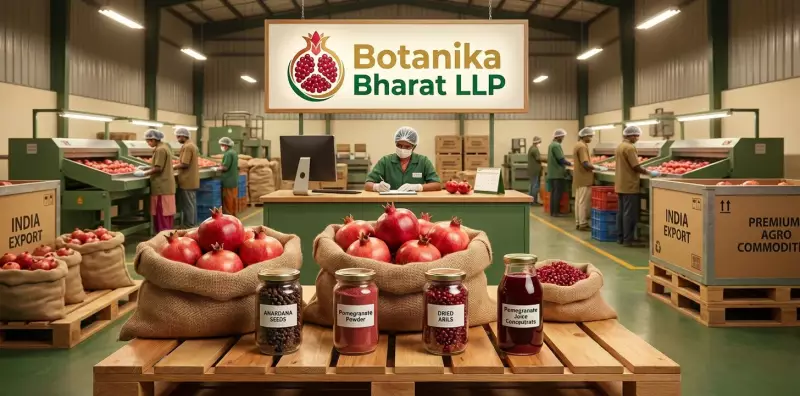
Pomegranate Exporter, Wholesaler & Supplier in India
Botanika Bharat LLP is a certified Indian exporter of premium Pomegranate (Punica granatum), shipping globally from Rudrapur, Uttarakhand under HS Code 0810. We serve importers, wholesalers, manufacturers and FMCG buyers seeking stable quality supply. Each export lot can ship with commercial invoice, packing list, bill of lading or airway bill, certificate of origin, phytosanitary and fumigation certificates plus NABL-accredited COA. We support FOB Nhava Sheva or ICD Rudrapur as well as CIF and DDP under Incoterms 2020.
Quotes: WhatsApp +91 96666 68428 · [email protected] · request a FOB/CIF price.
Pomegranate Export From India to USA and Other Markets
Botanika Bharat LLP ships pomegranate export from India to the USA under FSMA and FSVP rules. We also serve the EU under MRL rules and the GCC and UK markets. Each lot carries a NABL COA and a phytosanitary certificate from DPPQS. Transit time is 22 to 28 days to the USA and 7 to 12 days to the GCC.
If you plan to import pomegranate from India then start with a trial of 250 kg. A full FCL of 18 to 20 MT follows once you approve the sample test. We send a pre-shipment inspection report with every order. Payment can be TT advance or LC at sight.
Pomegranate Bulk Supply and Wholesale Market in India
The biggest pomegranate market in India is Maharashtra and it supplies most of our Bhagwa lots. The top 10 pomegranate producing states in India also include Karnataka, Gujarat and Andhra Pradesh. This spread keeps pomegranate bulk supply steady through the season. We buy from farms and pack at our Rudrapur facility.
Pomegranate suppliers in India often quote only one grade. We quote Bhagwa export grade with a clear spec sheet. As a pomegranate supplier India buyers can call directly you get the packing list and COA before dispatch. Our pomegranate wholesale price depends on grade and Incoterm so ask for a CIF quote.
Pomegranate Packing for Export and Container Loading
For pomegranate packing for export we use 4 kg cartons in a ventilated CFB. Cartons are palletised and strapped for ocean freight. Fumigation is done as per ISPM-15. We load at Nhava Sheva or ICD Rudrapur under FOB. CIF and DDP terms are also available on request.
Each carton is marked with lot number and pack date. A packing list goes with the invoice. This helps the buyer match the sample test to the shipped lot. If you want pomegranate arils or anardana we pack those in food-grade liners under the same export discipline.
HS Codes and Buyer Questions on Pomegranate Export India
The pomegranate hsn code for fresh fruit is 0810. The same code family covers arils. For anardana powder hsn code check with us and we will confirm the correct invoice line. Every export invoice must match the HS code and the phytosanitary certificate.
Buyers often ask can i get contact details before they send a PO. Our email is [email protected] and phone is +91 9666668428. If you are a new exporter asking export sathi or delima import dari mana then read our buyer guide first. For questions like aur koi or i want to seel our team replies within one working day.
Pomegranate Powder Plant Cost and Value-Added Products
Some buyers ask about pomegranate powder manufacturing plant cost. We do not build plants but we can quote pomegranate powder and anardana from our partner units. The powder is made from dried arils and packed in food-grade liners. A COA comes with each lot.
Ayurvedic and food companies use anar ka powder as a raw material. If your plan is a new plant then our team can share the product spec and MOQ. Costs depend on capacity and location. We keep the focus on supply of export-grade fruit and processed pomegranate products.
Common Buyer Questions
Do you export pomegranate from India to the USA?
Yes. We ship to the USA under FSMA and FSVP rules. Transit is 22 to 28 days. Each lot has a NABL COA and a phytosanitary certificate. A trial order of 250 kg is possible before a full container.
What is the pomegranate HS code for export invoices?
The HS code for fresh pomegranate is 0810. The invoice line must match the phytosanitary certificate and the packing list. For anardana powder ask us and we will confirm the right line before you file.
How is pomegranate packed for export?
We pack in 4 kg ventilated cartons and palletise them for ocean freight. Cartons carry lot number and pack date. Fumigation is done as per ISPM-15. Loading is at Nhava Sheva or ICD Rudrapur.
What is the minimum order for bulk pomegranate?
The trial MOQ is 250 kg. A regular order starts at 1 MT. A full container load is 18 to 20 MT. Dispatch is 2 to 5 business days after payment.
Which states in India grow the pomegranate you export?
Maharashtra is the biggest pomegranate market in India and the main source of Bhagwa. We also buy from Karnataka, Gujarat and Andhra Pradesh. This spread keeps bulk supply steady across the season.
Can I get contact details for a pomegranate quote?
Yes. Email [email protected] or call +91 9666668428. Send your destination port and target volume. We reply with a CIF quote in 24 hours.
Start Your Own Pomegranate Brand with Botanika Bharat
If you want to launch your own pomegranate brand we are happy to guide you step by step. You can start with low MOQ based on one FCL so you do not need a very big budget. We handle farm sourcing in Solapur and Nashik and move your fruit in a safe cold chain. Our team can pack as per your brand and give full export and compliance documents with lab testing and NABL COA for each lot.
You can choose fresh Bhagwa Ganesh or Sindori fruits or pomegranate arils for your product range. We help with basic sales ideas and simple team training so you can sell with confidence in your market. There is no extra charge for this start up support. You pay only for the pomegranates and agreed packing and freight.
Talk to us on WhatsApp +91 96666 68428 · [email protected]
Pomegranate Lot Testing: How Each Consignment Is Measured
Each pomegranate lot is measured and documented before it leaves the packhouse, so the buyer's specification sheet and the shipped cartons match. Sampling steps, instruments, and the paperwork issued per lot are listed below.
- Size is read with a digital caliper at the widest diameter on a 10-fruit draw per 6 kg carton: Bhagwa Super 2A at 100 mm and above, Bhagwa and Ganesh/Sindori Grade A at 80–100 mm.
- Brix is taken on a calibrated refractometer from a composite juice sample of 3 fruits per carton, with dispatch targets of 16–18° for Bhagwa and 14–16° for Ganesh and Sindori.
- A NABL-accredited COA is issued per lot, covering Brix, titratable acidity, moisture, and pesticide residue screen, alongside a phytosanitary certificate for the consignment.
- HS code 0810.90 appears on the commercial invoice, packing list, and shipping bill so the buyer's customs broker can classify the entry without a query.
- Order sizes run at 250 kg for a trial, 1 MT for regular supply, and 18–20 MT for a full FCL, routed via ICD Rudrapur or Nhava Sheva.
- Statutory registrations quoted on every offer: FSSAI 10251007107816296, IEC ABFFB5548L, APEDA RCMC, and Spices Board CRES.
Send your target size band and Brix floor, and the sampling plan will be written to match it.
Pomegranate Trial Order Checklist for New Buyers
A 250 kg pomegranate trial order lets buyers check grade, documents and routing before a 1 MT regular order or 18–20 MT FCL.
- Order tiers are 250 kg trial, 1 MT regular and 18–20 MT FCL; confirm the tier and lot ID on the PO.
- The dispatch file should contain an NABL-accredited COA per lot, phytosanitary certificate, commercial invoice with HS code and packing list.
- Supplier identifiers to check are FSSAI 10251007107816296, IEC ABFFB5548L, APEDA RCMC and Spices Board CRES.
- Routing is via ICD Rudrapur or Nhava Sheva; the invoice, packing list and phytosanitary certificate should name the same route.
- Use the COA to match the accepted Brix range, size grade and colour before approving the step from 250 kg to 1 MT.
- Keep the same COA, phytosanitary certificate and HS-coded invoice set for the 18–20 MT FCL as used for the trial.
Do not scale to 1 MT or 18–20 MT FCL until the trial documents match the PO line by line.
Pomegranate Introduction
We are Botanika Bharat LLP, a pomegranate-focused exporter and supplier based in Rudrapur, Uttarakhand. We handle Indian pomegranate (Punica granatum) in several forms: anardana (dried pomegranate seeds), pomegranate powder, dried arils, and pomegranate juice concentrate for spice blends, Middle Eastern and Indian cuisine, FMCG, HORECA, and retail. We source from India and the wider region and supply to agreed specifications. Along with pomegranate, we also work with spices, herbs, and other agro commodities for bulk supply, FMCG raw material needs, private label requirements, and export sourcing. We support buyers in identifying suitable quality, help farmers obtain better rates through direct procurement and contract arrangements, and assist other exporters with sourcing and documentation. For some products we manage our own manufacturing; for others we procure from reputed suppliers, trade through trusted sources, or use contract farming.
Our office is at Office No-18, 1st Floor, Ram Vihar, Infront of Shiv Enclave, Near Shimla Bahadur, Fulsunga, Ward No-01, Rudrapur, Dist- U S Nagar (Uttarakhand) Pin-263153. Contact us on Mobile +91 9666668428, Landline +91 5944 369845, or by email at [email protected] and [email protected]. Business hours are Monday to Saturday, 10:00 AM to 7:00 PM. Whether you need anardana, pomegranate powder, juice concentrate, or bulk pomegranate for FMCG, HORECA, or spice blends, we are your partner from India.
Pomegranate Seasonality & Lead-Time Planning
Pomegranate procurement from India runs on two clocks: the fresh-fruit picking windows and the processed-lot cycle, which is not harvest-bound. This section sets out how each clock affects trial size, HS classification and dispatch routing.
- Fresh pomegranate is picked in two main windows — the Mrig bahar crop (November–January) and the Ambe bahar crop (June–August). A fresh-fruit order placed between them waits for the next cycle.
- Dried anardana, pomegranate powder and juice concentrate are not tied to a picking window, so a 250 kg trial can be drawn from a stored lot and released against a NABL-accredited COA per lot.
- HS classification is fixed per form and printed on the commercial invoice: 0810 for anardana and dried arils, 2009 for juice and concentrate, 1211 for powder.
- FCL dispatch routes by rail from ICD Rudrapur (Uttar Pradesh) to Nhava Sheva; stuffing is booked so the phytosanitary certificate and COA are in hand before vessel cut-off.
- Order tiers: 250 kg trial, 1 MT regular, 18–20 MT FCL. Registrations on file are FSSAI 10251007107816296, IEC ABFFB5548L, APEDA RCMC and Spices Board CRES.
Confirm the form and the intended dispatch month at enquiry stage, and the quote will reflect the correct crop window or stored-lot availability.
Pomegranate Landed Cost: Incoterms and Charge Lines
Every pomegranate quote we issue names one Incoterm and stops at a defined handover point. The lines below show what sits on our side of that point and what your broker files at yours, so the landed-cost sheet is built once and not corrected after the vessel sails.
- Quote structure: FOB Nhava Sheva or ICD Rudrapur as the base line, with ocean freight and marine insurance added only when you ask for CIF. Destination THC, customs duty, broker fee and inland haulage stay on your side and are listed as named lines, not absorbed into the unit price.
- Volume tier drives the freight maths: 250 kg trial (air or LCL), 1 MT regular, 18-20 MT FCL whole fruit. Per-kg freight only drops at the 18-20 MT tier, so ask for both FOB and CIF figures before you award.
- Three documents set the duty figure and must agree line for line: commercial invoice with the HS code, packing list with net and gross weight per carton, and the bill of lading. A weight or description mismatch between the three holds the entry at your broker's desk.
- Supplier identity fields your bank and broker verify: legal name, GST, IEC ABFFB5548L and FSSAI 10251007107816296 printed on the proforma and commercial invoice, with a NABL-accredited COA per lot and a phytosanitary certificate attached as file copies.
- Payment route changes the charge build: advance by TT, L/C at sight or usance as agreed, DP or DA for approved buyers. Bank charges follow the party named in the instrument, so confirm which side pays before the credit is opened.
- Proforma validity is stated in days and covers the FOB/CIF figure and the FX reference. Once it lapses, the freight and currency components are reissued rather than carried forward.
Send your destination port and preferred Incoterm, and we will return the charge lines split between our side of the handover and yours.
Pomegranate Pre-Shipment Inspection: Buyer Rights & Records
Most sourcing disputes turn on who inspected what, and which record proves it. This section covers the verification steps a pomegranate buyer can write into a purchase order before the container is sealed.
- Test scope is agreed at quote stage: the buyer lists the parameters, and the NABL-accredited COA is issued against that list for each lot rather than a generic panel.
- Sample draw and third-party survey can be scheduled at ICD Rudrapur (inland stuffing) or Nhava Sheva (port); surveyor name, scope and cost are fixed in the PO before dispatch.
- The phytosanitary certificate is issued per consignment by the Directorate of Plant Protection, Quarantine & Storage; a scanned copy reaches the buyer before the original document courier.
- The commercial invoice carries the HS code for the shipped format alongside IEC ABFFB5548L and FSSAI 10251007107816296, so classification, importer identity and licensing are settled on one page.
- A sealed retention sample from the dispatched lot is held against its COA, so a buyer's own lab result is compared like-for-like with the shipped material, not with a reference spec.
- The 250 kg trial tier exists so a buyer can lab-check the actual format before moving to a 1 MT regular order or an 18-20 MT FCL.
Send your parameter list and surveyor preference with the enquiry, and both are written into the quote.
Pomegranate Health Benefits & Global Export Potential
Pomegranate (Punica granatum) is widely used in FMCG, HORECA, spice blends, Middle Eastern and Indian cuisine, and retail. We export Indian pomegranate (anardana, pomegranate powder, juice concentrate) with clear specifications. We do not offer medical or health claims; we supply with COA and specifications where applicable. As a bulk pomegranate supplier and FMCG raw material supplier, we serve food manufacturers, FMCG brands, HORECA, and buyers in North America, Europe, UK, Middle East, and Asia. We supply pomegranate in packaging as per buyer requirement. Global export potential for Indian pomegranate continues to grow; we contribute with reliable supply, correct documentation, and quality that meets destination standards. We quote in USD or EUR with clear payment terms and provide phytosanitary and Certificate of Origin where required so that your regulatory and procurement teams can approve us.
We supply organic pomegranate where available with certification and traceability. Contact us for supply and for certification that suits your market.
Processing & Export Excellence
Our processing and export systems support consistent pomegranate supply. We source from India and the region and operate or partner with facilities that produce and grade anardana, pomegranate powder, and pomegranate juice concentrate. Every lot we export is tested where applicable before release, and we provide a Certificate of Analysis from NABL or FSSAI approved labs with each shipment where applicable. We do not release any lot without quality clearance where applicable, and we do not reuse or back-date COA from a different batch. We maintain traceability from source to shipment so that specifications are met as agreed. As a bulk pomegranate supplier, we pack according to buyer requirements and ensure that every shipment is labelled in line with destination and certification requirements.
We are an Indian pomegranate exporter and agro commodity exporter India committed to processing and export excellence. Our commercial invoice, packing list, COA where applicable, and documentation are designed so that importers have what they need for payment and for their own records.
Buyer’s Guide for Pomegranate Importers
Our buyer’s guide for importers explains what you can expect from our supply of pomegranate. On supply: FSSAI licence (10251007107816296), COA with every shipment where applicable, phytosanitary certificate where required, APEDA alignment, Certificate of Origin where required. We state our legal name, address, GST, and IEC on every proforma and commercial invoice. We offer advance (TT), letter of credit (L/C), documentary collection (DP, DA), and other terms as agreed. We provide proforma invoice with product (anardana, pomegranate powder, juice concentrate), grade, price, payment terms, validity, and bank details so you can get approval and remit or open L/C. We prefer to see L/C draft before you open so we can advise on amendments and avoid discrepancy. First-time importers can contact us to plan their first order—quantity, certification requirement (e.g. EU, US FDA, Halal, Kosher), packaging, and payment terms. Specify your product and payment terms when enquiring.
Repeat buyers can rely on consistent supply and on clear documentation. We are your premier source to buy pomegranate from India with full documentation and professional process.
Our Pomegranate & Specifications
When you work with us, we share clear references to our pomegranate products and specifications. We export anardana (dried pomegranate seeds), pomegranate powder, dried arils, and pomegranate juice concentrate (Punica granatum), each with defined specifications as applicable. Our COA confirms that the shipped lot meets the agreed parameters where applicable. We state the correct HS code (0810 for dried fruit/anardana, 2009 for juice, 1211 for powder as applicable) on the invoice so your customs and finance teams can classify correctly. For large or recurring orders, you can request a technical data sheet (TDS) and quality agreements. We provide specifications and sample COA where applicable to support vendor qualification. As an Indian pomegranate exporter, we align our supply and specifications with your quality and procurement requirements.
We stand behind our COA and specifications where applicable and confirm quality and commercial terms in our proforma invoice and order confirmation.
Your Premier Source to Buy Pomegranate from India
We position ourselves as your premier source to buy pomegranate from India. Contact us via website, email, or phone with product (anardana, pomegranate powder, juice concentrate), quantity, destination, and any certification requirement for a tailored offer. We combine reliable supply—with COA and specifications where applicable, phytosanitary where required, and full documentation—with clear payment terms (advance, L/C, DP, DA) and professional proforma and commercial invoice so that importers, distributors, and FMCG brands can approve us and pay on time. We serve North America, Europe, Middle East, and Asia. Every consignment we export is backed by correct documentation. Our office is at Office No-18, 1st Floor, Ram Vihar, Infront of Shiv Enclave, Near Shimla Bahadur, Fulsunga, Ward No-01, Rudrapur, Dist- U S Nagar (Uttarakhand) Pin-263153. Contact: Mobile +91 9666668428, Landline +91 5944 369845. Email: [email protected], [email protected]. Monday to Saturday, 10:00 AM to 7:00 PM.
We are an Indian pomegranate exporter supplying bulk pomegranate products and related agro commodities for FMCG and raw material needs. Our focus is on reliable supply supported by the quality parameters and documentation that importers and buyers require.
Pomegranate HS Code & Invoice Line Discipline
Duty and clearance follow the tariff line printed at the top of the invoice, not the packing list. This section covers how the HS code, lot ID and document set are keyed to one another for pomegranate consignments.
- Fresh pomegranate is declared under ITC-HS 0810 90 20, and the same eight-digit code appears on the commercial invoice, the shipping bill and the phytosanitary certificate so the destination broker can map it to the local tariff line without a correction request.
- Each invoice line carries five fields in a fixed order: lot ID, grade, pack type, net weight in kg and HS code — so a 250 kg trial and an 18–20 MT FCL are described by the same schema.
- The lot ID printed on the invoice is the same lot ID printed on the NABL-accredited COA covering that consignment; the two documents are filed together.
- FSSAI licence 10251007107816296 and IEC ABFFB5548L are printed on the invoice header, with APEDA RCMC details supplied alongside the originals.
- Before sealing at ICD Rudrapur or movement to Nhava Sheva, the phytosanitary certificate, COA and invoice are cross-checked for matching HS code, lot ID and net weight.
Send your destination tariff line and we will confirm the matching HS code and document set before the quote is issued.
Packaging & Global Logistics for Bulk Pomegranate
We use food-grade, compliant packaging to preserve pomegranate quality and can pack as per buyer requirements, including custom packing and private labelling on request. Standard markings include product name (pomegranate, anardana, pomegranate powder, juice concentrate), batch or lot number, net weight, and certification or destination-specific information. For CIF shipments we procure comprehensive marine insurance. Documentation—commercial invoice, packing list, COA where applicable, phytosanitary certificate where required, Certificate of Origin where required, and Bill of Lading—is prepared so that every consignment is import-ready and payment under L/C or DP can be released. We coordinate with our freight forwarder for shipment, and transit times vary by destination. As an Indian pomegranate exporter, we align packaging and logistics with your supply and payment processes.
Contact us for supply and for packaging and documentation details. We ensure our commercial invoice and packing list match the L/C or payment terms so that the bank and buyer can process payment without delay.
History of Pomegranate
Pomegranate (Punica granatum) has a long history in Middle Eastern and Indian cuisine. Anardana (dried pomegranate seeds) and pomegranate powder have been used in chutney, curries, spice blends, and traditional preparations for centuries. India and the region today grow and export anardana, pomegranate powder, and pomegranate juice concentrate for global markets. As a trusted Indian pomegranate exporter and bulk pomegranate supplier, Botanika Bharat LLP carries forward this heritage with reliable supply, COA where applicable, and full documentation so that global buyers can access Indian pomegranate with quality and compliance they can trust.
Today pomegranate is supplied in various forms and packaging—anardana, pomegranate powder, dried arils, juice concentrate. We supply Indian pomegranate with specifications and Certificate of Analysis where applicable for every shipment. Contact us for supply and for the grade and certification that suit your market.
Past Concerns with Pomegranate
In the past, buyers sometimes faced concerns around consistency of quality, documentation, or regulatory compliance for dried fruit and spice products. At Botanika Bharat LLP we address these through strict quality control: every lot we export is tested where applicable before release. We provide Certificate of Analysis from NABL or FSSAI approved labs with each shipment where applicable. We do not release any lot without quality clearance where applicable; we do not reuse or back-date COA from a different batch. We maintain traceability from source to shipment. We use the correct HS codes (0810, 2009, 1211 as per product form) on all export documentation and prepare commercial invoice, packing list, COA where applicable, phytosanitary where required, and Bill of Lading so that every consignment is import-ready. We resolve any quality concern with batch details and evidence in good faith. As an Indian pomegranate exporter and bulk pomegranate supplier, we are committed to quality and documentation that meet destination and buyer expectations.
Contact us for specifications and sample COA where applicable. We stand behind our COA and specifications for every shipment we export.
Importance of Pomegranate in Life
Pomegranate is widely used in daily life and in global trade. It is an important ingredient in Middle Eastern and Indian cuisine—through anardana, pomegranate powder, and juice concentrate—and in FMCG, HORECA, retail, and distribution. It is used by food manufacturers, FMCG brands, HORECA, and consumers, and as a raw material (anardana, pomegranate powder, juice concentrate) it supports consistent quality in the supply chain. For farmers and processors in India it is a significant segment, and for importers and distributors it is a staple in the spices and dried fruit category. At Botanika Bharat LLP we recognise this role and supply Indian pomegranate with COA and specifications where applicable so that buyers receive the quality they require. We help buyers identify suitable material, support farmers with better rates where we source from farm level, and assist other exporters with sourcing and documentation. As an Indian pomegranate exporter, we focus on supply and documentation that support your business and your market.
Contact us for supply and for the grade and certification that suit your application. We are your partner from India.
Pomegranate Spec Lock: How Order Changes Are Controlled
Between PO confirmation and container sealing, the only things that move are the calendar and the paperwork — the specification does not. This section sets out how specification changes, deviations and document packs are handled so a procurement team can plan around a fixed reference point.
- The signed specification sheet is versioned and attached to the purchase order; any revision is issued as a new numbered version and countersigned by both parties before packing starts, so the packing line never works from a verbal change.
- Each lot leaves with a NABL-accredited COA, a phytosanitary certificate, and a commercial invoice carrying the HS code; COA values are checked against the locked spec sheet before the container is sealed.
- A parameter that falls outside the locked sheet places that lot on hold, with written notice quoting the lot ID and the measured value, and the buyer chooses re-grading or replacement — no silent substitution into the same container.
- Quantity changes follow fixed slabs: MOQ 250 kg for a trial, 1 MT for regular orders, and 18–20 MT per FCL; movement between slabs requires a written amendment rather than a revised loading plan.
- Vendor-onboarding packs are issued as one set: FSSAI 10251007107816296, IEC ABFFB5548L, APEDA RCMC, Spices Board CRES, and a sample COA, so registration and purchase-order setup run on the same documents.
- Dispatch routing is fixed at booking — ICD Rudrapur for the inland leg and Nhava Sheva as port of loading — and a change of routing is confirmed in writing before the container is gated in.
Send your specification sheet and we will return it as a numbered, version-controlled document with the matching COA format.
Pomegranate Composition Dossier for Health Claim Review
We issue no health, nutrient or disease claims for pomegranate. This section sets out the composition data and paperwork your regulatory team receives, so the label wording stays your decision.
- Each lot carries a NABL-accredited COA; on request, punicalagin and total polyphenols are reported as measured HPLC values (% w/w), not as claim statements.
- The COA panel covers moisture, total ash, acid-insoluble ash, pH and microbial counts, with each result printed against the pass limit on the agreed specification sheet.
- Fresh arils, anardana (dried seed), powder and juice concentrate each hold a separate specification and a separate COA panel, so the form is fixed in writing before a price is quoted.
- Claim wording sits with you: EU labels fall under Regulation (EC) 1924/2006 and US supplements under DSHEA structure/function rules; we supply the data behind a statement, never approved claim text.
- Document pack per consignment: phytosanitary certificate, lot COA, packing list, and an invoice carrying the HS code; registrations are FSSAI 10251007107816296, IEC ABFFB5548L, APEDA RCMC and Spices Board CRES.
- Order tiers are 250 kg trial, 1 MT regular and 18-20 MT FCL, dispatched through ICD Rudrapur or Nhava Sheva.
Send the exact label wording you intend to use and the destination market, and we will confirm which parameters the COA must carry.
Curing & Conditioning Pomegranate: Hold Time, Temp, Moisture
Curing here is a timed hold with numbers attached, not a storage step. Fresh fruit, anardana and juice concentrate each pass through a different hold window, and the figures below are the ones written on the batch record.
- Fresh pomegranate rests 18–24 hours at 10–12 °C and 90–95 % relative humidity before grading; the hold drops field heat and surface moisture so calyx and rind defects are visible at the grading table.
- Anardana is cured to ≤8 % moisture and ≤0.60 water activity; both results are printed on the NABL-accredited COA issued for that lot, under the same batch ID shown on the packing list.
- Pomegranate juice concentrate is held at 0–4 °C in aseptic or food-grade lined drums, with °Brix and titratable acidity recorded on the lot COA before the drum is released for dispatch.
- A lot reading above 8 % moisture returns for a second drying pass; it is not blended into a passing lot to average the figure down.
- Each curing record carries start and end timestamps, room-temperature readings and operator initials, and the batch ID on it matches the COA, phytosanitary certificate, invoice carrying FSSAI 10251007107816296 and IEC ABFFB5548L, and the APEDA RCMC file.
- Trial lots from 250 kg are cut from a cured, already-tested batch, so the moisture and water activity figures a buyer sees belong to the material actually shipped.
The curing record travels with the COA in the enquiry pack, so the hold numbers can be checked before a container is booked.
Pomegranate FCL Load Plan: Pallets, Payload & Seal Records
Every pomegranate container is booked against a written load plan that fixes pack format, pallet or floor-loaded configuration, gross weight and seal number before the box is gated at ICD Rudrapur. The plan is issued as a document, not agreed over a call.
- Order tiers set the load type: a 250 kg trial lot, a 1 MT regular order, or an 18–20 MT net FCL.
- Gross weight is weighed once and reused without change on the VGM declaration, the packing list and the Bill of Lading, so one 40 ft container cannot carry three different weights.
- Palletised versus floor-loaded is recorded on the plan before booking — pallets protect carton corners and allow forklift discharge at destination, floor-loading frees the pallet footprint for extra payload.
- Routing is fixed at quotation: cargo is gated at ICD Rudrapur and railed to Nhava Sheva, clearing customs inland and loading under a single Bill of Lading.
- A container is released for loading only when the NABL-accredited COA for that specific lot and the phytosanitary certificate are on file; both certificate numbers are entered on the load plan.
- The plan carries seal number, tare, gross weight and pallet count, and the seal number is copied onto the packing list and B/L so the importer can match box to paperwork at the gate.
Send the destination port and pack format, and the load plan comes back with weight, seal and document fields already filled in.
Pomegranate Payment Terms & Invoice Discipline
Payment and paperwork are handled as one process: the pomegranate proforma sets the instrument, the HS code and the document list before any deposit moves, and the commercial invoice repeats them unchanged at dispatch.
- Four instruments are quoted at enquiry — advance TT, irrevocable LC at sight, DP and DA — with the chosen one written into the proforma invoice so treasury approves against a single document.
- Every proforma and commercial invoice carries the HS code, Incoterm, net/gross weight, packing count and payment terms; finance does not need a second quote to release funds.
- The LC document set is checked line by line before cargo leaves ICD Rudrapur or Nhava Sheva: invoice, packing list, NABL-accredited COA per lot, phytosanitary certificate and bill of lading.
- A NABL-accredited COA is issued per lot before the balance payment or LC negotiation stage, so the result is on file when the bank examines documents.
- Supplier identifiers printed on the invoice — FSSAI 10251007107816296, IEC ABFFB5548L, APEDA RCMC and Spices Board CRES — let the buyer's compliance team verify the exporter without separate correspondence.
- The 250 kg trial runs on advance payment; 1 MT regular orders and 18-20 MT FCL volumes move to LC, DP or DA once terms are agreed in writing.
Send the required instrument, Incoterm and destination port, and the proforma with HS code and document list is returned for approval.
Pomegranate Enquiry Intake: Six Fields, One Working Quote
A pomegranate quote can only be priced once six data points are on the table. Send them in one message and the reply comes back as a line-itemed offer tied to a named specification, not a brochure.
- Include in the first message: product form (anardana, powder, juice concentrate or whole fruit), quantity in kg or MT, destination port, required grade or spec, any certificate you must receive, and your payment instrument (advance, L/C, DP or DA).
- The offer returns with the HS code printed on the proforma and repeated on the commercial invoice, so your customs broker and your finance team work from the same reference.
- Every lot is released against a NABL-accredited COA and a phytosanitary certificate; company identifiers quoted on documents are FSSAI 10251007107816296, IEC ABFFB5548L, APEDA RCMC and Spices Board CRES.
- Dispatch routing is confirmed at quotation stage: ICD Rudrapur for inland consolidation, Nhava Sheva for sea freight, stated per line rather than assumed.
- Entry quantity is 250 kg for a trial lot, stepping to 1 MT regular and 18–20 MT FCL; the same six fields drive pricing at each step.
- Enquiries are answered Monday to Saturday, 10:00–19:00 IST, at +91 9666668428 or [email protected]; written replies come from Office No-18, 1st Floor, Ram Vihar, Fulsunga, Ward No-01, Rudrapur, Dist-U S Nagar (Uttarakhand) Pin-263153.
Send the six fields together and the first reply is a priced, document-referenced offer you can put in front of your committee.
Sourcing Pomegranate: Approved Supplier Register & Lot IDs
Supplier approval and lot numbering are kept as one record at Botanika Bharat LLP, so any bag we ship can be traced back to its collection centre, intake date and the supplier registration held on file.
- The approved-supplier register is keyed to FSSAI registration numbers; our own entries carry FSSAI 10251007107816296 and IEC ABFFB5548L, matching the details printed on the commercial invoice.
- Every lot is given a three-part ID — collection-centre code, intake date in YYMMDD, sequence number — and the same ID appears on the NABL-accredited COA, the packing list and the phytosanitary certificate application.
- Dried anardana, powder and juice concentrate are approved as separate categories: a supplier cleared for whole dried fruit is not automatically cleared for powder, which is assessed on its own moisture and mesh specification.
- Registrations held against the sourcing file are APEDA RCMC, Spices Board CRES for the spice-grade anardana line, and IEC ABFFB5548L.
- A lot is blocked from dispatch until both the NABL-accredited COA and the phytosanitary certificate are issued against its ID — no ID, no shipment release.
- The HS code is written on each invoice line so the buyer's customs broker can map the lot ID to the customs entry without a separate lookup.
Ask for the register extract and a sample lot-ID sheet with your enquiry; both travel with the quotation.
Pomegranate Certificate Validity & Re-Test Triggers
Each certificate we issue names one lot ID and stays with that lot only. This section covers how long a document holds, and the specific events that force a fresh test or a re-issue rather than a correction.
- A NABL-accredited COA is raised per lot and printed with the lot ID, FSSAI licence 10251007107816296 and IEC ABFFB5548L, so the lab paper, the invoice line and the phytosanitary certificate all reconcile to the same number.
- A COA is not carried forward to a later lot or a later dispatch. If a lot is re-sampled after curing or re-grading, it receives a new COA under a new lot ID; the earlier certificate is withdrawn, not amended.
- The phytosanitary certificate is issued per consignment after quarantine inspection. If dispatch moves beyond the validity window the destination authority sets, the consignment is re-inspected and a fresh certificate is issued — the original is never re-dated.
- Three re-test triggers are written into the order: a buyer MRL specification tighter than the destination default, a change of farm or packhouse mid-order, and an outturn counter-sample that disagrees with the shipped COA.
- Document cross-check happens at three fixed points — sampling, pre-shipment inspection and document release — and certificate number, issue date and lab name are entered on the invoice annexure before the set goes to the bank under L/C.
- Trial lots from 250 kg and regular lots from 1 MT carry the same certificate set; moving to an 18-20 MT FCL adds consignment-level phytosanitary and container detail, not extra laboratory scope.
State the lot ID and destination market in your enquiry and we will confirm which certificates apply to that order before quoting.
Pomegranate Export Document Custody & Release
What separates a clean document set is not the list of papers but who issues each one, how many originals exist, and the exact point at which they change hands. This section sets out the issuer, the original count and the release point for a pomegranate consignment.
- One issuer per document: commercial invoice and packing list on Botanika Bharat LLP letterhead, COA from a NABL-accredited laboratory, phytosanitary certificate from the Plant Quarantine authority, Bill of Lading from the shipping line, Certificate of Origin from the designated issuing body.
- The Bill of Lading is issued as a set of three originals plus non-negotiable copies; the courier schedule states how many originals are surrendered to the negotiating bank and how many are couriered to the buyer, so no original is unaccounted for.
- A scanned set — invoice, packing list, COA, phytosanitary certificate — is released ahead of the courier packet so the buyer's customs broker can pre-file before the aircraft or vessel departs from Nhava Sheva or ICD Rudrapur.
- Where the destination requires chamber or consular attestation of the invoice and COA, attestation is completed before the courier pack is sealed, and it is flagged at quotation stage rather than after the container is stuffed.
- FSSAI 10251007107816296, IEC ABFFB5548L, APEDA RCMC and Spices Board CRES numbers are printed identically on every original and every copy, so buyer compliance teams can match the file against the invoice without amendment.
- Before presentation, invoice, packing list and Bill of Lading are checked line by line against the L/C for goods description, quantity, Incoterm and port pair; any mismatch is raised as a written amendment request, not patched with a shipper's side note.
- Originals are released against the agreed payment term — documents against payment or L/C negotiation — and the 250 kg trial and 1 MT regular order follow the same original-set discipline.
Send the L/C draft and destination port, and we will return the document list with issuer, original count and attestation route before the price is fixed.
Pomegranate Supply for Merchant Exporters: Who Files What
If you hold the buyer relationship, we can sit behind it as the registered upstream supplier. The split is fixed: you carry the PO, the LC and the buyer file; we carry the lot, the sealed counter-sample and the lab report.
- Four identifiers are released once for your supplier-setup form and reused on every order: FSSAI 10251007107816296, IEC ABFFB5548L, APEDA RCMC and Spices Board CRES.
- Each lot ships with a matched paper set: NABL-accredited COA, phytosanitary certificate, and a commercial invoice with the HS code printed on every line.
- Order sizes are 250 kg for a trial, 1 MT for a regular run and 18-20 MT for an FCL, so a first order can be sized to fit a single buyer's trial clause.
- Lot-level records stay on our side and are released on request: the sealed counter-sample and the original laboratory report matched to the lot ID raised at farm-gate intake.
- Freight follows your nominated routing, ICD Rudrapur for inland consolidation or Nhava Sheva for sea, with the container seal number and shipping bill copy passed to your CHA.
Send the buyer's spec sheet and destination port, and the reply comes back with the lot ID, the document list and the routing that fits.
How We Help Importers
We help importers with clear product specifications (anardana, pomegranate powder, juice concentrate), COA with every shipment where applicable, phytosanitary certificates where required, and import-ready documentation. We help buyers find the best quality material by supplying pomegranate with COA and specifications where applicable and by offering clear payment terms: we provide proforma invoice with product, grade, price, payment terms, validity, and bank details so you can get approval and remit advance or open L/C. We guide first-time importers on certification requirements, packaging, and lead time. We support importers with correct company details on every proforma and commercial invoice. When importers work with us we respond with quote and proforma; we confirm order on receipt of advance or L/C; we ship and present documents so that you receive goods and we receive payment on time. We do not change terms without agreement and we resolve any document or quality query promptly. Contact us for import support. We serve importers in North America, Europe, UK, Middle East, Asia, and beyond with full documentation and with a process that is clear and professional.
What Buyers Must Confirm Before a Pomegranate Lot Moves
Most delays on a pomegranate order originate on the buyer side of the file, not in the packhouse. These are the inputs we need from you, each with the deadline it carries.
- Consignee block: legal name, registered address, import licence or importer number, and confirmed HS code 0810 90 20 — all needed before the proforma is issued, since they print on the invoice and the phytosanitary certificate application.
- Destination plant-health wording: the exact additional-declaration text your NPPO or import permit requires must be on file 5 working days before dispatch, otherwise the phytosanitary certificate cannot be drafted to match.
- Label artwork: print-ready file approved within 3 working days of PO, carrying lot ID, pack date, net weight, origin India and importer address; unapproved artwork holds the packing line.
- Inspection booking: third-party agency name, scope and date confirmed at least 7 days before stuffing at ICD Rudrapur or Nhava Sheva, so the NABL-accredited COA and the inspection report reference the same lot ID as the counter-sample we retain.
- Payment instrument: LC draft wording or DP/DA terms agreed before the order tier is fixed — 250 kg trial, 1 MT regular or 18-20 MT FCL — with bank charges and validity dates written onto the proforma rather than agreed verbally.
- Change control: any spec revision after sample-seal acceptance is logged against the lot ID and priced before it is applied, so the version on the invoice is the version that was sealed.
Send these six items with your enquiry and the quote returns as a working document rather than a price list. Company identifiers for your vendor file: FSSAI 10251007107816296, IEC ABFFB5548L, APEDA RCMC and Spices Board CRES.
Pomegranate Farm-Gate Intake: Grade, Sample Seal, Payment Basis
This section covers how a pomegranate farm lot enters Botanika Bharat LLP’s export chain: grade and quantity are fixed in the farmer agreement, a sealed sample and lot ID are created at intake, and payment timing is tied to the same records.
- The farmer agreement is signed before harvest and fixes grade, quantity, receipt condition and payment timing; changes require a revised agreement, not a verbal instruction.
- Every farm lot receives a unique lot ID; the intake sheet records net weight, grade, sealed sample reference and the NABL-accredited COA for that lot.
- The lot file links the farmer intake sheet to the export invoice line carrying the HS code, plus the phytosanitary certificate and company IDs FSSAI 10251007107816296 / IEC ABFFB5548L / APEDA RCMC / Spices Board CRES.
- Payment release is checked against three records: signed farmer agreement, signed intake sheet and COA reference; a missing record holds the payment file.
- Sample seals are retained against the lot ID so a grade question is checked on the sealed sample, not on a mixed or re-bagged lot.
Farmers quoting a new pomegranate lot should provide grade, quantity, harvest window and receipt location for intake scheduling.
Pomegranate Order Desk: Who Answers, and When
Pomegranate enquiries are handled by one named coordinator per account, and document releases are tied to fixed points in the lot cycle rather than to reminders. That keeps vendor setup and pre-shipment clearance inside your approval calendar instead of running alongside it.
- Enquiries stating grade, pack format, destination port and target tonnage get a written quote within two working days; any field left blank is queried in the same reply rather than assumed on your behalf.
- Every lot carries a reference you can quote back - lot ID, pack mark, and HS code 08109010 on the commercial invoice line - so accounts payable can match invoice to purchase order without an email trail.
- Documents are sequenced before stuffing, not after: the NABL-accredited COA for that lot and the phytosanitary certificate are issued while the container is still at ICD Rudrapur or Nhava Sheva, leaving room to correct a discrepancy before the seal is applied.
- Supplier-master data is supplied as one fixed block - FSSAI 10251007107816296, IEC ABFFB5548L, APEDA RCMC and Spices Board CRES - so vendor creation is a copy-paste step for your compliance team.
- Escalation runs on a clock: a query on quality, documents or dispatch that is not closed within two working days moves to a partner-level signatory, who replies in writing with the lot evidence attached.
Send grade, pack, port and tonnage, and the coordinator named on the quote stays with the order through document release.
Explanation of Export & Import Documentation
Certificate of Analysis (COA) confirms quality parameters from a lab where applicable. Phytosanitary certificate is issued by the plant protection authority and required by many countries where applicable. Certificate of Origin confirms the country of origin where required by the buyer’s country. Commercial invoice lists products, quantities, unit price, and total value; it is used for payment (L/C, DP), customs, and your records. Packing list details the contents of each package. Bill of Lading is the transport document. Our company details (legal name, address, GST, IEC, FSSAI) are stated on every official document we issue. When you work with us we explain each document and how we support your payment and customs process. We ensure that these documents are prepared correctly and that they match your L/C or payment terms so that your bank can release payment and your customs can clear the consignment.
Contact us for any specific document or certification requirement. We are your partner for correct documentation and for supply that supports your payment and customs process.
India’s Global Export Leadership & SEO Focus
Botanika Bharat LLP supports India’s role in the global pomegranate trade as a trusted Indian pomegranate exporter and bulk supplier for the FMCG, spice, and food industries. We provide reliable supply of Indian pomegranate in different forms (anardana, pomegranate powder, and juice concentrate), with Certificates of Analysis (COA) where applicable and complete export documentation. Buyers can also reference HS code 0810 2009 1211, APEDA registration, and phytosanitary and other regulatory requirements relevant to FMCG, HORECA, spice blends, and Middle Eastern and Indian cuisine when working with us.
Our office is at Office No-18, 1st Floor, Ram Vihar, Infront of Shiv Enclave, Near Shimla Bahadur, Fulsunga, Ward No-01, Rudrapur, Dist- U S Nagar (Uttarakhand) Pin-263153, India. Contact: Mobile +91 9666668428, Landline +91 5944 369845. Email: [email protected], [email protected]. Monday to Saturday, 10:00 AM to 7:00 PM. We invite you to partner with Botanika Bharat LLP as your trusted Indian pomegranate exporter for consistent supply into your processing, packing, or distribution operations.
What Lab Test Needed for Pomegranate
For pomegranate we arrange and provide the lab tests that buyers and importers require for quality and regulatory compliance. Typical tests for anardana and pomegranate powder may include moisture, microbiology (total plate count, yeast and mould, E. coli, Salmonella), heavy metals, pesticide residue where applicable, and ash as per destination. For pomegranate juice concentrate, common tests include Brix, pH, microbiology, heavy metals, and pesticide residue where applicable. We use NABL or FSSAI approved labs and provide a Certificate of Analysis (COA) with every shipment where applicable. For EU and USA destinations we can arrange testing according to destination limits, and we do not release any lot without quality clearance where applicable or reuse or back‑date COA from a different batch. Contact us for a sample COA and a test list suited to your market; this supports vendor qualification and smooth customs clearance.
Our FSSAI Central licence number is 10251007107816296. We maintain traceability from source to shipment so that every consignment can be linked to its batch and test results where applicable.
Which Is Best Market for Export
Pomegranate (anardana, pomegranate powder, juice concentrate) from India finds strong demand in several export markets. North America (USA, Canada) is a major market for FMCG, spice blends, Middle Eastern and Indian cuisine, and HORECA; US FDA and food regulations apply. Europe (EU, UK) is another key market for pomegranate; EU regulations and duty structures apply for dried fruit (HS 0810) and juice (2009). Middle East and Gulf (UAE, Saudi Arabia, etc.) have strong demand for anardana and pomegranate; Halal certification is often requested. Asia (Singapore, Malaysia, Japan, etc.) and Australia also import Indian pomegranate for FMCG and HORECA. Best market for you depends on your product, certification requirement, and payment terms. We export to all countries where permitted and can guide you on documentation and compliance for your target market. We are an Indian pomegranate exporter and bulk pomegranate supplier with experience across these regions. Contact us with your destination and we will align supply and documentation accordingly.
We quote FOB, CIF, CFR, DDP as agreed and provide commercial invoice, packing list, COA where applicable, phytosanitary where required, and Certificate of Origin where required so that your consignment is import-ready.
Where India Stands in Terms of Pomegranate in the World
India is a growing producer and exporter of pomegranate (anardana, pomegranate powder, juice concentrate). India and the surrounding region grow Punica granatum and supply anardana, pomegranate powder, and juice concentrate to both domestic and export markets. India’s share in global spices and dried fruit trade continues to increase, and Indian pomegranate is recognised for its quality and value. Botanika Bharat LLP contributes to this position by supplying Indian pomegranate with COA where applicable and full documentation so global buyers can reliably source Indian origin. We help buyers identify suitable quality grades, support farmers with better rates where we source at farm level, and assist other exporters with sourcing and documentation. Contact us for supply, grades, and certification options that fit your market; we act as your partner from India.
Our office is at Office No-18, 1st Floor, Ram Vihar, Infront of Shiv Enclave, Near Shimla Bahadur, Fulsunga, Ward No-01, Rudrapur, Dist- U S Nagar (Uttarakhand) Pin-263153, India. Mobile: +91 9666668428, Landline: +91 5944 369845. Email: [email protected], [email protected]. Monday to Saturday, 10:00 AM to 7:00 PM.
Botanika Bharat LLP stands as a principal Pomegranate exporter from India, supplying international clientele with exceptional fresh and processed Pomegranate offerings. Our extensive product range includes wholesale Pomegranate, dried pomegranate seeds, and pomegranate powder, all backed by thorough quality control measures. We cater to diverse B2B requirements, guaranteeing efficient logistical solutions and strict adherence to global export regulations.
Quick Answers – Pomegranate Export
Who is the best Pomegranate exporter in India?
Botanika Bharat LLP is widely regarded as a top Pomegranate exporter in India, leveraging over a decade of expertise and a robust supply network from Rudrapur, Uttarakhand. We specialize in exporting Pomegranate, ensuring superior quality and adherence to international benchmarks for all bulk orders.
What is the minimum order quantity for bulk Pomegranate?
For bulk Pomegranate from Botanika Bharat LLP, the standard minimum order quantity starts at 5 metric tons for fresh produce or 500 kg for dried varieties such as anardana. We are fully equipped to manage significant volumes for clients aiming to buy Pomegranate in bulk, offering competitive Pomegranate wholesale price structures for our global customers.
Which certifications does a trusted Pomegranate supplier from India hold?
A trusted Pomegranate supplier like Botanika Bharat LLP holds essential certifications including FSSAI, APEDA, IEC, NABL for COA, and complies with EU, US FDA, Halal, and Kosher standards. We consistently provide phytosanitary Certificate of Origin and comprehensive traceability vendor qualification for all Pomegranate import export inquiries.
What are the primary uses for wholesale Pomegranate from India?
Wholesale Pomegranate from India finds widespread applications across the FMCG, HORECA, and retail sectors globally. It is processed into products like pomegranate juice concentrate, pomegranate powder, dried pomegranate seeds, and pomegranate arils dried, serving various food applications and Middle Eastern Indian cuisine spice blends.
How does Botanika Bharat ensure quality for Pomegranate import export?
Botanika Bharat LLP guarantees superior quality for Pomegranate import export through rigorous NABL-accredited laboratory testing, strict adherence to specifications regarding moisture content and purity, and meticulous quality inspections at every stage. A Certificate of Analysis (COA) is issued with each shipment, confirming product integrity.
Key Export Facts – Pomegranate
- Botanika Bharat LLP manages the export of Pomegranate from its operational hub in Rudrapur, Uttarakhand, India.
- The company possesses over ten years of proficiency in agro-commodity exports, having been established in 2016.
- We ship by sea and air from Nhava Sheva and ICD Rudrapur.
- Prominent Pomegranate cultivars for export include Bhagwa, Ganesh, and Ruby, primarily sourced from Maharashtra and Karnataka.
- Botanika Bharat LLP is certified with FSSAI (Lic. No. 10251007107816296) and IEC (Lic. No. ABFFB5548L), ensuring regulatory compliance.
- Relevant Harmonized System (HS) codes for Pomegranate and its derivatives include 0810, 2009, and 1211.
- The company provides all necessary export documentation, such as phytosanitary certificates, commercial invoices, and packing lists.
- Botanika Bharat LLP upholds compliance with international benchmarks like EU, US FDA, Halal, and Kosher standards.
- Pomegranate products are available for the FMCG, HORECA, and retail industries.
- Export consignments are dispatched on a regular schedule from our Rudrapur facility.
Pomegranate Order Tiers, Documents & Dispatch Routing
This section covers the commercial mechanics rather than the fruit itself: the three order sizes quoted, the document packet issued against each consignment, and the inland-to-port route.
- Order tiers: 250 kg trial lot, 1 MT regular order, 18–20 MT full container load (FCL).
- Each lot is released against a NABL-accredited COA; the phytosanitary certificate is issued per consignment, not per season.
- HS code 0810.90.90 is printed on the commercial invoice, packing list and bill of lading.
- Registration numbers stated on every offer: FSSAI 10251007107816296, IEC ABFFB5548L, APEDA RCMC.
- Cargo is routed via ICD Rudrapur for container stuffing, then Nhava Sheva for ocean loading.
Send the target grade and order tier, and the COA parameters, document list and routing come back in one reply.
Pomegranate Bid Comparison: Six Fields Before Award
A pomegranate quotation is comparable only when six fields are written in the same format. Use this matrix to compare suppliers before a purchase order is raised.
- Grade and variety: require the quote to name Bhagwa, Ganesh or Ruby, the calibre range and the pack count; otherwise the price cannot be matched to a specification.
- Order tier: separate 250 kg trial, 1 MT regular and 18–20 MT FCL pricing so a trial rate is not compared with a container rate.
- Pack format: state box type, fill weight and pallet pattern; pack changes alter both material cost and container loading.
- Routing: confirm whether the movement is via ICD Rudrapur or Nhava Sheva and name the discharge port; routing must be identical on both bids.
- Document set: require NABL-accredited COA per lot, phytosanitary certificate and HS code on the commercial invoice; these are the minimum shipment documents to compare.
- Registration check: verify FSSAI 10251007107816296, IEC ABFFB5548L, APEDA RCMC and Spices Board CRES on the supplier’s paperwork before awarding the order.
Award only after all six fields are fixed in writing; a lower price with missing fields is not a lower offer.
Comprehensive Buyer Procurement & Export Market Overview – Pomegranate
Botanika Bharat LLP exports pomegranates with end-to-end supply solutions for international buyers, supporting both regular import programs and high-volume bulk requirements for global trade.
Commercial buyers working with us benefit from clear pricing and contract structures for Indian pomegranates, supported by our experience in handling bulk orders for wholesale customers.
Our agricultural processing infrastructure supports consistent pomegranate handling and packing, enabling us to fulfill specialized orders for distributors, import–export partners, and wholesale buyers serving different industrial uses.
Quality assurance is central to every pomegranate shipment, with compliance to required supplier standards, Indian export regulations, and all mandatory clearances for products such as anardana.
As an established Indian pomegranate supplier, Botanika Bharat LLP offers end-to-end supply solutions for whole fruit, pomegranate powder, dried pomegranate seeds, and Punica granatum products for international trade.
In addition to pomegranates, we supply Indian spices with transparent commercial structures, using our experience as a bulk spice supplier and organic spice exporter to support wholesale and industrial buyers.
Our agricultural processing setup also handles a range of herbs and spices, enabling us to serve agro-commodity exports from India, FMCG raw material needs, and private-label spice manufacturing across sectors.
From our base in Rudrapur, Uttarakhand, Botanika Bharat LLP maintains strict quality controls, supporting buyers who source pomegranates from India and manage export documentation and clearances for anardana and related products.
Botanika Bharat LLP supplies pomegranate juice concentrate and dried pomegranate arils for international buyers, supporting applications in Middle Eastern and Indian cuisine spice blends and meeting documentation needs such as NABL COA, FSSAI, APEDA, and IEC.
We support shipments with full export documentation, including phytosanitary certificates and certificates of origin, aligned with EU, US FDA, Halal, and Kosher requirements, along with traceability, vendor qualification, and payment terms such as letter of credit (L/C), DP, and DA.
Our agricultural processing infrastructure supports reliable shipments under FOB CIF CFR DDP terms and handles all required export documentation, including commercial invoices and packing lists, to meet confirmed industrial orders under a no return, no refund policy once the order is placed.
Quality assurance is maintained for every shipment, with dispatch typically within 2 to 5 days from order confirmation and pricing from 8.50 INR per kg, supporting pomegranate supply for FMCG, HORECA, and retail channels in line with required standards and clearances.
As an established Indian pomegranate exporter, Botanika Bharat LLP offers end-to-end supply solutions to international buyers under HS code 0810 2009 1211, including high-volume organic pomegranate shipments for global trade.
Commercial buyers of pomegranate benefit from transparent pricing and contract structures, supported by our experience in international trade and our role as an accredited bulk supplier.
Our agricultural processing infrastructure supports consistent wholesale pomegranate supplier services, enabling specialized bulk orders for export from India and meeting wholesale price requirements across diverse industrial sectors.
Quality assurance is applied to every wholesale pomegranate shipment, with manufacturing, distribution, import, and export activities carried out in line with applicable standards and mandatory clearances.
Our integrated supply chain supports buyers working with a trusted pomegranate exporter and supplier, ensuring complete regulatory compliance from origin through to port.
Pomegranate Counter-Sample & Outturn Claim Protocol
Outturn disputes are settled on evidence drawn before the container leaves ICD Rudrapur, not on photographs taken at destination. The protocol below defines what is sealed, who holds it, and the window in which a claim can be filed.
- Two sealed counter-samples are drawn per lot before stuffing — 500 g each — labelled with the lot ID and signed by the exporter's QC and, where the buyer appoints one, the buyer's representative.
- One unit stays in Rudrapur storage, the other travels with the document set: the NABL-accredited COA for that lot ID, phytosanitary certificate, packing list and commercial invoice showing the HS code.
- A discrepancy notice must be filed in writing within 7 working days of container discharge, supported by carton-marking photographs and a third-party surveyor report; the retained counter-sample is then re-tested against the COA parameters.
- Assessment is made only against the signed specification sheet and the COA values for that lot ID — never against a sample of a different grade, origin or crop week.
- Resolution covers the affected quantity within the lot at the awarded unit rate; replacement lots are dispatched on the same MOQ tiers — 250 kg trial, 1 MT regular, 18–20 MT FCL via Nhava Sheva.
- Because the counter-sample, COA, carton marking and invoice all carry one lot ID, a claim resolves to a single Rudrapur stuffing line and a single test report.
Buyers receive the counter-sample reference number with the pre-shipment document set, before the container moves to Nhava Sheva.
Pomegranate Exporter From India for Bulk Buyers
Botanika Bharat LLP supports importers, wholesalers, spice brands, food manufacturers,
ingredient buyers, traders, procurement teams, and private-label sellers who want to
source Pomegranate from India with
clear specifications, quotation support, COA availability, packaging options, and export
documentation. This page is maintained for buyers searching for reliable Indian supply,
bulk purchase, wholesale pricing, import-export support, and verified sourcing from
Rudrapur, Uttarakhand.
Common buyer searches for this product include
Pomegranate exporter,
Pomegranate supplier,
bulk Pomegranate supplier,
wholesale Pomegranate, and
Pomegranate exporter from India.
We supply to buyers across the globe with full export documentation and NABL-certified COA per lot.
Buyer Documents
COA, invoice, packing list, Certificate of Origin, phytosanitary where required, and buyer-specific documentation review.
Supply Use Cases
Bulk import, wholesale distribution, FMCG manufacturing, food service, spice blending, private label, and export trading.
How to Enquire
Share product name, grade/specification, quantity, destination country, packaging, certification needs, and target shipment date.
Important links:
request export quote,
view COA reports,
review certifications,
verify company details,
and contact Botanika Bharat LLP.
Related product pages:
Spices & Herbs, Spices, Garlic, Black Pepper, Cardamom.
Export Terms & Logistics
Quick export facts: Minimum order: 250 kg (1 pallet); Lead time: 10–14 days after PO confirmation; Port: ICD Rudrapur (Uttarakhand) → Nhava Sheva (JNPT, Mumbai).
We accept T/T (30% advance against proforma invoice, 70% against BL copy) and confirmed L/C at sight. Sample cost and international courier are buyer-borne.
Frequently Asked Questions – Pomegranate, Buyers, Sellers & General
Pomegranate (Punica granatum) is a fruit-bearing deciduous shrub native to the Iranian Plateau and the Himalayas, including India. It thrives in dry, semi-arid climates and is cultivated for its juicy arils and dried seeds (anardana). India is the world's largest producer, with major growing states like Maharashtra, Karnataka, Gujarat, and Andhra Pradesh. The fruit has been used for millennia in Ayurveda for its anti-inflammatory and antioxidant properties. Botanika Bharat LLP exports premium Indian pomegranate products globally from Rudrapur, Uttarakhand.
India cultivates several high-yielding pomegranate varieties: Bhagwa (soft-seeded, deep red, high juice), Ganesh (medium-sized, sweet), Arakta (dark red, thick rind), Ruby (reddish-pink), and Mridula (soft seeds). Bhagwa dominates export markets due to its superior colour and shelf life. Other varieties include Phule Arakta and Jalore Seedless. These varieties are grown in Maharashtra, Karnataka, and Gujarat. Botanika Bharat LLP sources from certified farms to ensure consistent quality for bulk buyers.
In traditional Indian medicine (Ayurveda), pomegranate is used as a blood purifier, digestive aid, and remedy for diarrhea. Dried pomegranate seeds (anardana) are a popular souring agent in North Indian cuisine. The rind is used to treat intestinal parasites, while the juice is considered a tonic for heart health. Pomegranate extracts are also used in cosmetics for anti-aging. Botanika Bharat LLP supplies anardana and pomegranate powder that retain these traditional benefits for global food and nutraceutical applications.
Maharashtra is India's leading pomegranate producer, contributing over 70% of national output, followed by Karnataka, Gujarat, Andhra Pradesh, and Telangana. Key districts include Solapur, Ahmednagar, Nashik, and Sangli in Maharashtra. The total annual production exceeds 3 million metric tonnes. This concentration ensures year-round availability for exporters. Botanika Bharat LLP sources from these regions to provide consistent supply and competitive pricing for bulk orders.
Punica granatum belongs to the Lythraceae family. Its key active compounds include punicalagins, ellagic acid, anthocyanins (delphinidin, cyanidin), and tannins. These confer high antioxidant, anti-inflammatory, and antimicrobial properties. The fruit's edible arils contain vitamins C and K, potassium, and dietary fiber. Dried seeds (anardana) are rich in polyphenols. Botanika Bharat LLP ensures that export-grade pomegranate products retain these bioactive compounds through careful processing and storage.
Indian pomegranate for export is graded based on fruit size, colour, and blemish-free skin. Common grades include A (premium, 250-350g per fruit), B (200-250g), and C (150-200g). AGMARK grading under the Agricultural Produce (Grading and Marking) Act specifies parameters for moisture, foreign matter, and uniformity. Exporters also follow buyer-specific grades. Botanika Bharat LLP supplies grades as per customer requirements, ensuring compliance with international standards for fresh fruit and processed forms like anardana.
AGMARK is India's agricultural grading and marking system. For pomegranate, AGMARK specifies grades like Special, Good, and Fair based on fruit diameter, colour, and freedom from defects. Special grade requires uniform size, deep red colour, and no blemishes. Moisture content for dried anardana should not exceed 10%. Botanika Bharat LLP adheres to AGMARK standards, ensuring that all pomegranate exports meet quality parameters for international markets, enhancing buyer confidence.
The Spices Board of India regulates the export of spices and spice products, including anardana (dried pomegranate seeds). Specifications cover moisture (max 10%), total ash (max 5%), acid-insoluble ash (max 1.5%), and volatile oil content. For pomegranate powder, mesh size and purity are defined. Botanika Bharat LLP complies with these standards, ensuring that every shipment meets the stringent quality requirements of global buyers and regulatory authorities.
Export-grade pomegranate is evaluated for fruit size (50-120mm), colour (deep red to pink), firmness, and absence of cracks, sunburn, or pest damage. Moisture content for dried forms is kept below 10%. Purity for anardana should be 99% minimum. Pesticide residues must be within EU MRLs. Botanika Bharat LLP conducts rigorous quality checks at every stage, from farm to packaging, to ensure that buyers receive only the best Indian pomegranate products.
Botanika Bharat LLP implements a multi-step quality assurance protocol: raw material sourcing from certified farms, laboratory testing for moisture, purity, and contaminants, and final inspection before packing. We provide a Certificate of Analysis (COA) with each shipment. Our facilities follow GMP and HACCP principles. By maintaining strict documentation and traceability, we guarantee that every bulk order meets the agreed specifications, building long-term trust with international buyers.
The moisture content for export-grade anardana (dried pomegranate seeds) is typically 8-10% maximum. This low moisture ensures longer shelf life, prevents mold growth, and maintains flavour intensity. Higher moisture can lead to caking and spoilage during shipping. Botanika Bharat LLP uses advanced drying techniques to achieve optimal moisture levels, and each batch is tested before dispatch. We provide COA confirming moisture content, ensuring compliance with buyer specifications.
Our pomegranate powder is 100% pure, with no additives, fillers, or preservatives. Purity is maintained at 99.5% minimum, with foreign matter below 0.5%. The powder is made from carefully selected, sun-dried arils and seeds, ground to a fine mesh (80-100 mesh). We guarantee that the product is free from artificial colours and flavours. Each batch is tested for purity, and a COA is provided. This makes our powder ideal for nutraceutical and food applications.
Pomegranate seeds contain negligible volatile oil, typically less than 0.1%. The primary volatile compounds are hexanal, limonene, and other aromatic hydrocarbons. While not a major source of essential oil, these contribute to the fruit's aroma. For export, volatile oil content is not a primary specification. Botanika Bharat LLP focuses on key quality parameters like moisture, purity, and microbial safety, which are critical for pomegranate products.
Pomegranate is rich in punicalagins (unique to pomegranate), ellagic acid, anthocyanins, and tannins. These compounds exhibit potent antioxidant, anti-inflammatory, and cardioprotective effects. Punicalagins are found in the peel and juice, while ellagic acid is concentrated in the seeds. Our export-grade anardana and powder retain these actives due to minimal processing. Botanika Bharat LLP provides products with verified polyphenol content, catering to the health-conscious global market.
The colour value of pomegranate powder, measured in ASTA units, typically ranges from 20 to 40, depending on the raw material and drying method. A higher ASTA value indicates a more intense red colour, desirable for food applications. Botanika Bharat LLP ensures that our pomegranate powder meets customer-specified colour values by selecting deep-red varieties and using gentle drying. We provide ASTA colour readings in our COA for transparency.
Yes, Botanika Bharat LLP holds FSSAI license number 10251007107816296. This certification ensures that our facilities and products comply with the Food Safety and Standards Authority of India's regulations. FSSAI certification covers hygiene, processing, packaging, and labeling. It is mandatory for food exports from India. Our FSSAI license is a testament to our commitment to food safety and quality, giving buyers confidence in our pomegranate products.
Our Import Export Code (IEC) is ABFFB5548L, issued by the Directorate General of Foreign Trade (DGFT), India. The IEC is mandatory for any Indian company engaged in export or import. It enables us to legally ship goods internationally and is required for customs clearance. Buyers can verify our IEC to confirm our authenticity. This code is a key credential that underscores our legitimacy as a reliable exporter of Indian pomegranate and agro-commodities.
Yes, Botanika Bharat LLP is registered with the Agricultural and Processed Food Products Export Development Authority (APEDA). APEDA registration (RCMC) is essential for exporting agricultural products from India, including pomegranate and its derivatives. It ensures that our products meet international quality standards and allows us to avail export incentives. Our APEDA RCMC number is available upon request. This registration reinforces our capability to handle large-scale exports efficiently.
Botanika Bharat LLP is ISO 22000 certified, demonstrating our commitment to food safety management systems. ISO 22000 integrates HACCP principles and ensures that our processes from sourcing to dispatch meet global food safety standards. This certification is recognized worldwide and is often a prerequisite for supplying to major importers. It assures buyers that our pomegranate products are processed under stringent hygiene and quality controls.
HACCP (Hazard Analysis and Critical Control Points) is a systematic preventive approach to food safety. Botanika Bharat LLP complies with HACCP principles, identifying potential hazards and implementing controls at critical points. Our HACCP plan covers receiving, processing, packaging, and storage. This compliance ensures that our pomegranate products are safe for consumption. We undergo regular audits to maintain our HACCP certification, providing buyers with assurance of consistent quality.
Our MOQ is 250 kg for trial orders, 1 metric ton (MT) for regular orders, and 18-20 MT for full container load (FCL) shipments. The trial order allows buyers to test our quality before committing to larger volumes. For FCL, we offer competitive freight rates. We accommodate mixed containers with other spices and agro-commodities. Contact us to discuss your specific requirements and we will tailor a solution.
We offer flexible packaging: PP bags (25/50 kg), HDPE drums (25/50 kg), jute bags (50 kg), and customised retail packs. For anardana and powder, we use food-grade liners inside drums to prevent moisture ingress. Packaging can be customised with buyer's branding. All packaging materials are food-safe and comply with international standards. Botanika Bharat LLP ensures that packaging protects product integrity during transit and storage.
Yes, we offer private labeling and custom packaging for pomegranate products. Buyers can provide their brand artwork, and we will print it on bags, drums, or retail packs. We also offer various pack sizes from 100g to 50kg. Our design team can assist with label compliance for destination countries. Private labeling is ideal for importers, distributors, and retailers looking to build their brand with high-quality Indian pomegranate.
Shelf life varies by product: fresh pomegranate (if offered) 2-3 weeks under refrigeration; dried anardana 12 months; pomegranate powder 18 months when stored in cool, dry conditions away from direct sunlight. Proper storage is key to maintaining quality. We use moisture-barrier packaging to extend shelf life. Each shipment includes a best-before date. Botanika Bharat LLP guarantees that products meet shelf-life specifications at the time of dispatch.
FOB prices for Indian pomegranate vary based on product form, quality, and season. Fresh pomegranate: USD 800-1200 per MT. Dried anardana: USD 1500-2500 per MT. Pomegranate powder: USD 2000-3500 per MT. Prices are indicative and subject to market fluctuations. For a precise quote, please contact us with your specifications and destination port. Botanika Bharat LLP offers competitive pricing for bulk orders.
We accept TT (Telegraphic Transfer), LC at sight, DP (Documents against Payment), and DA (Documents against Acceptance) for established buyers. For first-time buyers, we recommend LC at sight or TT advance. Payment terms are negotiable based on order size and relationship. All payments must be in USD or INR as per RBI guidelines. Botanika Bharat LLP ensures secure and transparent transactions.
Our price quotations are typically valid for 7-15 days due to volatile market conditions and currency fluctuations. For long-term contracts, we can offer fixed prices for specific periods subject to mutual agreement. Once an order is confirmed with advance payment or LC, the price is locked. Botanika Bharat LLP advises buyers to confirm orders promptly to secure the quoted price. We provide updated quotes upon request.
For bulk orders (1 MT and above), we accept 30% advance TT and balance against scanned documents, or 100% irrevocable LC at sight. For FCL shipments, LC at sight is preferred. We also accept DA/DP for repeat buyers with good credit history. All payment terms are outlined in the proforma invoice. Botanika Bharat LLP ensures that payment processes are smooth and compliant with international trade regulations.
No, our FOB price includes all costs up to loading on board the vessel at the port of loading. It excludes freight, insurance, and destination charges. We provide a clear breakdown of costs in the proforma invoice. Any additional services like certification, custom packaging, or testing are quoted separately. Botanika Bharat LLP believes in transparent pricing with no hidden fees, ensuring buyers can calculate landed costs accurately.
Each shipment includes: Commercial Invoice, Packing List, Bill of Lading (BL), Certificate of Origin (COO), Phytosanitary Certificate, Fumigation Certificate, and Certificate of Analysis (COA). Additional documents like GMP, HACCP, or Halal can be provided upon request. These documents are essential for customs clearance and quality assurance. Botanika Bharat LLP ensures all documents are accurate and dispatched promptly to avoid delays.
A Certificate of Analysis (COA) is a document that reports test results for a specific batch. For pomegranate products, it includes parameters like moisture, purity, ash content, volatile oil, pesticide residues, heavy metals, and microbial counts. Our COA is issued by accredited laboratories. It assures buyers that the product meets agreed specifications. Botanika Bharat LLP provides a COA with every shipment for full transparency.
A phytosanitary certificate is an official document issued by the plant protection organization of the exporting country. It certifies that the shipment is free from pests and diseases and meets the importing country's plant health regulations. For pomegranate exports, it is mandatory for most countries. Botanika Bharat LLP obtains this certificate from the relevant Indian authority for each shipment, ensuring smooth customs clearance at destination.
Fumigation may be required by certain countries to prevent the introduction of pests. For pomegranate and its dried products, methyl bromide or phosphine fumigation is commonly used. Botanika Bharat LLP arranges fumigation at accredited facilities and provides a Fumigation Certificate. The treatment schedule follows ISPM 15 or country-specific protocols. We ensure that fumigation does not compromise product quality and is carried out under strict safety standards.
A Certificate of Origin (COO) is a document that certifies the country where the goods were produced. It is often required for customs clearance and to claim preferential tariffs under trade agreements. Botanika Bharat LLP obtains COO from the Indian Chamber of Commerce or DGFT. We provide the original COO along with other shipping documents. This helps buyers comply with import regulations and potentially reduce duty costs.
Shipping lead time to GCC countries (UAE, Saudi Arabia, Qatar, Kuwait, Oman, Bahrain) is typically 7-12 days from Indian ports like Mundra or Nhava Sheva. This includes transit time only; order processing and documentation take an additional 3-5 days. We ship via direct vessels or feeder services. Botanika Bharat LLP provides real-time tracking and updates. For urgent orders, express options are available at extra cost.
Shipping to the UK takes approximately 18-22 days from Indian ports to Felixstowe or Southampton. This includes ocean transit and port handling. We offer FOB and CIF terms. Documentation is prepared in advance to avoid delays. Botanika Bharat LLP works with reliable freight forwarders to ensure timely delivery. For LCL shipments, lead time may be longer due to consolidation. We provide estimated arrival dates at the time of booking.
Shipping to EU countries (Germany, Netherlands, France, Italy, Spain) takes 20-25 days from Indian ports to major hubs like Rotterdam, Hamburg, or Antwerp. Transit time varies by destination and carrier. We handle all export documentation, including EU-specific requirements like phytosanitary certificates. Botanika Bharat LLP ensures compliance with EU regulations. For urgent shipments, we can arrange air freight at higher cost.
Shipping to the USA takes 22-28 days from Indian ports to East Coast (New York) or West Coast (Los Angeles) ports. This includes ocean transit and customs clearance at destination. We provide all necessary documents for FDA prior notice. Botanika Bharat LLP ships via reliable carriers with competitive rates. For time-sensitive orders, air freight is available. We keep buyers informed with tracking details throughout the journey.
Shipping to Japan takes approximately 15-20 days from Indian ports to Tokyo or Yokohama. Japan has strict import regulations for agricultural products, including pomegranate. We ensure all phytosanitary and quality requirements are met. Botanika Bharat LLP works with experienced freight forwarders to navigate Japanese customs. Lead time may vary during peak seasons. We provide proactive updates to ensure smooth delivery.
Shipping to Australia takes 20-25 days from Indian ports to Sydney or Melbourne. Australia has strict biosecurity laws; we ensure our pomegranate products meet all requirements, including fumigation and phytosanitary certificates. Botanika Bharat LLP collaborates with Australian importers to clear customs efficiently. Transit time may be longer if transshipment is involved. We provide all necessary documentation to facilitate a hassle-free import process.
Yes, we can arrange expedited shipping via air freight or express sea services for urgent orders. Air freight reduces transit time to 3-7 days depending on destination, but costs are higher. We also prioritize documentation and customs clearance for urgent shipments. Botanika Bharat LLP is committed to meeting tight deadlines. Contact us with your required delivery date, and we will propose the best logistics solution.
To place your first order, simply email us at [email address] or call [phone number] with your product requirements, quantity, and destination port. We will send a proforma invoice with price, payment terms, and lead time. Upon confirmation and receipt of advance payment or LC, we initiate processing and documentation. Our team guides you through every step. Botanika Bharat LLP ensures a seamless first-time export experience.
To provide an accurate quotation, we need: product form (fresh, dried, powder), quantity, desired quality specifications (moisture, purity, etc.), packaging preference, destination port, and preferred shipping terms (FOB/CIF). If you have a target price, please share. We will respond within 24 hours with a detailed offer. Botanika Bharat LLP aims to make the quoting process quick and transparent for global buyers.
Once you accept our proforma invoice, we send a sales contract for signing. You then arrange payment as per agreed terms. Upon receipt of advance or LC, we confirm the order and schedule production. We keep you updated on progress. Before shipment, we share draft documents for approval. After your approval, we ship and send original documents. This structured process ensures clarity and avoids misunderstandings.
We provide comprehensive after-sales support: shipment tracking, documentation assistance, and resolution of any quality concerns. If you face issues at destination, our team coordinates with you and the freight forwarder to resolve them promptly. We also welcome feedback to improve our services. Botanika Bharat LLP values long-term relationships and strives to exceed buyer expectations in every transaction.
Yes, we provide samples for evaluation. For trial orders (250 kg), we can send a small sample (up to 500g) free of charge, but courier costs are borne by the buyer. For larger samples, we charge a nominal fee that is refundable against a bulk order. Samples are dispatched within 2-3 days. Botanika Bharat LLP encourages buyers to test our quality before committing to volume.
The EU sets specific MRLs for pomegranate in Regulation (EC) 396/2005. For example, chlorpyrifos is 0.01 mg/kg, imidacloprid 0.05 mg/kg, and carbendazim 0.1 mg/kg. Exporters must ensure residues are below these limits; non-compliance leads to RASFF alerts. Botanika Bharat LLP tests every lot via NABL labs to meet EU standards.
RASFF has issued alerts for Indian pomegranates due to pesticide residues (e.g., chlorpyrifos, acephate) and microbial contamination. In 2023, several alerts were triggered for exceedances. To avoid border rejections, we implement strict farm-level controls and pre-shipment testing. Our FSSAI license 10251007107816296 ensures compliance.
We follow a multi-step approach: approved farms with GAP, residue monitoring, and testing at NABL-accredited labs for EU MRL compliance. Each consignment comes with a Certificate of Analysis (COA). We also provide pre-shipment samples for buyer testing. This minimizes RASFF risk and ensures smooth customs clearance in the EU.
Yes, pomegranate is classified as a 'miscellaneous fruit' in EU MRL legislation, and some MRLs differ from those for other fruits. For instance, the MRL for imidacloprid in pomegranate is 0.05 mg/kg, while for apples it is 0.5 mg/kg. Exporters must refer to the EU Pesticides Database for exact limits before shipping.
For EU customs, you need a phytosanitary certificate, Certificate of Origin, commercial invoice, packing list, bill of lading, and a COA showing MRL compliance. Additionally, a RASFF-free history helps. Botanika Bharat provides all documents promptly to ensure smooth clearance. Our IEC ABFFB5548L facilitates export documentation.
Under FSMA, importers must comply with the Foreign Supplier Verification Program (FSVP), ensuring foreign suppliers meet U.S. safety standards. This includes hazard analysis, supplier verification, and corrective actions. Botanika Bharat supports buyers by providing food safety plans, COAs, and audit reports to facilitate FSVP compliance.
Prior Notice must be filed with FDA via the Prior Notice System Interface (PNSI) or ACE. It requires details like manufacturer, shipper, importer, and expected arrival. Filing must be done no more than 15 days before arrival and at least 8 hours for air shipments. We assist buyers by providing necessary information for timely filing.
The HS code for fresh pomegranates is 0810.90.20. The general duty rate is 0% for countries with free trade agreements, but for India, it is 0% under the Generalized System of Preferences (GSP) if applicable, otherwise 0% MFN. Check current tariffs; we provide commercial invoices with correct HS codes for smooth customs.
Yes, our farms and packhouses follow Good Agricultural Practices (GAP) and Good Manufacturing Practices (GMP) aligned with FSMA's Produce Safety Rule. We conduct regular water, soil, and hygiene testing. Our food safety plan addresses biological, chemical, and physical hazards. We provide documentation to support buyer FSVP compliance.
FDA requires labeling for pomegranates including common name, net quantity, name and place of business of manufacturer/packer/distributor, country of origin, and ingredient statement if processed. For fresh pomegranates, country of origin is mandatory. We ensure all labels meet FDA and FSMA requirements.
Yes, we offer free samples of up to 500g for pomegranate arils, anardana, or powder. However, courier costs are borne by the buyer. Samples are dispatched within 3-5 business days after confirmation. Each sample includes a Certificate of Analysis (COA) and product specification sheet for your evaluation.
Sample lead time is typically 3-5 business days for dispatch, with delivery via express courier (DHL/FedEx) taking 3-7 days depending on destination. We provide tracking details. For urgent requests, we can expedite to 2 days. Note that courier charges are at actuals and payable by the buyer.
Yes, every sample shipment includes a comprehensive Certificate of Analysis (COA) covering parameters like moisture, pesticide residues, microbial counts, and heavy metals. This ensures transparency and helps you assess compliance with your market's regulations. Additional tests can be arranged upon request.
Courier costs vary by destination and weight: to EU, approximately $50-80 for 500g; to USA, $60-100. We ship via DHL/FedEx with tracking. Costs are at actuals and must be prepaid. We provide a quote before dispatch. Samples are free, but courier is buyer's account.
Yes, we can provide samples in your desired packaging for private label evaluation. However, custom packaging may incur a nominal fee for setup. Sample lead time extends to 7-10 days. We work closely with you to ensure the product meets your specifications before mass production.
Our minimum order quantity (MOQ) for private label pomegranate arils or powder is 1,000 kg per SKU. For anardana, MOQ is 500 kg. This ensures cost-effective production and packaging. We can discuss flexible MOQs for trial orders, but standard terms apply for regular supply.
Artwork approval typically takes 5-7 business days after you provide design files. We offer dieline templates and support. Once approved, production begins. We ensure labels comply with destination regulations (e.g., FDA, EU FIC). Timelines may vary based on complexity and revisions.
After artwork approval and advance payment, production takes 15-20 days for pomegranate products. Delivery via sea freight adds 20-30 days to EU/USA. Air freight reduces to 5-7 days at higher cost. We provide regular updates and coordinate logistics for timely delivery.
Yes, we offer white-label options where products are packed in neutral packaging without our branding. You can apply your own labels upon receipt. This is ideal for buyers who want to test the market before investing in custom packaging. MOQ for white-label is 500 kg.
Absolutely. We provide full private label services, including printing your logo, brand name, and required information on packaging. We use food-grade materials and comply with labeling regulations. Send us your artwork, and we'll handle the rest. MOQ applies for custom printed packaging.
Yes, we supply organic pomegranate products certified under NPOP (India), NOP (USA), and EU Organic. Our certifications ensure no synthetic pesticides or fertilizers. We provide transaction certificates for each organic shipment. Organic products command a premium of 20-30% over conventional.
Organic pomegranate typically costs 20-30% more than conventional due to lower yields and higher production costs. For example, organic pomegranate arils may be priced at $4-5/kg vs. $3-3.5/kg for conventional. We offer competitive pricing based on volume and contract terms.
We hold NPOP (National Programme for Organic Production, India), NOP (USDA Organic), and EU Organic certifications. These are renewed annually. We can provide copies of certificates and transaction certificates for each shipment. Our organic supply chain is fully traceable from farm to port.
Yes, we provide EU Organic certification for pomegranate shipments. Each consignment comes with a Certificate of Inspection (COI) issued by an EU-approved control body. This ensures compliance with EU Organic Regulation (EU) 2018/848. We handle all documentation for smooth import.
Shelf life is similar if stored properly: fresh pomegranate 2-3 weeks at 5-7°C, arils 10-14 days at 0-2°C, and powder 12-18 months in airtight containers. Organic products may have slightly shorter shelf life due to lack of synthetic preservatives. We recommend proper storage conditions.
Fresh pomegranates should be stored at 5-7°C with 90-95% relative humidity. Avoid direct sunlight and ethylene-producing fruits. Proper ventilation is essential. Under these conditions, shelf life is 2-3 months for whole fruit. We pre-cool and pack in ventilated cartons for export.
Pomegranate arils have a shelf life of 10-14 days when stored at 0-2°C in modified atmosphere packaging (MAP). They should be kept refrigerated and consumed within a few days after opening. We use food-grade MAP to extend freshness during transit.
Pomegranate powder should be stored in airtight containers in a cool, dry place away from direct sunlight. Ideal temperature is below 25°C and humidity below 60%. Under these conditions, shelf life is 12-18 months. We pack in food-grade, moisture-barrier bags or drums.
Anardana has a shelf life of 12-18 months when stored in airtight containers in a cool, dry place. Avoid moisture and direct sunlight. We pack in food-grade pouches or bulk bags. Proper storage retains flavor and color. We recommend using within 12 months for best quality.
Fresh pomegranates require 5-7°C and 90-95% RH. Arils need 0-2°C and 85-90% RH. Powder and anardana need <25°C and <60% RH. We provide storage guidelines with each shipment. Deviations can reduce shelf life and quality.
Maharashtra is the largest producer, accounting for over 70% of India's pomegranate output, followed by Karnataka, Gujarat, Andhra Pradesh, and Tamil Nadu. Key districts include Solapur, Ahmednagar, and Kurnool. Harvest seasons vary: Maharashtra (Jan-Feb, Jun-Jul), Karnataka (Dec-Feb).
Pomegranate harvest in India varies by region: Maharashtra has two main seasons—Mrig Bahar (harvested June-July) and Hasta Bahar (harvested January-February). Karnataka harvests December-February. Andhra Pradesh harvests January-March. We source from multiple regions to ensure year-round availability.
Post-harvest, pomegranates are carefully harvested, washed, graded, and packed. We use pre-cooling, fungicide treatment (if required), and ventilated cartons. Arils are extracted in hygienic facilities and packed under MAP. All steps follow GAP and HACCP to maintain quality and extend shelf life.
Post-harvest treatments like fungicide dips (e.g., carbendazim) and waxing are used to control decay and extend shelf life. However, EU MRLs must be met. We use approved treatments and test residues. For organic, we use natural alternatives. Proper handling reduces post-harvest losses by up to 20%.
We use refrigerated containers (reefers) set at 5-7°C for whole fruit and 0-2°C for arils. Humidity is controlled, and containers are pre-cooled. We monitor temperature logs and use ethylene absorbers. This ensures arrival in optimal condition, minimizing rejections.
Pomegranate is used in juices, beverages, jams, jellies, sauces, dressings, and as a topping in cereals and desserts. Arils are used fresh or frozen. Powder is used as a natural colorant and flavoring. Anardana is used in spice blends and chutneys. Its high antioxidant content adds functional appeal.
Pomegranate extracts are used in pharmaceuticals for their antioxidant, anti-inflammatory, and antimicrobial properties. Punicalagins and ellagic acid are key compounds. It's used in supplements for heart health, diabetes management, and oral care. We supply standardized extracts and dried powder for formulations.
Pomegranate extracts are used in skincare for anti-aging, moisturizing, and UV protection. Its antioxidants combat free radicals. It's found in creams, serums, masks, and lip balms. We supply pomegranate seed oil and extract for cosmetic manufacturing, with COA and MSDS.
Pomegranate is a key ingredient in nutraceuticals due to its high polyphenol content. It's used in capsules, tablets, and powders for antioxidant support, cardiovascular health, and immune function. We provide pomegranate extract standardized to punicalagins or ellagic acid for nutraceutical use.
Pomegranate juice, concentrate, and arils are used in beverages like juices, smoothies, cocktails, and functional drinks. Its vibrant color and tart-sweet flavor are popular. We supply NFC juice, concentrate, and dried arils for beverage manufacturing, ensuring consistent quality and year-round supply.
Yes, pomegranate powder and juice concentrate are used as natural colorants in foods and beverages, providing red to pink hues. They are rich in anthocyanins. This aligns with clean-label trends. We offer color-stable pomegranate powder for various applications.
India is the world's largest producer of pomegranates, but in terms of exports, it ranks among the top 5 globally. According to APEDA, India exported 72,000 MT of pomegranates in FY 2024-25, valued at $60 million. Major markets include UAE, Bangladesh, Netherlands, and Saudi Arabia.
India accounts for approximately 5-7% of global pomegranate exports. In FY 2024-25, India's pomegranate exports reached 72,000 MT, with a value of $60 million. Key competitors include Spain, Peru, and Iran. India's share is growing due to quality improvements and market diversification.
Top destinations for Indian pomegranates are UAE, Bangladesh, Netherlands, Saudi Arabia, Nepal, and the UK. In FY 2024-25, UAE and Bangladesh accounted for over 50% of exports. The EU and USA are emerging markets. We supply to all these regions with tailored packaging and compliance.
APEDA promotes pomegranate exports through infrastructure development, quality standards, and market promotion. It provides financial assistance for cold chain, packaging, and certification. APEDA also organizes buyer-seller meets. We are registered with APEDA and benefit from its initiatives.
Sun drying relies on open solar exposure for 7-10 days, yielding darker, tangier arils with 12-15% moisture and higher microbial load. Machine drying uses hot air at 55-60°C for 8-12 hours, achieving uniform 8-10% moisture, brighter color, and lower microbial counts (TPC <10^4 CFU/g). Botanika Bharat offers both, but machine-dried is preferred for EU and GCC markets due to consistent quality and safety compliance.
Yes, we provide steam sterilization for pomegranate powder and dried arils. This chemical-free process uses saturated steam at 120-130°C for 3-5 minutes, reducing microbial load by 5-log while preserving color and bioactive compounds. It meets EU and US FDA norms, with no ETO residues. Our steam-sterilized pomegranate powder retains ≥90% punicalagins and is ideal for organic-certified supply chains.
Absolutely. All our pomegranate products are ETO-free. We use steam sterilization or irradiation (where permitted) and provide certificates of analysis confirming no ethylene oxide residues (<0.01 mg/kg). Our facilities adhere to FSSAI and EU regulations, and we supply ETO-free pomegranate powder, arils, and extracts to buyers in the EU, GCC, and USA, with full traceability and third-party lab reports.
Freeze-drying preserves the highest punicalagin levels (up to 95% retention), but it's costly. For bulk supply, hot air drying at 50-55°C retains 80-85% punicalagins, while sun drying retains only 60-70%. Botanika Bharat uses controlled hot air drying for pomegranate powder and arils, balancing cost and quality. We provide HPLC analysis showing punicalagin content, typically 8-12% in our standard powder.
Yes, we tailor drying and sterilization to your needs. Options include sun drying, hot air drying (50-70°C), freeze-drying, steam sterilization, and irradiation. We adjust parameters to meet target moisture (5-12%), microbial limits, and bioactive retention. Our team works with you to develop a protocol that complies with your destination regulations, ensuring pomegranate products meet your exact specifications.
Pomegranate arils contain punicalagins (0.2-0.8% in fresh arils, 8-12% in dried powder), ellagic acid (0.1-0.5% fresh, 2-5% dried), anthocyanins (0.1-0.3% fresh), and punicic acid (60-80% of seed oil). Other compounds include flavonoids, tannins, and vitamin C. Botanika Bharat provides HPLC and GC-MS analysis to verify these values, ensuring product potency for nutraceutical and food applications.
Yes, we offer GC-MS analysis for pomegranate seed oil and extracts, identifying fatty acid profiles (punicic acid, linoleic acid, oleic acid) and volatile compounds. For non-volatile compounds like punicalagins and ellagic acid, we use HPLC. Our reports include chromatograms, retention times, and quantification, ensuring full transparency. We partner with NABL-accredited labs for all analyses.
Our standard pomegranate powder contains 8-12% punicalagins (HPLC-verified). We also offer high-punicalagin extracts with 20%, 30%, and 40% concentrations for nutraceutical applications. The punicalagin content depends on the raw material (arils vs. whole fruit) and extraction process. We provide a certificate of analysis with each batch, ensuring you receive consistent potency.
We implement strict raw material sourcing, standardized processing, and rigorous QC. Each batch is tested for punicalagins, ellagic acid, and moisture using HPLC. We maintain a retention sample library and use statistical process control to minimize variation. Our COA includes actual values, and we reject batches outside specifications. This ensures consistent bioactivity for your formulations.
Pomegranate seed oil typically contains 60-80% punicic acid (a conjugated linolenic acid), 5-10% linoleic acid, 5-10% oleic acid, and 5-10% palmitic acid. Our GC-MS analysis confirms these ranges. Punicic acid is valued for its antioxidant and anti-inflammatory properties. We supply cold-pressed pomegranate seed oil with a minimum 65% punicic acid, verified by GC.
We offer pomegranate powder, oleoresin, essential oil (from seeds), extracts (water/alcohol), and encapsulated powder. Prices vary: powder (USD 8-15/kg), extract 20% punicalagins (USD 30-50/kg), oleoresin (USD 60-100/kg), seed oil (USD 20-40/kg), and encapsulated (USD 50-80/kg). Factors include concentration, purity, and certification. Contact us for a detailed quote.
Pomegranate oleoresin is a concentrated extract obtained by solvent extraction, containing both volatile and non-volatile actives. It typically has 20-40% punicalagins, 5-10% ellagic acid, and a characteristic aroma. It's used in flavors, nutraceuticals, and cosmetics. Our oleoresin is standardized, ETO-free, and available in food-grade packaging. Price ranges USD 60-100/kg depending on concentration.
Yes, we supply pomegranate essential oil obtained from seeds via cold pressing or steam distillation (though true essential oil is rare; most are seed oils). Our seed oil contains 60-80% punicic acid, with minor volatiles. It's used in cosmetics and aromatherapy. We provide GC-MS analysis. Price: USD 20-40/kg for cold-pressed oil. Minimum order: 25 kg.
Pomegranate powder (8-12% punicalagins) is priced at USD 8-15/kg FOB India. A 20% punicalagin extract costs USD 30-50/kg, while 40% extract can be USD 80-120/kg. The price difference reflects the concentration process, raw material requirements, and purity. Extracts are standardized and more potent, ideal for supplements. We offer both, with volume discounts.
Yes, we offer encapsulated pomegranate extract (e.g., 20% punicalagins) in vegetarian capsules, typically 500 mg. This form offers convenience, precise dosing, and protection from oxidation. It's popular for nutraceuticals. Price: USD 50-80/kg depending on fill weight and capsule type. We can custom-label for private brands. Minimum order: 100 kg.
We test for lead (Pb), cadmium (Cd), arsenic (As), and mercury (Hg). EU limits for food supplements: Pb ≤3.0 mg/kg, Cd ≤1.0 mg/kg, As ≤0.1 mg/kg (inorganic), Hg ≤0.1 mg/kg. For dried fruits, limits are Pb ≤0.2 mg/kg, Cd ≤0.05 mg/kg. Our products typically show Pb <0.1 mg/kg, Cd <0.02 mg/kg, As <0.05 mg/kg, Hg <0.01 mg/kg.
We use ICP-MS (Inductively Coupled Plasma Mass Spectrometry) for trace heavy metals, as it offers low detection limits (ppb levels). For some elements, AAS (Atomic Absorption Spectroscopy) may be used. All tests are performed at NABL-accredited labs or equivalent. We provide test reports with method details, detection limits, and results, ensuring compliance with EU, US, and GCC regulations.
Yes, we provide NABL-accredited lab reports for heavy metals (Pb, Cd, As, Hg) with each shipment. These reports include sample details, test methods (ICP-MS), results, and limits. We also offer third-party testing from SGS, Intertek, or Eurofins upon request. Our typical results are well below EU limits, ensuring safety for your market. Additional testing may incur extra cost.
For pomegranate powder as a food supplement, EU Regulation (EC) No 1881/2006 sets maximum lead content at 3.0 mg/kg. For dried fruits, it's 0.2 mg/kg. Our pomegranate powder typically contains <0.1 mg/kg lead, well within limits. We test each batch and provide COA. For specific applications, consult your regulatory expert.
We source raw materials from controlled orchards, monitor soil and water, and test every batch for heavy metals using ICP-MS at NABL labs. We maintain documentation for traceability and provide COA with results. Our QC team stays updated on EU regulations (e.g., EC 1881/2006). If a batch exceeds limits, it's rejected. This ensures compliance and safety.
We test for aflatoxin B1, B2, G1, and G2. EU limits for dried fruits: total aflatoxins (B1+B2+G1+G2) ≤4 ppb, with B1 ≤2 ppb. For pomegranate, we ensure total aflatoxins <4 ppb and B1 <2 ppb. We use HPLC or ELISA for screening. Our products typically show non-detect (<0.1 ppb). We provide test reports with each shipment.
ELISA is a rapid, cost-effective screening method with detection limits around 1-2 ppb, but may cross-react. HPLC with fluorescence detection is more precise, with detection limits of 0.1 ppb, and is the reference method. We use ELISA for initial screening and confirm positives with HPLC. For EU compliance, we recommend HPLC. Our NABL labs perform both.
Yes, we include aflatoxin test reports (B1, B2, G1, G2) with each shipment, showing results and limits. These are from NABL-accredited labs using HPLC or ELISA. We also offer third-party testing. Our typical results are non-detect, ensuring safety. For specific buyer requirements, we can arrange testing at additional cost.
We prevent aflatoxin through good agricultural practices, proper drying to <10% moisture, and hygienic storage in temperature-controlled warehouses. We monitor humidity and use antifungal treatments where necessary. Regular testing ensures early detection. Our pomegranate products are tested for aflatoxins, and we reject any batch exceeding EU limits. This proactive approach ensures safety.
The EU limit for aflatoxin B1 in dried fruits, including pomegranate, is 2 ppb (µg/kg). Total aflatoxins (B1+B2+G1+G2) must not exceed 4 ppb. Our pomegranate products comply with these limits, with typical results below detection. We provide COA and third-party reports to verify compliance.
We perform ASTA method for color and purity, DNA barcoding to verify species (Punica granatum), and NIR spectroscopy for rapid authentication. We also use HPLC to check punicalagin and ellagic acid profiles. These tests detect adulterants like other fruit powders, sugars, or synthetic colors. Our products are 100% pure, with test reports available.
DNA barcoding uses short genetic markers (e.g., ITS, rbcL) to identify species. For pomegranate, it confirms the presence of Punica granatum and detects substitutes like grape, apple, or other fruit powders. It's highly specific and can detect adulteration at 1-5% levels. We use this method for authenticity testing, ensuring your product is genuine.
NIR (Near-Infrared) spectroscopy measures molecular vibrations to create a spectral fingerprint. For pomegranate, it can rapidly detect adulterants (e.g., sugars, starches) and quantify punicalagins. It's non-destructive and fast. We use NIR for incoming raw material screening and finished product QC. Calibration models are built with reference samples. Results are verified by HPLC.
The ASTA (American Spice Trade Association) method provides guidelines for analyzing spices and herbs, including color, ash, moisture, and volatile oil. For pomegranate, it helps detect foreign matter and adulterants. We follow ASTA methods for physical and chemical tests. Our products meet ASTA specifications, ensuring purity and quality.
Yes, we provide a COA that includes adulteration test results, such as DNA barcoding, NIR, and HPLC. These tests confirm authenticity and purity. We also offer third-party testing from reputed labs. The COA includes method details, results, and conclusions. This ensures transparency and compliance with buyer requirements.
Saudi FDA requires importers to register with SFDA, obtain a food import license, and ensure products meet Saudi standards (GSO). Pomegranate products must have a shelf life of at least 6 months, Arabic labeling, and a certificate of origin and health. We provide necessary documents, including COA, halal certificate, and radiation certificate. Our products comply with SFDA limits for contaminants.
SFDA requires labels in Arabic (or bilingual Arabic/English) with product name, ingredients, net weight, production and expiry dates, storage conditions, importer details, and country of origin. Nutritional information is mandatory. For pomegranate powder, specify 'Pomegranate Powder' and any additives. We provide label templates and ensure compliance. Our export team assists with labeling.
GCC Standardization Organization (GSO) sets standards for food imports, including pomegranate. Key requirements: compliance with GSO 9 (labeling), GSO 1016 (microbiological limits), and GSO 382 (contaminants). Products must be halal, with a health certificate and COA. We ensure our pomegranate products meet these standards, with testing for heavy metals, pesticides, and aflatoxins.
UAE ESMA (Emirates Authority for Standardization and Metrology) requires food products to comply with UAE.S GSO standards. For pomegranate, this includes labeling in Arabic, halal certification, and testing for contaminants. Importers must register with Dubai Municipality or equivalent. We provide necessary documents: health certificate, COA, halal certificate, and radiation certificate. Our products meet ESMA requirements.
Yes, we provide halal certification for all our pomegranate products, issued by recognized halal authorities in India. This is essential for GCC markets. The certificate confirms no prohibited substances and compliance with Islamic dietary laws. We include it with export documents. Additional costs may apply for specific halal logos.
GCC countries generally require a minimum remaining shelf life of 6 months at the time of import. Our pomegranate powder and dried arils have a shelf life of 18-24 months when stored properly. We ensure production dates are recent, and we can customize packaging to extend shelf life. We provide storage recommendations (cool, dry place) to maintain quality.
Required documents: commercial invoice, packing list, bill of lading, certificate of origin, health certificate, halal certificate, radiation certificate, COA (including heavy metals, aflatoxins, microbiology), and SFDA import license (buyer's responsibility). We prepare and provide all export documents, ensuring smooth customs clearance. Our team assists with documentation.
In FY2024-25 (April 2024-March 2025), India exported approximately 65,000 MT of pomegranates (fresh and processed), valued at USD 120 million FOB. This represents a 10% increase in volume from FY2023-24. The growth is driven by demand from GCC, EU, and Southeast Asia. Botanika Bharat contributed to this with consistent supply.
The top 5 buyers of Indian pomegranates in FY2024-25 are: 1) UAE (25% share), 2) Saudi Arabia (20%), 3) Netherlands (15%), 4) Bangladesh (10%), and 5) USA (8%). Other significant markets include Qatar, Kuwait, and UK. These countries value Indian pomegranates for quality and competitive pricing.
The average FOB value for Indian fresh pomegranates in FY2024-25 is USD 1,800-2,200 per MT, while processed products like powder fetch USD 8,000-15,000 per MT. The value varies by grade, packaging, and destination. Botanika Bharat offers competitive pricing based on volume and specifications.
India is the world's largest pomegranate producer, but exports are lower than countries like Peru and Chile due to domestic consumption. However, Indian pomegranates are prized for high aril color, sweetness, and year-round availability. In FY2024-25, India exported 65,000 MT, while Peru exported 50,000 MT. Indian processed products (powder, extract) are gaining traction.
Indian pomegranate powder is mainly exported to the USA, EU (Germany, UK, France), and GCC (UAE, Saudi Arabia). These markets use it in nutraceuticals, beverages, and cosmetics. In FY2024-25, powder exports reached 5,000 MT, valued at USD 60 million. Demand is growing due to health trends.
Indian pomegranates are known for deeper red arils, higher sweetness (16-18 Brix), and larger size compared to Vietnamese (12-14 Brix). Indian varieties like Bhagwa have thick skin, better shelf life, and higher punicalagin content. Vietnamese pomegranates are often smaller and more acidic. Indian products are preferred for premium markets, though Vietnamese are cheaper.
Indian pomegranate powder (8-12% punicalagins) is priced at USD 8-15/kg FOB, while Chinese powder is USD 6-10/kg. Indian extracts (20% punicalagins) cost USD 30-50/kg vs. Chinese USD 20-35/kg. Indian products command a premium due to higher quality, better color, and compliance with international standards. However, Chinese products are competitive in price-sensitive markets.
Indian pomegranates offer superior color, taste, and bioactive content. They are available year-round due to multiple harvests. India has stringent quality control, with FSSAI and NABL labs ensuring safety. Botanika Bharat provides traceability, competitive pricing, and customized processing. Our products meet EU, GCC, and US standards, making them ideal for global buyers.
Canada CFIA requires a Phytosanitary Certificate from India's NPPO, confirming freedom from quarantine pests. Pomegranate (HS 0810) must comply with SFCR preventive controls. Botanika Bharat LLP provides all documents: commercial invoice, packing list, BOL, and CFIA-compliant labels. Our IEC ABFFB5548L and FSSAI 10251007107816296 ensure smooth clearance. Pre-shipment inspections by CFIA-accredited agencies are arranged. No return once confirmed.
Australia's DAFF requires an import permit and phytosanitary certificate for Indian pomegranate. BICON case for Punica granatum mandates methyl bromide fumigation or cold treatment. Botanika Bharat LLP ensures compliance with DAFF's biosecurity. We provide treatment records and pre-shipment inspections. Our export protocols align with BICON. Contact us for current requirements; no return once confirmed.
Japan's Positive List System sets maximum residue limits (MRLs) for all pesticides in pomegranate. Importers must ensure compliance; non-compliant shipments are rejected. Botanika Bharat LLP sources from farms adhering to Japan's MRLs. We provide NABL lab test reports for multi-residue analysis. Our FSSAI and IEC credentials support smooth customs clearance. Always verify latest MRLs; no return once confirmed.
Yes, Canadian labeling requires bilingual (English/French) information: product name, net weight, country of origin, and importer details. Botanika Bharat LLP ensures all labels meet CFIA's Food Labelling for Industry. We include lot numbers and storage instructions. Our export team assists with label approval. No return once confirmed.
For Australia, you need: import permit, phytosanitary certificate, commercial invoice, packing list, bill of lading, and treatment certificate. Botanika Bharat LLP handles all documentation, ensuring DAFF compliance. We also provide NABL COA for quality. Our IEC ABFFB5548L and FSSAI license facilitate smooth export. No return once confirmed.
FOB (Free On Board) means Botanika Bharat LLP delivers goods onto the vessel at Indian port; you bear freight and insurance. Suitable for importers with own logistics. We handle export clearance. FOB is cost-effective for bulk pomegranate. Our team provides competitive FOB prices. No return once confirmed.
CIF (Cost, Insurance, Freight) includes product cost, insurance, and freight to your port. Botanika Bharat LLP arranges shipping and insurance, simplifying import. Ideal for new importers. We offer CIF to major ports worldwide. Pricing includes all charges up to destination. No return once confirmed.
DDP (Delivered Duty Paid) means Botanika Bharat LLP handles all costs and risks, including import duties, to your door. Best for hassle-free import. We manage customs clearance and delivery. DDP simplifies your process but may have higher upfront cost. Available for select markets. No return once confirmed.
DAP (Delivered At Place) means we deliver to your specified location, but you handle import clearance and duties. Suitable if you have customs expertise. Botanika Bharat LLP ensures safe delivery. DAP balances cost and convenience. We provide all export documents. No return once confirmed.
FOB: you arrange and pay freight/insurance from Indian port. CIF: we arrange and include freight/insurance in price. FOB gives you control; CIF is simpler. Botanika Bharat LLP offers both. Choose based on your logistics capability. Both ensure quality pomegranate. No return once confirmed.
1. You and Botanika Bharat LLP agree on LC terms. 2. Your bank issues LC. 3. We ship and present documents to our bank. 4. Our bank forwards to your bank. 5. You pay and receive documents. 6. You clear goods. LC protects both parties. We accept LC at sight and usance. No return once confirmed.
SBLC (Standby Letter of Credit) acts as a bank guarantee. If you fail to pay, bank pays us. It reassures us for new importers. Botanika Bharat LLP accepts SBLC for large orders. It's a secure payment method. Terms negotiable. No return once confirmed.
Yes, bank guarantee (BG) ensures payment if you default. Botanika Bharat LLP accepts BG from prime banks. It's suitable for high-value orders. BG terms vary; we work with your bank. This reduces risk for both. No return once confirmed.
Typically: commercial invoice, packing list, bill of lading, phytosanitary certificate, certificate of origin, and insurance. Botanika Bharat LLP prepares all. We ensure LC compliance to avoid discrepancies. Our team coordinates with banks. No return once confirmed.
Contact your bank with our proforma invoice. Specify LC terms: amount, validity, documents. Your bank issues LC to our bank. We ship upon LC confirmation. Botanika Bharat LLP provides all necessary documents. LC ensures secure transaction. No return once confirmed.
RoDTEP (Remission of Duties and Taxes on Exported Products) refunds embedded taxes to Indian exporters. Botanika Bharat LLP avails RoDTEP, reducing costs. This benefit can be passed to importers. Rates vary by HS code; pomegranate under 0810 gets 0.5-1.5%. We ensure compliance. No return once confirmed.
Duty drawback for HS 0810 pomegranate is around 1-2% of FOB value. Botanika Bharat LLP claims drawback, lowering export costs. This can make our prices competitive. We handle all paperwork. Contact us for current rates. No return once confirmed.
India-UAE CEPA eliminates tariffs on pomegranate (HS 0810) for UAE importers. Botanika Bharat LLP provides certificate of origin for preferential duty. This reduces landed cost. UAE importers save 5% duty. We ensure compliance with CEPA rules. No return once confirmed.
Pomegranate must be wholly obtained in India. Botanika Bharat LLP provides certificate of origin and supports documentation. We source from Indian farms. CEPA allows 0% duty for UAE. We ensure all criteria met. No return once confirmed.
Yes, under CEPA, pomegranate from India is duty-free in UAE. Botanika Bharat LLP supplies certificate of origin. This saves 5% customs duty. We handle all export documents. Ensure your import declaration cites CEPA. No return once confirmed.
Prices fluctuate due to seasonality (peak Oct-Feb), weather, demand, and export trends. Botanika Bharat LLP monitors NCDEX and Spices Board auctions. We advise on best procurement timing. Our direct farm sourcing stabilizes prices. No return once confirmed.
NCDEX offers pomegranate futures? Actually, NCDEX doesn't list pomegranate. But you can track agricultural commodity trends. Botanika Bharat LLP provides market intelligence. We help plan purchases. For hedging, consider other agri futures. No return once confirmed.
Spices Board of India publishes price trends for spices; pomegranate isn't a spice, but anardana (dried pomegranate) may be referenced. Botanika Bharat LLP tracks relevant auctions. We provide current market rates. Our pricing is transparent. No return once confirmed.
Prices are lowest during harvest (Oct-Feb) and rise in off-season (Jun-Sep). Botanika Bharat LLP sources year-round, with best rates during harvest. We offer cold storage to ensure supply. Plan purchases accordingly. No return once confirmed.
Drought or excess rain reduces yield, increasing prices. Botanika Bharat LLP monitors weather patterns. We source from multiple regions to mitigate risk. Our prices reflect market conditions. No return once confirmed.
SEDEX/SMETA audits assess social compliance: labor standards, wages, safety. Botanika Bharat LLP undergoes regular audits. Ethical sourcing ensures no child labor. Importers prefer SMETA-compliant suppliers. We provide audit reports. No return once confirmed.
We work directly with farms, ensuring fair wages, no child labor, and safe conditions. Regular internal and third-party audits. Our SEDEX membership demonstrates commitment. We provide traceability. No return once confirmed.
Fair wages mean paying above minimum wage, timely payments, and benefits. Botanika Bharat LLP ensures farmers receive fair prices. We audit labor practices. Ethical sourcing is core to our operations. No return once confirmed.
Botanika Bharat LLP has zero-tolerance policy. We conduct regular audits, verify age documents, and work with NGOs. Our farms are SMETA-compliant. We ensure no child labor. No return once confirmed.
SMETA (Sedex Members Ethical Trade Audit) covers labor, health, safety, environment, and business ethics. Botanika Bharat LLP undergoes SMETA 4-pillar audits. Importers gain assurance of ethical sourcing. We share reports. No return once confirmed.
EU Deforestation Regulation (EUDR) requires proof that products are deforestation-free. Pomegranate is not listed as a commodity, but if derived from deforested land, may be scrutinized. Botanika Bharat LLP ensures sustainable sourcing. We provide geolocation data. No return once confirmed.
EUDR covers cattle, cocoa, coffee, palm oil, rubber, soya, wood. Pomegranate is not directly listed. However, importers should ensure no deforestation. Botanika Bharat LLP sources from non-deforested areas. We provide due diligence. No return once confirmed.
For EUDR, importers need geolocation, deforestation-free proof, and risk assessment. Botanika Bharat LLP provides farm coordinates and land-use documents. We ensure compliance. Even if not listed, we support voluntary compliance. No return once confirmed.
Botanika Bharat LLP sources from established farms, not deforested land. We provide satellite imagery and land titles. Our supply chain is transparent. Importers can meet EUDR requirements. No return once confirmed.
We provide farm geolocation, land-use certificates, and declarations of deforestation-free sourcing. Our due diligence reports support EUDR compliance. Even if not mandatory, we ensure readiness. No return once confirmed.
Options: reefer containers (0-5°C, 90-95% RH) for sea; temperature-controlled air freight for premium. Botanika Bharat LLP arranges both. We monitor temperature with data loggers. Ensure freshness. No return once confirmed.
Pomegranate requires 0-5°C and 90-95% relative humidity. Botanika Bharat LLP sets reefer containers accordingly. We use data loggers. Proper cold chain extends shelf life. No return once confirmed.
Air freight is faster (1-3 days) but costlier; sea is economical but slower (15-30 days). Botanika Bharat LLP offers both. For premium quality, air; for bulk, sea. We ensure temperature control. No return once confirmed.
At 0-5°C, pomegranate lasts 2-3 months. Botanika Bharat LLP ensures proper pre-cooling and storage. We provide handling guidelines. Extend shelf life with optimal conditions. No return once confirmed.
Ventilated cartons with liners, palletized for airflow. Botanika Bharat LLP uses export-grade packaging. We ensure no bruising. Custom packaging available. No return once confirmed.
Botanika Bharat LLP uses data loggers in containers. We provide temperature records. Any deviation is addressed. Ensures quality. No return once confirmed.
Direct sourcing eliminates middlemen, reducing costs and ensuring traceability. Botanika Bharat LLP provides NABL COA, consistent pre-shipment inspection, and dedicated support. Marketplaces may lack transparency. We guarantee quality. No return once confirmed.
NABL COA is a lab test report from accredited labs. Botanika Bharat LLP provides COA for pesticides, microbiology, and quality. Ensures compliance. Importers trust our COA. No return once confirmed.
We conduct pre-shipment inspections, use NABL labs, and comply with import regulations. Our rigorous QC ensures consistent pre-shipment inspection. We handle documentation accurately. No return once confirmed.
Marketplaces may have unverified suppliers, inconsistent quality, and hidden costs. Botanika Bharat LLP offers direct communication, verified quality, and no middleman. We provide full documentation. No return once confirmed.
Botanika Bharat LLP is ISO 22000:2018 certified (FSSAI: 10251007107816296), ensuring a robust food safety management system. We do not currently hold FSSC 22000 or BRC Global Standard certifications. Our ISO 22000:2018 certification covers the processing and export of pomegranate products, including anardana and pomegranate powder, meeting international buyer requirements for documented food safety protocols.
Yes, our ISO 22000:2018 certification encompasses all pomegranate products: whole fresh pomegranate, anardana (dried seeds), and pomegranate powder. The scope includes processing, packaging, storage, and distribution. This certification assures buyers of consistent food safety management across our entire pomegranate supply chain, from raw material sourcing to final export.
While we do not hold FSSC 22000 or BRC certifications, we can facilitate audits or certifications through third-party agencies at the buyer's request, subject to additional costs and timelines. Our existing ISO 22000:2018 and FSSAI compliance provide a strong foundation. For specific buyer requirements, we recommend discussing certification needs during contract negotiation to ensure feasibility.
ISO 22000:2018 is a globally recognized food safety management standard, while FSSC 22000 and BRC are GFSI-benchmarked schemes often required by major retailers. Botanika Bharat chose ISO 22000:2018 for its comprehensive approach and international acceptance, particularly for bulk spice and agro-commodity exports. It aligns with our commitment to food safety without the higher costs of GFSI schemes, keeping our pomegranate pricing competitive.
Our ISO 22000:2018 certification ensures systematic hazard control, traceability, and compliance with international food safety regulations. Buyers gain confidence in product safety, reduced risk of recalls, and streamlined import processes. For pomegranate exports, this certification supports documentation for EU, US, and Asian markets, minimizing border delays and enhancing brand reputation.
No, pomegranate (Punica granatum) is not listed among the 14 major allergens in Annex II of EU FIC Regulation 1169/2011. Therefore, allergen labeling is not mandatory for pomegranate products unless they contain added allergens. Botanika Bharat LLP provides allergen-free declarations for pure pomegranate exports, ensuring compliance with EU labeling requirements.
We provide a formal allergen declaration stating that pomegranate products are free from the 14 allergens specified in EU FIC Regulation 1169/2011. This declaration is included in shipping documents and product specifications. Buyers can rely on this for their own labeling compliance. Our pomegranate powder and anardana are processed in dedicated facilities to prevent cross-contamination.
While rare, some individuals may be allergic to pomegranate, but it is not recognized as a major allergen under EU regulations. Botanika Bharat LLP implements strict allergen control programs, including segregation of production lines and cleaning protocols, to prevent cross-contact with major allergens. We also provide full traceability and can supply additional testing for specific allergen proteins upon request.
No, we do not include 'may contain' statements for pomegranate products unless there is a verified risk of cross-contamination with major allergens. Our facility handles only pomegranate and other non-allergenic spices, so cross-contamination risks are minimal. We adhere to EU FIC Regulation 1169/2011 and provide truthful, compliant labeling.
We provide a Certificate of Analysis (COA) and an allergen declaration letter confirming pomegranate's non-allergen status under EU FIC Regulation 1169/2011. These documents are prepared by our quality assurance team and can be validated by third-party labs if required. They facilitate smooth customs clearance and regulatory compliance in EU member states.
Per 100g, pomegranate arils contain approximately 83 kcal, 1.7g protein, 1.2g fat, 18.7g carbohydrates, and 4g fibre. They are rich in vitamin C (10.2mg), vitamin K (16.4mcg), potassium (236mg), and folate (38mcg). Botanika Bharat LLP provides nutritional analysis from accredited labs, ensuring accurate labeling for export markets.
Pomegranate arils provide about 10.2mg vitamin C per 100g, along with potent antioxidants like punicalagins and anthocyanins. Our pomegranate products retain these nutrients through careful processing. We supply lab-tested data on antioxidant activity (ORAC values) upon request, supporting health claims in buyer marketing.
Pomegranate arils contain approximately 4g dietary fibre per 100g, primarily insoluble fibre from seeds. Botanika Bharat LLP uses low-temperature drying for anardana and pomegranate powder to preserve fibre integrity. Our processing avoids excessive heat, ensuring final products maintain natural fibre levels, as verified by periodic lab testing.
Yes, we provide nutrition facts panels compliant with EU Regulation 1169/2011 and US FDA 21 CFR 101.9. Our labels include calories, macronutrients, vitamins, and minerals per 100g and per serving. Data is derived from accredited laboratory analyses, ensuring accuracy for import clearance and consumer transparency.
Pomegranate is rich in potassium (236mg/100g), copper (0.158mg), and manganese (0.119mg). Botanika Bharat LLP tests mineral content using ICP-MS at certified labs. Results are provided in Certificates of Analysis, ensuring buyers receive accurate data for nutritional labeling and quality assurance.
In Ayurveda, pomegranate is cited in Charaka Samhita and Sushruta Samhita as 'Dadima', used for digestive disorders, anaemia, and as a heart tonic. It balances Pitta and Kapha doshas. Botanika Bharat LLP supplies pomegranate products adhering to traditional quality parameters, supporting Ayurvedic formulations.
Classical Ayurvedic texts recommend 10-20ml of pomegranate juice or 3-5g of dried seed powder daily. Botanika Bharat LLP offers anardana and pomegranate powder in bulk, enabling precise dosing for Ayurvedic manufacturers. Our products are processed to retain phytochemicals, ensuring therapeutic efficacy.
In Unani medicine, pomegranate is known as 'Anar' and used for liver health, blood purification, and as a cardiotonic. The recommended dose is 5-10ml of juice or 2-3g of dried rind powder. Botanika Bharat LLP supplies pomegranate products suitable for Unani formulations, with quality documentation.
Siddha medicine references pomegranate as 'Madulai' for treating diarrhoea, dysentery, and skin diseases. The usual dose is 5-10ml of leaf or fruit juice. Botanika Bharat LLP provides pomegranate products that meet Siddha quality standards, supporting traditional medicine manufacturers.
We follow pharmacopoeial standards (API, UPI, SPI) for heavy metals, microbial limits, and active compounds. Our pomegranate products are tested for punicalagins and ellagic acid, key markers. Certificates of Analysis confirm compliance, enabling use in traditional medicine formulations.
Yes, pomegranate extract is used in cosmetics for its antioxidant, anti-inflammatory, and anti-aging properties. Botanika Bharat LLP supplies cosmetic-grade pomegranate powder and extract with low microbial counts and heavy metal compliance. We provide MSDS and specifications for cosmetic manufacturers.
Pomegranate-derived compounds are used in fragrances for their fruity notes and in agrochemicals as natural pesticides (e.g., punicalagin). Botanika Bharat LLP offers pomegranate products for such applications, with customization options for particle size and extraction solvents.
Yes, pomegranate rind is rich in tannins used for natural dyeing. We supply dried pomegranate rind in bulk for textile and leather industries. Our material is sun-dried and milled to specification, with consistent tannin content verified by lab tests.
We provide INCI name (Punica Granatum Extract), MSDS, COA, and allergen statements. Our pomegranate powder is tested for pesticides and heavy metals, meeting EU Cosmetic Regulation 1223/2009. We assist with formulation trials by supplying small samples upon request.
Yes, pomegranate seed cake after oil extraction is used in animal feed due to its protein and fibre content. Botanika Bharat LLP exports pomegranate seed cake in bulk, with protein content around 12-15%. We provide nutritional analysis and ensure aflatoxin levels are within permissible limits.
China GACC requires overseas food manufacturers to register and obtain approval for specific products. Botanika Bharat LLP is registered with GACC for pomegranate exports, ensuring compliance with Chinese import regulations. We provide the necessary registration numbers and documentation for smooth customs clearance.
Yes, Botanika Bharat LLP complies with South Korea MFDS requirements for pomegranate imports. We provide documentation including phytosanitary certificates, COA, and allergen declarations. Our products meet Korean pesticide residue limits (MRLs) and labeling standards, facilitating import approval.
Singapore SFA requires importers to be licensed and products to meet safety standards. Botanika Bharat LLP supplies pomegranate with necessary certificates: phytosanitary, COA, and food safety declarations. We ensure compliance with SFA's pesticide MRLs and labeling requirements for smooth entry.
Yes, we can provide our GACC registration details and support buyers in their import registration process. We offer documentation assistance and coordinate with Chinese authorities if needed. However, buyers must ensure their own import licenses are in order.
South Korea MFDS requires labels in Korean with product name, ingredients, allergens, nutrition facts, and importer details. Botanika Bharat LLP provides bilingual labels and ensures compliance with Korean Food Code. We also supply necessary test reports for MRLs and contaminants.
Singapore SFA does not require pre-market approval for pomegranate, but importers must comply with general food safety regulations. Botanika Bharat LLP provides all necessary export certificates and ensures products meet SFA's standards, enabling quick clearance.
Our annual contract pricing is based on fixed rates for agreed volumes, with a price revision clause allowing adjustments for significant market fluctuations (e.g., >10% change in raw material costs). Contracts specify Incoterms, payment terms, and delivery schedules. Volume discounts are available for large orders.
Price revisions are triggered by mutual agreement if raw material costs, currency exchange rates, or freight charges vary by more than 10%. We provide transparent documentation and negotiate in good faith. This clause ensures fairness for both parties in volatile markets.
We offer tiered discounts: 5% for 1-5 MT, 10% for 5-10 MT, and 15% for orders above 10 MT. Discounts apply to FOB prices and are negotiable for annual contracts. Larger volumes can be customized further. Contact us for a tailored quote.
Yes, we offer fixed-price contracts for 6-12 months, subject to a price revision clause if market conditions change drastically. This provides buyers with budget certainty. We also offer optional hedging mechanisms through financial instruments for very large volumes.
Standard payment terms are 30% advance and 70% against shipping documents, or irrevocable LC at sight. For long-term buyers, we may offer credit terms up to 60 days. All terms are specified in the contract, ensuring clarity and security.
In case of quality disputes, we request a joint inspection or third-party PSI (SGS/Intertek) at destination. If the claim is valid, we offer replacement or credit note as per contract. We maintain detailed batch records to trace issues and resolve them swiftly.
Third-party PSI provides impartial quality and quantity verification. We cooperate fully with SGS or Intertek inspections at load port or destination. Their report is binding for dispute resolution. We also pre-shipment inspect all batches to minimize discrepancies.
If a shipment is rejected due to verified quality deviations, we offer a replacement or refund as per contract terms. Rejections must be supported by a PSI report. We strive to resolve amicably and prevent future occurrences through root cause analysis.
We conduct pre-shipment inspections, lab testing for pesticides, heavy metals, and microbiology, and provide samples for buyer approval. Our ISO 22000:2018 system ensures consistency. We also offer pre-shipment PSI at buyer's request.
Yes, we welcome buyer inspections or third-party audits at our facility. We provide access to production and storage areas, and facilitate sample drawing. This transparency builds trust and ensures product meets specifications before shipment.
We aim to resolve disputes within 15 days of receiving a PSI report. Replacement shipments are arranged within 30 days, subject to production schedules. Clear communication and documentation expedite the process.
We have a strict 'No return or refund once order is confirmed' policy for B2B exports. This is because pomegranate products are perishable and customized. However, we address quality disputes through replacement or credit notes as per contract. Buyers are encouraged to inspect pre-shipment.
Due to the perishable nature of pomegranate and international shipping complexities, returns are impractical. Our policy ensures clarity and avoids logistical burdens. We compensate for genuine quality issues via replacements, ensuring buyer satisfaction without returns.
Orders can only be cancelled before production begins, subject to a cancellation fee. Refunds are not provided after shipment. In case of force majeure, we may offer credit notes. All terms are outlined in the sales contract.
We do not offer refunds, but we provide replacement or credit note for future orders if rejection is due to our fault, supported by PSI. This policy is clearly stated in contracts. We prioritize amicable resolution to maintain long-term relationships.
Each lot gets a unique code at farm gate. We record harvest date, village, farmer ID, and input history. This code follows through cleaning, grading, packing, and container loading. Buyers receive a traceability sheet with the container number, seal, and lot code. Our system aligns with APEDA and FSSAI traceability norms, ensuring full transparency from Rudrapur facility to your port.
We audit farms for GAP, pesticide use, water quality, and worker safety. Audits occur pre-season and during harvest. We test soil and water for heavy metals and pesticide residues. Only farms meeting our criteria supply us. Audit reports are available to buyers on request, demonstrating our commitment to quality and compliance with international standards.
Yes, our supplier code covers ethical labor, environmental care, and food safety. Suppliers must sign it annually. It prohibits child labor, mandates fair wages, and requires safe agrochemical handling. We conduct spot checks. This code ensures your pomegranate is sourced responsibly, aligning with EU and US buyer expectations for ethical supply chains.
Absolutely. Upon request, we provide farm names, locations, and audit summaries for the specific lots in your shipment. This data is linked to your invoice and container number. It helps you verify origin, support marketing claims, and meet your own traceability requirements, such as those under FSMA or EU regulations.
APEDA RCMC (Registration-cum-Membership Certificate) is mandatory for Indian exporters of pomegranate. It validates our credentials, ensures compliance with export norms, and allows us to avail government incentives. For buyers, it signals that we are a recognized, legitimate exporter. Our RCMC number is available upon request, and it underpins our IEC and FSSAI registrations.
CRES (Certificate of Registration as Exporter of Spices) is issued by the Spices Board of India. While pomegranate is a fruit, our CRES registration for spices and herbs demonstrates our compliance with quality and export regulations. For buyers, it indicates our facility meets stringent hygiene and processing standards, adding confidence when sourcing pomegranate and other agro commodities from us.
Yes. APEDA RCMC can be verified via the APEDA website using our IEC (ABFFB5548L). Spices Board CRES can be checked on the Spices Board portal. We encourage buyers to verify our credentials. These registrations are renewed periodically, and we maintain active status to ensure uninterrupted exports and compliance with Indian and international trade laws.
They mean we are a government-recognized exporter, adhering to quality, safety, and ethical trade practices. APEDA focuses on agricultural exports, while Spices Board oversees spices and herbs. Together, they assure you of our reliability, traceability, and ability to meet contract specifications. This reduces your risk and simplifies due diligence when sourcing from India.
The EU (Netherlands, Germany, UK), UAE, Saudi Arabia, Bangladesh, Nepal, and the USA are key growth markets. Demand is rising due to health awareness and year-round availability. India's pomegranate exports grew at a CAGR of 15% from 2018-2023. The Middle East and Europe are expected to remain top destinations through 2030.
Global pomegranate demand is projected to grow 6-8% annually, driven by health trends and retail expansion. India, as a major producer, is poised to increase exports, especially to the EU and Gulf. By 2030, Indian pomegranate exports could exceed 100,000 MT. Buyers should secure supply contracts early to mitigate price volatility.
China, Vietnam, and Russia show emerging potential. China's imports have grown 20% annually, though phytosanitary barriers exist. Vietnam and Russia are opening up to Indian pomegranate. The EU and USA remain stable, high-value markets. We monitor these trends to help buyers plan their sourcing strategies.
Indian pomegranate harvest peaks from August to February, with Maharashtra and Gujarat as main producers. Off-season supplies come from Karnataka and Andhra Pradesh. This ensures year-round availability, but prices are lowest during peak harvest. We advise buyers to book contracts 2-3 months ahead to secure best rates and volumes.
Retail grade: premium size (80-100mm), uniform color, blemish-free, high juice content. Wholesale: 60-80mm, minor blemishes allowed, good color. Industrial: any size, defects acceptable, used for juice, powder, or anardana. Pricing decreases from retail to industrial. We supply all grades with clear specifications to match your end use.
Retail grade commands a 20-30% premium over wholesale. Industrial grade is 40-50% cheaper than retail. Prices also depend on variety (Bhagwa, Ganesh), size, color, and packaging. We provide FOB and CIF quotes. For bulk industrial orders, we offer competitive rates. Contact us for current price lists.
Retail: 4kg, 5kg cartons with punnets or trays. Wholesale: 10kg, 15kg cartons. Industrial: 20kg mesh bags or 200kg drums for powder. We also offer private labeling for retail packs. Packaging meets international standards and can be customized for your market requirements.
Retail grade requires uniform deep red color, size 80-100mm, firmness, no cracks or sunburn, and minimum 15% juice content. Brix level should be 14-16%. We ensure hand-picked selection, meticulous grading, and pre-cooling to maintain freshness during transit.
Industrial grade tolerates size variation, skin blemishes, and internal defects. It is intended for processing into juice, concentrate, powder, or anardana. We focus on high juice yield and low pesticide residues. COA includes microbial and heavy metal tests to ensure safety for further processing.
For wholesale, our MOQ is 1 x 20ft reefer container (about 14-16 MT). For industrial grade, MOQ is 5 MT. We can consolidate mixed grades in one container. For trial orders, we accept 500kg via air freight. Contact us for tailored solutions.
In Middle Eastern cuisine, pomegranate seeds garnish salads, dips like hummus, and desserts. Pomegranate molasses is used in marinades, stews (e.g., fesenjan), and dressings. Fresh pomegranate is a staple in mezze. Our anardana (dried seeds) is used in spice blends. We supply both fresh and processed forms to meet this demand.
In Europe, pomegranate is popular in salads, yogurt bowls, and cocktails. It's used in French and Mediterranean dishes, often as a garnish or in vinaigrettes. Pomegranate juice is consumed for health. Our retail-grade fruit is ideal for supermarkets, while industrial grade goes into juices and jams.
In the USA, pomegranate is used in juices, smoothies, salads, and as a topping for cereals and desserts. Pomegranate powder is a superfood ingredient in supplements and beverages. We supply industrial-grade pomegranate for juice extraction and powder production, meeting FDA and USDA standards.
In India, pomegranate seeds are used in chaats, raitas, and curries. Anardana is a key spice in North Indian dishes like chole. In Iran and Afghanistan, it's used in rice dishes. We export anardana and pomegranate powder to Asian markets, where demand for authentic ingredients is growing.
Modern fusion chefs use pomegranate in glazes, salsas, and desserts. Its sweet-tart flavor pairs well with meats, cheeses, and greens. Pomegranate powder adds color and tang to baked goods. We support chefs with consistent quality supplies, from fresh fruit to industrial ingredients.
Turkey, Iran, Spain, Peru, and Chile are key competitors. Turkey and Iran dominate the Middle East and Europe. Peru and Chile supply the USA and EU in off-season. India's advantage is lower price and year-round supply. However, competitors often have better phytosanitary access to some markets.
Indian pomegranate (Bhagwa) is known for deep red color, high sweetness, and thin skin. Turkish fruit is larger but less colorful. Iranian fruit is sweet but has thicker skin. Indian fruit is competitively priced. Quality is comparable when graded and packed properly, which we ensure.
Indian pomegranate FOB prices are 10-20% lower than Turkish and 15-25% lower than Peruvian. This gap exists due to lower labor and input costs. However, buyers may pay a premium for competitor fruit due to shorter transit or better market access. We offer competitive pricing without compromising quality.
Turkish 'Hicaznar' is tart and deep red; Iranian 'Malas' is sweet and large; Indian 'Bhagwa' is sweet-tart with soft seeds. Peruvian 'Wonderful' is tart and used for juice. Taste preferences vary by market. We can supply varieties to match your market's preference.
India offers year-round supply, competitive pricing, and a wide range of grades. Our proximity to ports reduces transit to the Middle East and Southeast Asia. We have modern processing and cold chain facilities. With APEDA and FSSAI compliance, we meet international standards, making India a reliable source.
For air freight, we accept orders from 500kg to 2MT. This is ideal for trial shipments or urgent needs. Air freight costs $2.5-$4 per kg, depending on destination and season. We handle all documentation and provide pre-cooled packs to maintain freshness during air transit.
For sea freight, our MOQ is 1 x 20ft reefer container (14-16 MT). For LCL, minimum is 5 MT. Sea freight costs $0.30-$0.60 per kg, significantly cheaper than air. Transit times vary: 10-15 days to Middle East, 20-25 days to Europe. We ensure proper cold chain.
Air freight costs $2.5-$4/kg, while sea freight costs $0.30-$0.60/kg. Air is 5-10 times more expensive but faster (2-5 days vs. 10-25 days). For perishable, high-value retail orders, air is viable. For bulk, sea is economical. We help you choose based on your market needs.
Factors include order size, urgency, shelf life, and destination. Air suits small, urgent, premium orders. Sea suits large, cost-sensitive orders. Pomegranate has a shelf life of 30-45 days under optimal conditions, so sea is feasible for most destinations. We advise based on your specific requirements.
Yes, we can split your order: part by air for immediate needs, part by sea for cost efficiency. This is common for trial orders followed by bulk. We coordinate logistics to ensure timely delivery. Our team provides a single point of contact for all shipments.
After confirmation, we issue a proforma invoice. You pay 30% advance. We then schedule harvest, processing, and QC. You receive daily updates. Pre-shipment inspection is arranged. Once approved, we book freight and prepare documents. Balance payment is due before dispatch. Timeline: 7-10 days from confirmation to dispatch.
We conduct pre-harvest residue testing, post-harvest sorting, and final QC on size, color, brix, and defects. Samples are tested at NABL labs for pesticides and heavy metals. We provide COA. You or your agent can inspect before loading. Only compliant lots are shipped.
Pomegranate is packed in corrugated cartons with liners, or mesh bags for industrial. Retail packs use punnets. Cartons are palletized and pre-cooled. We use food-grade materials. Packaging is customized for your market. Container is loaded with proper ventilation and temperature set to 5-7°C.
From order confirmation to dispatch: 7-10 days. Sea transit: 10-15 days to Middle East, 20-25 days to Europe, 25-30 days to USA. Air transit: 2-5 days. We provide real-time tracking and handle all export documentation, ensuring smooth delivery.
We provide commercial invoice, packing list, bill of lading/airway bill, COA, phytosanitary certificate, certificate of origin, and insurance. Additional documents like health certificate can be arranged. All documents are couriered and emailed for your customs clearance.
Standard COA includes moisture, total ash, acid-insoluble ash, pesticide residues, heavy metals (lead, cadmium, arsenic, mercury), microbial counts (TPC, yeast, mold, E. coli, Salmonella), and aflatoxins. For fresh fruit, we also report brix, acidity, and juice content. These tests ensure safety and quality.
We test for organophosphates, organochlorines, pyrethroids, and carbamates, covering EU MRLs and US EPA limits. Common tests include chlorpyrifos, malathion, and imidacloprid. Results are compared to destination market MRLs. We ensure compliance to avoid rejections.
We test lead, cadmium, arsenic, and mercury. Limits follow EU 1881/2006 and FDA standards: lead 0.10 mg/kg, cadmium 0.05 mg/kg, arsenic 0.10 mg/kg, mercury 0.02 mg/kg. Our pomegranate typically tests well below these limits, ensuring safety.
We test total plate count, yeast and mold, E. coli, Salmonella, and Listeria. Limits: TPC <10^4 CFU/g, yeast/mold <10^3 CFU/g, absence of pathogens. These tests are crucial for food safety, especially for industrial-grade pomegranate used in further processing.
Visit the FSSAI website (foscos.fssai.gov.in) and use the 'Verify License' tool. Enter our FSSAI number 10251007107816296. The system will display our company details, license status, and validity. This confirms we are a licensed food business operator in India.
Go to the DGFT website (dgft.gov.in) and use the 'Verify IEC' option. Enter ABFFB5548L. The portal will show our firm name, address, and IEC status. This verifies our authorization to export from India. You can also cross-check with APEDA RCMC.
Buyers can verify our APEDA RCMC and Spices Board CRES via respective portals. We can provide scanned certificates. You may also check our company registration on MCA. We encourage due diligence. Our compliance team is available to assist with any verification queries.