What is cardamom and what is its botanical name?
Cardamom is a spice made from the seed pods of plants in the genera Elettaria and Amomum, both in the ginger family. The most common true cardamom is Elettaria cardamomum, known as green cardamom or small cardamom. It is native to the Indian subcontinent and is widely used in cooking and traditional medicine. Indian cardamom is prized for its intense aroma and flavor, with a high content of volatile oils like 1,8-cineole. Botanika Bharat LLP exports premium Indian green cardamom globally.
Where is cardamom primarily cultivated in India?
In India, cardamom is primarily cultivated in the Western Ghats region, particularly in the states of Kerala, Karnataka, and Tamil Nadu. The cool, misty hills of the Idukki district in Kerala are especially famous for producing high-quality cardamom. The unique agro-climatic conditions, including well-distributed rainfall and laterite soil, contribute to the distinct aroma and bold green color of Indian cardamom. Botanika Bharat LLP sources its cardamom from these prime regions to ensure top-grade quality for export.
What are the main varieties of Indian cardamom?
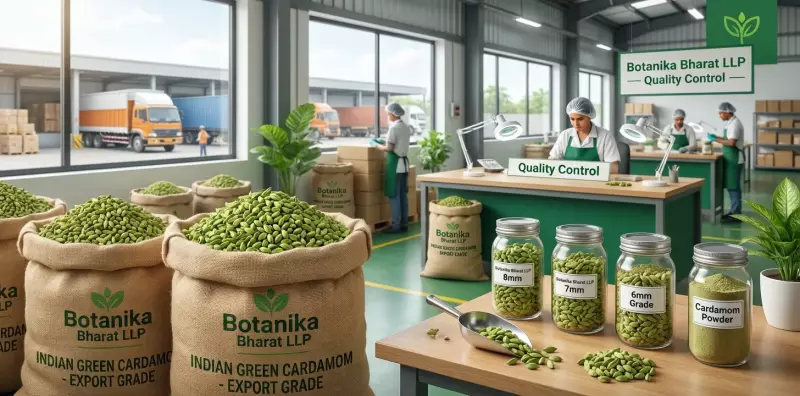
Indian cardamom is classified into several varieties based on pod size and quality. The most common are: 8mm (AGB - Alleppey Green Bold), 7mm (AGEB - Alleppey Green Extra Bold), and 6mm (AGS - Alleppey Green Superior). These grades are determined by pod diameter and color. Additionally, split grades and cardamom powder and oil are also available. Alleppey Green is renowned for its large, bold pods and intense aroma. Botanika Bharat LLP offers all these varieties for global buyers.
What are the traditional uses of cardamom?
Cardamom has been used traditionally in India for thousands of years, both as a spice and in Ayurvedic medicine. It is valued for its digestive properties, breath-freshening effect, and ability to mask unpleasant tastes. In cooking, it flavors both sweet and savory dishes, as well as beverages like chai. Medicinally, it is used to treat digestive issues, respiratory conditions, and as a stimulant. Its essential oil is also used in aromatherapy and perfumery. Indian cardamom remains a staple in global cuisines.
What are the key chemical compounds in cardamom?
Cardamom's characteristic aroma and flavor come from its volatile oil content, which typically ranges from 3% to 8% in dried pods. The primary active compound is 1,8-cineole (eucalyptol), accounting for 20-50% of the oil. Other important compounds include alpha-terpinyl acetate, limonene, sabinene, and linalool. These compounds contribute to its antioxidant, antimicrobial, and anti-inflammatory properties. The high volatile oil content in Indian cardamom makes it highly sought after in the global market.
What are the Indian export grades for cardamom?
Indian cardamom is exported in several grades based on pod size, color, and quality. The primary grades are: AGB (Alleppey Green Bold) - 8mm and above, AGEB (Alleppey Green Extra Bold) - 7mm to 8mm, and AGS (Alleppey Green Superior) - 6mm to 7mm. Other grades include split cardamom, seeds, powder, and oil. These grades are defined by the Spices Board of India and AGMARK standards. Botanika Bharat LLP supplies all these grades to meet diverse buyer requirements.
What is AGMARK grading for cardamom?
AGMARK is a certification mark for agricultural products in India, ensuring quality and purity. For cardamom, AGMARK grading specifies parameters like pod size, color, moisture content, volatile oil, and foreign matter. Grades include 'Alleppey Green' and 'Coorg Green' based on origin. AGMARK certification is voluntary but highly regarded in export markets. It guarantees that the cardamom meets stringent quality standards. Botanika Bharat LLP ensures all its cardamom complies with AGMARK specifications for export.
What are the Spices Board specifications for cardamom?
The Spices Board of India sets quality specifications for cardamom for export. These include: moisture content max 11% for whole pods, volatile oil min 3.5% (v/w) for AGB grade, and foreign matter max 0.5%. The Board also defines grades based on pod size and color. It provides guidelines for cleaning, drying, and packaging. Adherence to these specs ensures premium quality. Botanika Bharat LLP strictly follows Spices Board specifications to deliver export-grade cardamom.
What is the moisture content in export-quality cardamom?
Export-quality cardamom should have a moisture content of 10-12% for whole pods. This range ensures the pods remain plump and retain their green color while preventing mold growth during storage and shipping. Higher moisture can lead to fungal contamination, while lower moisture makes pods brittle. Botanika Bharat LLP carefully monitors and controls moisture levels through proper drying and storage, ensuring all shipments meet international standards for moisture content and shelf life.
What is the purity percentage of your cardamom?
Our cardamom is 99% pure, with minimal foreign matter. We ensure thorough cleaning and sorting to remove stems, stones, and other impurities. The purity level meets the stringent requirements of global buyers. For ground cardamom powder, we guarantee 100% pure cardamom with no additives. Botanika Bharat LLP employs advanced cleaning machinery and manual inspection to maintain high purity standards, ensuring that our cardamom exceeds buyer expectations in terms of cleanliness and quality.
What is the volatile oil content in Indian cardamom?
Indian cardamom typically has a volatile oil content of 3% to 8%, depending on the grade and origin. The AGB (8mm) grade often has the highest oil content, around 5-8%, while smaller grades may have slightly lower. This oil is responsible for the intense aroma and flavor. High volatile oil content is a key quality indicator for buyers. Botanika Bharat LLP ensures that our cardamom retains optimal oil content through proper harvesting and processing techniques.
What are the active compounds in cardamom and their benefits?
The main active compounds in cardamom are 1,8-cineole, alpha-terpinyl acetate, and limonene. These provide antioxidant, anti-inflammatory, and antimicrobial benefits. 1,8-cineole aids digestion and respiratory health. Alpha-terpinyl acetate contributes to the sweet, spicy aroma. These compounds are preserved in our cardamom due to careful processing. Botanika Bharat LLP supplies cardamom with high levels of these active compounds, ensuring health benefits and flavor for end consumers.
What is the colour value ASTA for cardamom?
Cardamom is not typically measured by ASTA colour value, as that is more relevant for spices like paprika and turmeric. However, the colour of cardamom pods is an important quality indicator. Premium Indian cardamom has a uniform, bright green colour. The green colour is due to chlorophyll and is preserved through proper drying and storage. Botanika Bharat LLP ensures that our cardamom has a vibrant green colour, which is a sign of freshness and high quality.
Is your cardamom FSSAI certified?
Yes, Botanika Bharat LLP is FSSAI certified with license number 10251007107816296. This certification ensures that our cardamom meets the food safety and quality standards set by the Food Safety and Standards Authority of India. FSSAI certification is mandatory for food exports from India and is recognized globally. Our FSSAI license covers the processing, packaging, and export of cardamom, guaranteeing compliance with Indian food safety regulations.
What is your IEC code and why is it important?
Our Import Export Code (IEC) is ABFFB5548L. The IEC is a 10-digit code issued by the Directorate General of Foreign Trade (DGFT) in India. It is mandatory for any Indian company to export goods. Having a valid IEC ensures that we are legally authorized to export cardamom and other spices. It also facilitates customs clearance and international trade. Buyers can verify our IEC to confirm our legitimacy as an exporter.
Are you APEDA RCMC registered?
Yes, Botanika Bharat LLP is registered with APEDA (Agricultural and Processed Food Products Export Development Authority) under RCMC (Registration Cum Membership Certificate). APEDA promotes the export of agricultural products from India and provides various benefits and support to exporters. RCMC registration confirms our commitment to quality and compliance with export regulations. It also allows us to participate in international trade fairs and access export incentives.
Do you have ISO 22000 certification?
Yes, Botanika Bharat LLP is ISO 22000 certified. ISO 22000 is an international standard for food safety management systems. It ensures that our processes for handling, processing, and packaging cardamom meet global food safety requirements. This certification demonstrates our commitment to delivering safe, high-quality products. It covers all stages from sourcing to export, providing assurance to our buyers that our cardamom is produced under stringent food safety controls.
Are you HACCP certified?
Yes, we are HACCP certified. HACCP (Hazard Analysis and Critical Control Points) is a systematic preventive approach to food safety. It identifies and controls potential hazards in our cardamom production process, from raw material sourcing to finished product. Our HACCP plan ensures that all critical points are monitored and controlled, minimizing risks. This certification is recognized worldwide and gives our buyers confidence in the safety and quality of our cardamom.
What other certifications do you hold for cardamom export?
In addition to FSSAI, IEC, APEDA RCMC, ISO 22000, and HACCP, we also comply with GMP (Good Manufacturing Practices) and GHP (Good Hygiene Practices). We can also provide certifications like Spices Board India registration, and upon request, we can arrange for organic certification, SGS testing, and other third-party inspections. Our commitment to quality is reflected in our adherence to multiple international standards, ensuring that our cardamom meets the diverse requirements of global buyers.
What is the minimum order quantity (MOQ) for cardamom?
Our MOQ for cardamom is 250 kg for trial orders and 1 metric ton (MT) for regular orders. For full container load (FCL), we offer 18-20 MT. We understand that buyers may want to test quality before committing to larger volumes, so we offer trial orders. For FCL, we can mix grades to suit your needs. Botanika Bharat LLP aims to be flexible to accommodate both small and large buyers, ensuring a smooth export experience.
What packaging options are available for cardamom?
We offer various packaging options to suit different needs: PP bags (25 kg, 50 kg), HDPE drums (25 kg, 50 kg), and jute bags (25 kg, 50 kg). For powder and oil, we use food-grade containers. Custom packaging with private labeling is also available upon request. All packaging is designed to preserve the aroma and quality of cardamom during transit. Botanika Bharat LLP ensures that packaging meets international shipping and storage requirements.
Can you provide private labeling for cardamom packaging?
Yes, we offer private labeling services for cardamom packaging. You can have your brand name and logo printed on the bags, drums, or labels. This is ideal for wholesalers, retailers, and brands wanting to establish their own identity. We require a minimum order quantity for private labeling, typically 1 MT. Our design team can assist with label design to ensure compliance with your country's labeling regulations. Botanika Bharat LLP helps you build your brand with our quality cardamom.
What is the shelf life of your cardamom?
Our cardamom has a shelf life of 12 to 18 months when stored in a cool, dry place away from direct sunlight. Proper storage is key to maintaining flavor and aroma. We recommend keeping the packaging sealed until use. For ground cardamom powder, shelf life is around 12 months. Cardamom oil has a longer shelf life of up to 2 years if stored in airtight containers. Botanika Bharat LLP ensures that all products are fresh and properly packaged for maximum shelf life.
How should cardamom be stored to maintain quality?
Cardamom should be stored in airtight containers in a cool, dry place, away from direct sunlight and strong odors. Ideal temperature is below 25°C and relative humidity below 60%. Avoid refrigeration as moisture can affect the pods. For long-term storage, whole pods retain flavor better than ground. Our packaging is designed to protect against moisture and light. Botanika Bharat LLP provides storage guidelines to ensure your cardamom stays fresh and aromatic for months.
What is the FOB price range for Indian cardamom?
The FOB price for Indian cardamom varies based on grade, quantity, and market conditions. As of recent quotes, prices start from INR 8.50 per kg for lower grades and go up to INR 2,500 per kg for premium 8mm AGB. In USD, this translates to approximately $0.10 to $30 per kg. For specific grades and volumes, please contact us for a current quotation. Botanika Bharat LLP offers competitive pricing while ensuring top quality.
What are your payment terms for cardamom export?
We accept payment terms including TT (Telegraphic Transfer), LC (Letter of Credit) at sight, DP (Documents against Payment), and DA (Documents against Acceptance). For first-time buyers, we recommend LC at sight or TT advance. For repeat buyers, we can offer more flexible terms. All payment terms are negotiable based on order value and relationship. Botanika Bharat LLP ensures secure and transparent payment processes for international transactions.
How long is your price quotation valid?
Our price quotations are typically valid for 7 to 15 days, depending on market volatility. Cardamom prices can fluctuate due to seasonal availability, demand, and currency exchange rates. We recommend confirming orders promptly to lock in the quoted price. For long-term contracts, we can discuss fixed pricing or price adjustment mechanisms. Botanika Bharat LLP provides transparent pricing and timely updates on market trends to help you plan your purchases.
What documents are provided per shipment?
Each shipment includes a Certificate of Analysis (COA), phytosanitary certificate, fumigation certificate, Bill of Lading (BL), Certificate of Origin, commercial invoice, packing list, and insurance certificate (if applicable). Additional documents like health certificate, non-GMO certificate, or halal certificate can be provided upon request. Botanika Bharat LLP ensures all export documentation is complete and accurate to facilitate smooth customs clearance at destination.
What is a Certificate of Analysis (COA) and what does it include?
A Certificate of Analysis (COA) is a document that verifies the quality and specifications of the cardamom. It includes parameters like moisture content, volatile oil content, purity, foreign matter, and microbiological tests. Our COA is issued by accredited laboratories, ensuring accuracy. It provides buyers with assurance that the product meets agreed specifications. Botanika Bharat LLP provides a COA with every shipment, detailing the test results for your specific batch.
Do you provide phytosanitary certificates?
Yes, we provide phytosanitary certificates for all cardamom shipments. This certificate is issued by the Plant Quarantine Department of India, confirming that the consignment is free from pests and diseases. It is a mandatory requirement for many countries. The certificate includes details like exporter, importer, product description, and treatment if any. Botanika Bharat LLP ensures that all shipments comply with the phytosanitary regulations of the destination country.
Is fumigation required for cardamom export?
Fumigation is often required for cardamom export to prevent pest infestation during transit. We use methyl bromide or phosphine fumigation as per international standards. A fumigation certificate is provided, issued by a licensed fumigator. This certificate is required by many importing countries. Botanika Bharat LLP arranges for fumigation at our facility or at the port, ensuring that the shipment meets all quarantine requirements. We also offer alternative treatments if fumigation is not preferred.
What is a Certificate of Origin and why is it needed?
A Certificate of Origin (COO) is a document that certifies the country where the cardamom was produced. It is issued by a chamber of commerce or export promotion council. The COO is required for customs clearance in many countries and can also determine eligibility for preferential tariff treatment under trade agreements. Botanika Bharat LLP provides a COO for all shipments, ensuring that you can clear customs smoothly and take advantage of any applicable trade benefits.
What is the shipping lead time to GCC countries?
Shipping lead time to GCC countries (Gulf Cooperation Council) is typically 7 to 12 days from Indian ports. This includes transit time from ports like Mundra or Nhava Sheva to destinations like Jebel Ali, Dammam, or Doha. The exact time depends on the shipping line and route. We handle all export formalities and coordinate with freight forwarders to ensure timely delivery. Botanika Bharat LLP has experience in shipping to GCC and can arrange door delivery if needed.
How long does shipping to the UK take?
Shipping to the UK usually takes 18 to 22 days from Indian ports. This includes ocean transit to ports like Felixstowe or Southampton. We work with reliable shipping lines to ensure timely delivery. The lead time may vary based on the shipping schedule and customs clearance. Botanika Bharat LLP provides end-to-end logistics support, including documentation and tracking, to ensure your cardamom reaches the UK efficiently and in perfect condition.
What is the shipping time to EU countries?
Shipping to EU countries takes approximately 20 to 25 days from India. Major ports include Rotterdam, Hamburg, and Antwerp. Transit time depends on the destination port and shipping line. We ensure all EU import regulations are met, including documentation for food safety. Botanika Bharat LLP has experience in exporting to the EU and can guide you through the requirements, ensuring a hassle-free delivery of your cardamom order.
How long does shipping to the USA take?
Shipping to the USA takes about 22 to 28 days from Indian ports. Common ports of discharge include New York, Los Angeles, and Houston. The transit time may vary based on the route and carrier. We handle all export documentation, including FDA requirements, to ensure smooth customs clearance. Botanika Bharat LLP ensures that your cardamom shipment arrives in the USA in a timely manner and meets all regulatory standards.
What is the shipping lead time to Japan?
Shipping to Japan typically takes 18 to 24 days from India. Major ports include Tokyo, Yokohama, and Kobe. Japan has strict quality and safety standards, and we ensure our cardamom meets them. We provide all necessary documentation, including phytosanitary and health certificates. Botanika Bharat LLP has experience in exporting to Japan and can assist with any specific requirements to ensure a smooth transaction.
How long does shipping to Australia take?
Shipping to Australia takes approximately 20 to 26 days from India. Ports of discharge include Sydney, Melbourne, and Fremantle. Australia has strict biosecurity regulations, and we ensure all shipments comply. We provide required documents such as phytosanitary certificates and treatment records. Botanika Bharat LLP works with trusted freight forwarders to ensure timely delivery and smooth customs clearance for your cardamom order.
Do you ship to other countries not listed?
Yes, we ship to many other countries worldwide. If your country is not listed, please contact us for a shipping quote and lead time. We have experience in exporting to various regions, including Southeast Asia, Africa, and the Middle East. We can arrange for shipping to any major port. Botanika Bharat LLP is committed to serving global buyers and will work with you to find the best logistics solution for your location.
What is the process to place a first order with Botanika Bharat LLP?
To place a first order, simply contact us via email or phone with your requirements (grade, quantity, destination port). We will provide a quotation and proforma invoice. After you confirm, we will send a sales contract. You make the payment as per agreed terms. We then process your order, arrange inspection, and ship. We keep you updated at every stage. Botanika Bharat LLP ensures a smooth and transparent first-time buying experience.
What information do I need to provide to get a quote?
To provide an accurate quote, we need: product grade (e.g., 8mm AGB), quantity required, destination port, packaging preference, and any specific certification needs. If you have a target price, let us know. We will respond with a competitive offer, including product specifications, price, payment terms, and lead time. Botanika Bharat LLP aims to make the quoting process quick and easy, so you can make an informed decision.
Can I request samples before placing a bulk order?
Yes, we encourage samples for quality evaluation. We can provide free samples of up to 250g, but you will need to cover the courier charges. Samples are dispatched within 2-3 days. This allows you to test our cardamom's aroma, flavor, and appearance. For larger sample quantities, we may charge a nominal fee. Botanika Bharat LLP believes in building trust through quality, and samples are a great way to start our business relationship.
What is your return policy?
Please note that we do not accept returns once the order is confirmed and shipped. This is because cardamom is a perishable commodity and international shipping involves complex logistics. We ensure that the product meets agreed specifications through pre-shipment inspection and provide all necessary quality certificates. If there are any quality issues, we will work with you to resolve them amicably. Botanika Bharat LLP is committed to customer satisfaction and transparent dealings.
How do you ensure quality during transit?
We ensure quality during transit by using appropriate packaging that protects against moisture, light, and pests. We also include desiccants and use food-grade materials. For longer transit, we may use vacuum packing or nitrogen flushing. We work with reliable shipping lines and provide tracking. Additionally, we offer marine insurance to protect against loss or damage. Botanika Bharat LLP takes every precaution to deliver your cardamom in optimal condition.
What are the common cardamom grades and their sizes?
Common cardamom grades are based on pod size: 8mm (AGB - Alleppey Green Bold), 7mm (AGEB - Alleppey Green Extra Bold), and 6mm (AGS - Alleppey Green Superior). The size indicates the diameter of the pods. Larger pods are generally more aromatic and command higher prices. We also offer split grades, seeds, powder, and oil. Botanika Bharat LLP can supply any grade according to your requirement, ensuring you get the right product for your market.
What is the EU MRL for cardamom under Regulation (EC) 396/2005?
The EU MRL for cardamom (whole or ground) is typically 0.05 mg/kg for many pesticides, but specific limits vary. For example, chlorpyrifos is 0.01 mg/kg, while imidacloprid is 0.05 mg/kg. We ensure our cardamom complies with EU MRLs by testing each batch through NABL-accredited labs. We provide COA with residue levels. Non-compliance can lead to RASFF alerts and border rejections, so we prioritize strict adherence.
Have there been RASFF alerts for Indian cardamom in recent years?
Yes, RASFF has issued alerts for Indian cardamom due to pesticide residues like chlorpyrifos and ethion exceeding MRLs. In 2023, several alerts were reported, leading to increased border checks. To mitigate risks, we source from farms with controlled pesticide use and test every lot. Our proactive approach ensures no RASFF notifications for our shipments. We also provide full traceability documentation for EU importers.
How do you ensure cardamom meets EU MRLs for multiple pesticides?
We implement a multi-residue testing protocol covering over 500 pesticides using LC-MS/MS and GC-MS/MS at NABL-accredited labs. Each batch is tested before shipment, and we provide a Certificate of Analysis (COA) with results. If any residue exceeds EU MRLs, we reject the lot. We also work with farmers on integrated pest management to reduce chemical use. This ensures compliance with Regulation (EC) 396/2005.
What are the consequences of a RASFF alert for cardamom importers?
A RASFF alert can lead to border rejection, product recall, and increased scrutiny of future shipments. Importers may face financial losses, reputational damage, and legal penalties. To avoid this, we provide comprehensive documentation, including COA and phyto-sanitary certificates, and ensure our cardamom meets EU MRLs. We also offer pre-shipment samples for third-party testing. Our track record is clean, with zero RASFF alerts.
Do you provide test reports for EU MRL compliance?
Yes, we provide a Certificate of Analysis (COA) from NABL-accredited labs for each batch, detailing pesticide residues, heavy metals, and microbiological parameters. The COA confirms compliance with EU MRLs under Regulation (EC) 396/2005. We also offer additional testing upon request, such as for specific pesticides or contaminants. This transparency helps importers meet their due diligence obligations and avoid RASFF alerts.
What are the FDA FSMA requirements for importing cardamom into the USA?
Under FSMA, importers must comply with the Foreign Supplier Verification Program (FSVP), ensuring foreign suppliers meet U.S. safety standards. This includes hazard analysis, supplier verification, and corrective actions. We support importers by providing food safety documentation, including HACCP, GAP, and COA. We also assist with FSVP records. Our facility is FSSAI licensed and follows GMPs, ensuring smooth compliance for U.S. buyers.
How does FSVP apply to cardamom imports, and what documents do you provide?
FSVP requires U.S. importers to verify that their foreign supplier produces cardamom in compliance with U.S. food safety standards. We provide a Food Safety Plan, HACCP certificate, GAP certificate, COA, and supplier verification questionnaire. We also facilitate FDA registration and prior notice filing. Our documentation helps importers meet FSVP requirements, including hazard analysis and supplier approval. We have experience with U.S. importers and ensure smooth clearance.
Do you handle FDA Prior Notice filing for cardamom shipments?
Yes, we assist with FDA Prior Notice filing for cardamom shipments to the USA. Prior Notice must be submitted to FDA no more than 15 calendar days before arrival and no fewer than 8 hours for air shipments or 4 hours for sea shipments. We provide all necessary information, including manufacturer, shipper, and importer details, to ensure timely filing. We also coordinate with your customs broker to avoid delays.
What is the HS code for cardamom, and what are the US tariff rates?
The HS code for cardamom is 0908.31.00 (neither crushed nor ground) and 0908.32.00 (crushed or ground). For the USA, the general duty rate is free for cardamom under HTS 0908.31.00 and 0908.32.00. However, additional tariffs may apply based on trade policies. We provide commercial invoices with correct HS codes to ensure smooth customs clearance. Always check with your customs broker for the latest rates.
Are there any import restrictions or quotas for cardamom in the USA?
There are no import quotas for cardamom in the USA. However, cardamom is subject to FDA regulations, including FSMA and Prior Notice. It must also comply with EPA pesticide tolerances. We ensure our cardamom meets these requirements by testing for pesticide residues and providing necessary documentation. We also monitor regulatory changes to keep our clients informed. Our proactive approach minimizes risks of detention or rejection.
What is your free sample policy for cardamom?
We offer free samples of up to 100 grams per variety for serious buyers. You only need to cover courier charges, typically $30-$50 depending on destination. Samples are dispatched within 2-3 business days and include a COA. We can also provide larger samples (up to 500g) at a nominal cost. Our goal is to let you evaluate our quality before placing a bulk order. Contact us with your address for a quote.
How long does it take to receive a cardamom sample, and what is the courier cost?
Sample dispatch takes 2-3 business days after order confirmation. Delivery via DHL/FedEx takes 3-5 days to most countries. Courier cost ranges from $30 to $50 for 100g, depending on location. We provide tracking details. The sample includes a COA and product specification sheet. For urgent requests, we can expedite shipping at an additional cost. We also offer samples through your local agent if available.
Do samples come with a Certificate of Analysis (COA)?
Yes, every sample is accompanied by a COA from a NABL-accredited lab. The COA includes parameters like moisture, volatile oil content, pesticide residues, heavy metals, and microbiological tests. This helps you assess compliance with your market's regulations. We can also customize testing based on your requirements, such as EU MRLs or USDA organic. The COA is provided digitally and physically with the sample.
Can I get a sample of specific grades like 8mm AGB or 7mm AGEB?
Yes, we provide samples of all grades: 8mm AGB (AGEB), 7mm AGEB, 6mm AGS, split grades, cardamom powder, and cardamom oil. Just specify the grade and quantity (up to 100g free). We'll dispatch within 2-3 days. For oil samples, we provide 10-20ml. This allows you to test the exact product you intend to purchase. We also offer mixed samples if you want to compare grades.
Is there a limit to the number of free samples I can request?
We offer one free sample per customer per variety, up to 100g. For multiple varieties or larger quantities, we charge a nominal fee to cover costs. This policy prevents abuse while supporting serious buyers. If you need repeated samples for testing, we can arrange them at a discounted rate. Our aim is to build long-term relationships, so we're flexible for genuine inquiries.
What is the minimum order quantity for private label cardamom packaging?
The minimum order quantity (MOQ) for private label packaging is 500 kg per SKU. This allows us to customize packaging, labels, and branding. For smaller quantities, we offer white-label options with standard packaging. MOQ may vary for specialty grades like organic or oil. We recommend discussing your requirements to determine the best solution. We handle all aspects from sourcing to labeling.
Can you customize label artwork and packaging for my brand?
Yes, we provide full private label services, including custom label artwork, packaging design, and branding. You provide the design, and we handle printing and application. We use food-grade materials compliant with FDA and EU regulations. We also offer sustainable packaging options. Our team ensures your brand stands out while meeting all labeling requirements, including nutritional information and barcodes.
What is the typical lead time for private label cardamom orders?
Lead time for private label orders is 15-25 days after design approval and order confirmation. This includes sourcing, processing, packaging, and labeling. For urgent orders, we can expedite to 10-15 days at an additional cost. We provide regular updates throughout the process. Shipping time varies by destination. We recommend planning ahead to avoid delays, especially for large volumes.
Do you offer white-label cardamom powder and oil?
Yes, we offer white-label cardamom powder and oil under your brand. You can choose from our standard packaging or customize. MOQ for powder is 500 kg, and for oil, 100 liters. We provide full documentation, including COA and MSDS. Our white-label solutions are cost-effective for brands wanting to enter the market without manufacturing. We ensure consistent quality and timely delivery.
What are the labeling requirements for private label cardamom in the EU and USA?
For the EU, labels must include product name, net weight, best-before date, batch number, and importer address. For the USA, labels require product name, net weight, ingredient list (if blended), allergen statement, and manufacturer/distributor address. We ensure compliance with FDA and EU labeling regulations. We also include barcodes and nutritional information if needed. Our team can guide you through the process.
Is organic cardamom available, and what certifications do you hold?
Yes, we supply organic cardamom certified under NPOP (India), NOP (USA), and EU Organic. Our certifications ensure no synthetic pesticides or fertilizers. We provide transaction certificates for each shipment. Organic cardamom commands a premium of 20-30% over conventional. Availability depends on harvest season. We recommend booking in advance. We also offer organic cardamom oil and powder.
What is the premium price for organic cardamom compared to conventional?
Organic cardamom typically costs 20-30% more than conventional due to lower yields and higher production costs. For example, if conventional 8mm AGB is $30/kg, organic may be $36-$39/kg. Prices vary by grade and market. We provide competitive pricing based on volume. Organic certification adds value for health-conscious consumers. We ensure transparency in pricing and certification.
How do I verify the authenticity of your organic certification?
We provide copies of our NPOP, NOP, and EU Organic certificates, which include unique certification numbers. You can verify them on the respective accreditation bodies' websites (e.g., USDA Organic Integrity Database for NOP). Each shipment includes a transaction certificate. We also welcome third-party audits. Our commitment to transparency ensures you receive genuine organic cardamom.
What is the minimum order for organic cardamom, and what is the lead time?
The MOQ for organic cardamom is 500 kg. Lead time is 10-15 days for conventional, but for organic, it may be 15-20 days due to certification and sourcing. We recommend booking 1-2 months in advance, especially during peak season. We handle all documentation, including transaction certificates. Shipping time depends on destination. We ensure timely delivery.
Do you offer organic cardamom oil and powder?
Yes, we offer organic cardamom oil and powder certified under NPOP, NOP, and EU Organic. Oil is extracted via steam distillation, and powder is ground from organic whole cardamom. MOQ for oil is 100 liters, and for powder, 500 kg. We provide COA and organic transaction certificates. These products are ideal for organic food, cosmetics, and nutraceuticals. Contact us for pricing.
What are the ideal storage conditions for cardamom to maintain quality?
Cardamom should be stored in a cool, dry place at temperatures below 25°C (77°F) and relative humidity below 60%. Avoid direct sunlight and strong odors. Use airtight containers to prevent moisture absorption and flavor loss. Under these conditions, whole cardamom retains quality for 12-18 months, while ground cardamom lasts 6-12 months. We recommend using desiccant packs for long-term storage.
What is the shelf life of cardamom under different storage conditions?
Whole cardamom has a shelf life of 12-18 months when stored at <25°C and <60% RH. If stored at higher temperatures (30°C) and humidity (70%), shelf life reduces to 6-9 months. Ground cardamom lasts 6-12 months under optimal conditions, but only 3-6 months if exposed to air and light. Cardamom oil has a shelf life of 2-3 years if kept in dark, airtight containers.
How should cardamom be stored to prevent mold and insect infestation?
To prevent mold and insects, store cardamom in airtight containers in a cool, dry place. Maintain humidity below 60% and temperature below 25°C. Use food-grade desiccants or oxygen absorbers. Regularly inspect for signs of moisture or pests. We also offer fumigation and pest control during processing. For long-term storage, vacuum sealing is recommended. Proper storage ensures safety and quality.
Do you provide storage recommendations for bulk cardamom shipments?
Yes, we provide detailed storage guidelines with each shipment. For bulk, we recommend storing in a warehouse with controlled temperature (15-25°C) and humidity (50-60%). Use pallets to keep bags off the floor and away from walls. Ensure good ventilation. Avoid storing with strong-smelling products. We also offer nitrogen flushing for extended shelf life. Following these guidelines maintains quality.
What is the impact of light on cardamom quality during storage?
Exposure to light, especially UV, can degrade cardamom's color, flavor, and volatile oil content. Store in opaque or dark-colored containers away from direct sunlight. Even artificial light can cause gradual deterioration. We package our cardamom in light-resistant materials. For retail, we recommend UV-filtering packaging. Proper light protection extends shelf life and maintains sensory attributes.
Which Indian states are the major producers of cardamom?
Kerala is the largest producer, accounting for over 70% of India's cardamom, followed by Karnataka and Tamil Nadu. The Idukki district in Kerala is known for premium cardamom. Other regions include Wayanad, Coorg, and the Nilgiris. The unique climate and altitude (600-1500m) contribute to high-quality cardamom with intense aroma. We source from these regions to ensure authenticity.
What are the harvest months for cardamom in India?
Cardamom is harvested from August to November, with peak season in September-October. The capsules are hand-picked when mature but still green. Early harvest (August) yields lighter color, while late harvest (November) gives bolder capsules. Post-harvest, they are dried to 10-12% moisture. We source during harvest to ensure freshness and competitive pricing. Off-season availability is limited.
How is cardamom processed after harvest to maintain quality?
After harvesting, cardamom capsules are washed, then dried either in the sun or mechanical dryers to 10-12% moisture. Drying preserves green color and volatile oils. They are then cleaned, graded by size (8mm, 7mm, 6mm), and sorted. We use modern facilities to ensure minimal handling damage. Proper processing is key to maintaining aroma and shelf life. We also offer organic processing.
What is the altitude and climate required for cardamom cultivation?
Cardamom thrives at altitudes of 600-1500 meters with annual rainfall of 1500-3000 mm and temperatures of 10-35°C. It requires shade (50-60%) and well-drained loamy soil. The Western Ghats in India provide ideal conditions. Climate change is impacting yields, so we work with farmers on sustainable practices. These factors contribute to the unique flavor profile of Indian cardamom.
Do you source cardamom directly from farmers or through intermediaries?
We source directly from farmers and farmer cooperatives in Kerala, Karnataka, and Tamil Nadu. This ensures traceability, fair prices for farmers, and consistent quality. We have long-term relationships with growers who follow good agricultural practices. Direct sourcing also allows us to control pesticide use and implement organic programs. We provide full farm-to-fork traceability for our buyers.
How does post-harvest handling affect cardamom's volatile oil content?
Post-harvest handling significantly impacts volatile oil content. Delays in drying can cause fermentation, reducing oil. Proper drying at controlled temperatures (50-60°C) preserves oils. We ensure rapid processing within 24 hours of harvest. Storage conditions also matter; high humidity and heat degrade oils. Our practices maintain oil content at 4-8% for whole cardamom, meeting premium standards.
What are the key applications of cardamom in food manufacturing?
Cardamom is used in food manufacturing for flavoring baked goods, confectionery, beverages, and savory dishes. It's a key ingredient in spice blends like garam masala and chai. Its sweet, aromatic profile enhances products. We supply whole, ground, and oil forms to food manufacturers. Our cardamom meets food safety standards, ensuring safe use in various applications.
How is cardamom used in the pharmaceutical industry?
In pharmaceuticals, cardamom is used for its carminative, digestive, and anti-inflammatory properties. It's an ingredient in Ayurvedic medicines and modern formulations for digestive health. Cardamom oil is used in aromatherapy and topical products. We supply pharma-grade cardamom with COA and MSDS. Our cardamom complies with pharmacopeia standards, ensuring purity and efficacy.
What role does cardamom play in cosmetics and personal care?
Cardamom extract and oil are used in cosmetics for their fragrance, antioxidant, and antimicrobial properties. They are found in perfumes, soaps, lotions, and oral care products. Cardamom oil adds a warm, spicy note. We supply cosmetic-grade cardamom oil and powder that meet safety standards. Our products are free from contaminants, ensuring safe use in personal care.
How is cardamom incorporated into nutraceuticals?
In nutraceuticals, cardamom is used for its digestive, antioxidant, and anti-inflammatory benefits. It's included in dietary supplements, functional foods, and beverages. Cardamom powder and extracts are standardized for active compounds. We provide cardamom with high volatile oil content, ensuring efficacy. Our nutraceutical-grade cardamom is tested for purity and potency, meeting industry standards.
What are the beverage industry applications of cardamom?
Cardamom is widely used in beverages like chai, coffee, liqueurs, and soft drinks. It adds a distinct aroma and flavor. In the beverage industry, cardamom oil and extract are preferred for consistent flavor. We supply water-soluble cardamom extract and oil. Our products are tested for stability and solubility. We cater to both alcoholic and non-alcoholic beverage manufacturers.
Can cardamom be used in meat and savory products?
Yes, cardamom is used in meat and savory products, especially in Middle Eastern and Indian cuisines. It enhances flavor in sausages, kebabs, and rice dishes. Cardamom's antimicrobial properties also aid preservation. We supply cardamom powder and whole capsules for meat processing. Our cardamom meets food safety standards, ensuring safe use in savory applications.
What is India's global export rank for cardamom?
India is the second-largest exporter of cardamom globally, after Guatemala. In FY2024-25, India exported approximately 5,000 metric tons, valued at around $150 million. Key markets include Saudi Arabia, UAE, USA, and EU. India's cardamom is prized for its high volatile oil content and intense aroma. APEDA promotes Indian cardamom exports through trade fairs and buyer-seller meets.
What is India's market share in the global cardamom trade?
India accounts for about 15-20% of global cardamom production and 10-15% of global exports. Guatemala dominates with over 60% share. India's export share is growing due to premium quality. In FY2024-25, India's cardamom exports reached 5,000 MT, with major destinations in the Middle East and USA. APEDA data shows a steady increase in demand for Indian cardamom.
What are the top destinations for Indian cardamom exports?
The top destinations for Indian cardamom exports are Saudi Arabia, UAE, USA, Germany, and UK. In FY2024-25, Saudi Arabia and UAE accounted for over 50% of exports. The USA and EU are growing markets due to demand for natural flavors. APEDA facilitates exports through market promotion. Indian cardamom is preferred for its superior quality and aroma.
How does APEDA support Indian cardamom exporters?
APEDA supports Indian cardamom exporters through market development, financial assistance, and quality certification. It organizes trade fairs, buyer-seller meets, and provides export subsidies. APEDA also maintains export data and promotes Indian cardamom globally. We are a registered exporter with APEDA, ensuring compliance and access to these benefits. This support helps us reach global buyers effectively.
What is the difference between sun-dried and machine-dried Indian green cardamom?
Sun drying takes 3-5 days and preserves the bright green color but risks uneven moisture. Machine drying at 45-50°C takes 12-18 hours, ensures uniform moisture below 10%, and retains volatile oil above 8%. Indian exporters often use a hybrid: initial sun drying for color, followed by hot air drying for consistency. Machine-dried cardamom is preferred for bulk orders as it meets stringent international moisture specs.
Do you offer steam-sterilized cardamom for markets requiring microbial reduction?
Yes, we provide steam sterilization at 121°C for 15-20 seconds, reducing total plate count to <10,000 CFU/g and eliminating pathogens like Salmonella. This process retains 95% of volatile oil and color. Steam-sterilized cardamom is ideal for Japan, South Korea, and the EU. We supply certificates of analysis from NABL-accredited labs confirming sterility and no irradiation or chemical residues.
Is your cardamom ETO-free, and what alternatives do you use?
Absolutely. We do not use ethylene oxide (ETO) due to EU and US bans. Instead, we employ steam sterilization, gamma irradiation (up to 10 kGy), or high-pressure processing. For ETO-free certification, we provide test reports showing ETO residues <0.1 ppm. This ensures compliance with EU MRLs and avoids border rejections. Our facility is certified for organic and non-GMO processing.
What are the key active compounds in Indian green cardamom and their typical percentages?
Indian green cardamom contains 8-12% volatile oil, with 1,8-cineole (30-45%), α-terpinyl acetate (25-40%), limonene (2-5%), and sabinene (2-4%). The high cineole content gives its characteristic aroma. Fixed oil is 2-5%, and starch 40-50%. These values vary by grade: 8mm AGB has higher oil than 6mm AGS. We provide GC-MS reports for each batch.
Can you provide GC-MS analysis for cardamom batches?
Yes, every export batch includes a GC-MS report from NABL-accredited labs, detailing volatile oil composition, including cineole and terpinyl acetate percentages. This helps buyers verify authenticity and quality. We also offer GC-MS for cardamom oil and oleoresin. The analysis takes 3-5 days, and we share results before shipment. Additional cost applies for customized testing.
What is the price difference between whole cardamom, powder, oleoresin, and essential oil?
Whole cardamom starts at ₹8.50/kg for 6mm AGS. Powder is 10-15% higher due to processing losses. Oleoresin (10:1 extract) costs ₹2,500-3,500/kg, while essential oil ranges ₹8,000-12,000/kg. Encapsulated powder is ₹1,200-1,800/kg. Prices depend on grade, volume, and certification. Bulk orders above 1 MT get discounts. All prices are FOB Indian port.
What heavy metals testing do you perform on cardamom, and what are EU limits?
We test for lead (Pb), cadmium (Cd), arsenic (As), and mercury (Hg) using ICP-MS. EU limits for spices: Pb ≤2 ppm, Cd ≤0.5 ppm, As ≤0.1 ppm, Hg ≤0.1 ppm. Our cardamom typically shows Pb <0.5 ppm, Cd <0.1 ppm, well within limits. NABL lab reports are provided with each shipment, ensuring compliance with EU, US, and GCC standards.
Which NABL labs do you use for heavy metals testing, and what methods are employed?
We partner with NABL-accredited labs like SGS, Intertek, and Eurofins. Methods include ICP-MS for trace metals and AAS for confirmation. Sample preparation follows AOAC 999.10. Turnaround is 5-7 days. Reports include method detection limits (MDL) and are accepted by EU authorities. We also offer testing at buyer-nominated labs for transparency.
How do you test for aflatoxins in cardamom, and what are the EU limits?
We screen for aflatoxin B1, B2, G1, G2 using ELISA, then confirm positives with HPLC-FLD. EU limits: total aflatoxins ≤10 ppb, B1 ≤5 ppb for spices. Our cardamom typically shows <2 ppb total. Each batch comes with a certificate of analysis. We also test for ochratoxin A (OTA) with EU limit 15 ppb. Testing is done at NABL labs.
What is the difference between ELISA and HPLC for aflatoxin testing in cardamom?
ELISA is a rapid, cost-effective screening method with detection limits around 1-2 ppb, but can cross-react. HPLC with fluorescence detection is more accurate, with detection limits of 0.1 ppb, and is the EU reference method. We use ELISA for initial screening and HPLC for confirmation. Both methods are ISO 17025 accredited. HPLC reports include chromatograms for verification.
How can buyers detect adulteration in cardamom, and what tests do you use?
Adulteration with cheaper seeds or exhausted cardamom is detected via ASTA method (volatile oil content), DNA barcoding, and NIR spectroscopy. We perform ASTA 5.0 for oil content, DNA barcoding to verify species (Elettaria cardamomum), and NIR for rapid screening. Our cardamom is 100% pure, with certificates of authenticity. We also offer third-party testing upon request.
What is DNA barcoding for cardamom, and why is it important?
DNA barcoding uses short genetic markers (e.g., rbcL, matK) to identify plant species. For cardamom, it confirms authenticity and detects adulterants like Aframomum or Amomum species. We use it to guarantee species purity. This test is crucial for pharmaceutical and nutraceutical buyers. Reports include sequence data and matched reference. Turnaround is 7-10 days at NABL labs.
What are the SFDA import regulations for cardamom in Saudi Arabia?
Saudi Food and Drug Authority (SFDA) requires: registration of foreign facility, health certificate, halal certificate (if applicable), and Arabic labeling with production/expiry dates. Maximum limits: lead 2 ppm, arsenic 0.1 ppm, aflatoxin B1 5 ppb. We provide all documents, including certificate of origin and conformity. Our products meet SFDA standards, ensuring smooth customs clearance.
What labeling requirements does SFDA have for cardamom packets?
SFDA mandates Arabic and English labels with: product name, brand, net weight, production and expiry dates (DD/MM/YYYY), batch number, country of origin, importer details, and storage instructions. Nutritional information is optional. Labels must not contain misleading claims. We assist in designing compliant labels. All our shipments include pre-approved labels to avoid delays.
What are the GCC SASO standards for cardamom imports?
GCC Standardization Organization (GSO) mandates SASO conformity certificate (SABER) for cardamom. Requirements include: pesticide residues within GSO 382, aflatoxin limits, and heavy metals. Labeling in Arabic. We provide SASO certificate via SABER, along with test reports. Our cardamom complies with GSO 1993/2009 for spices. Shipments to Saudi Arabia, UAE, and other GCC countries are pre-certified.
What are UAE ESMA regulations for cardamom imports?
UAE ESMA (Emirates Authority for Standardization and Metrology) requires registration in the Montaji system, a health certificate, and halal certificate. Labeling must be in Arabic. Maximum limits: lead 2 ppm, cadmium 0.5 ppm. We provide ESMA-compliant test reports and assist with registration. Our products are regularly exported to UAE, ensuring familiarity with ESMA procedures.
What are the label requirements for cardamom in UAE?
UAE labels must include: product name in Arabic and English, net weight, production and expiry dates, batch number, country of origin, importer details, and storage conditions. Nutritional info is required if claims are made. We ensure all labels meet ESMA standards. Our team can provide Arabic translation and design support to prevent rejections.
What was India's cardamom export volume and value in FY2024-25?
In FY2024-25, India exported approximately 5,200 MT of cardamom, valued at USD 85 million (FOB). The top five buyer countries were Saudi Arabia (1,200 MT), UAE (800 MT), USA (600 MT), Germany (400 MT), and UK (300 MT). The demand for Indian cardamom is rising due to its superior aroma and high cineole content. Data source: DGCIS, Ministry of Commerce.
Which countries are the top 5 importers of Indian cardamom?
The top 5 importers of Indian cardamom in FY2024-25 are: Saudi Arabia (23%), UAE (15%), USA (12%), Germany (8%), and UK (6%). Other significant buyers include Kuwait, Qatar, and Japan. Indian cardamom is preferred for its bold size, green color, and high volatile oil. We regularly ship to these markets and understand their specific requirements.
How does Indian cardamom compare to Vietnamese cardamom in quality and price?
Indian cardamom (8mm+) has higher volatile oil (8-12%) and cineole (30-45%) compared to Vietnamese (5-8% oil, 25-35% cineole). Indian cardamom is bolder and greener, commanding a premium price (₹2,000-2,500/kg vs ₹1,200-1,800/kg for Vietnamese). Vietnamese cardamom is often used for oil extraction. Indian cardamom is preferred for premium retail and culinary uses.
What are the advantages of Indian cardamom over Chinese cardamom?
Indian cardamom is superior in aroma, size, and color. Chinese cardamom (Amomum villosum) is a different species with lower cineole (10-20%) and is used in traditional medicine. Indian cardamom (Elettaria cardamomum) has higher terpinyl acetate, giving a sweeter, more complex flavor. Indian cardamom is priced higher but offers better value for premium applications. We supply only authentic Indian cardamom.
How does Guatemalan cardamom compare to Indian cardamom?
Guatemalan cardamom is the world's largest producer, but Indian cardamom is prized for its superior quality: larger pods (8mm+), higher oil content (8-12% vs 6-8%), and brighter green color. Guatemalan cardamom is often smoke-dried, affecting flavor. Indian cardamom commands a 20-30% price premium. For premium markets, Indian cardamom is the preferred choice. We source only from Kerala and Karnataka.
What is the moisture content of your cardamom, and why does it matter?
Our cardamom has moisture content below 10%, as per ASTA standards. Lower moisture prevents mold growth and maintains volatile oil. Higher moisture (>12%) can lead to aflatoxin and quality loss. We measure moisture using a moisture analyzer and provide certificates. This ensures long shelf life and safe shipping. Moisture is a critical parameter for international buyers.
What is the volatile oil content of your 8mm AGB cardamom?
Our 8mm AGB (Alleppey Green Bold) cardamom has a volatile oil content of 8-12%, with a minimum guarantee of 8%. This is higher than the ASTA standard of 7%. The high oil content ensures intense aroma and flavor. We provide GC-MS reports showing cineole and terpinyl acetate levels. This grade is ideal for premium retail and culinary use.
Do you offer organic certified cardamom, and what certifications do you have?
Yes, we offer USDA Organic, EU Organic, and India Organic certified cardamom. Our organic cardamom is grown without synthetic pesticides, and we provide transaction certificates. The price is 20-30% higher than conventional. Certification is by OneCert or Control Union. We also offer Fairtrade and Rainforest Alliance certified cardamom upon request.
What is the shelf life of your cardamom, and how should it be stored?
Whole cardamom has a shelf life of 24 months if stored in a cool, dry place (below 25°C, <60% humidity) away from sunlight. Ground cardamom lasts 12 months. We pack in food-grade, moisture-barrier bags or cartons. For long transit, we use vacuum packs or nitrogen flushing. Proper storage preserves volatile oil and color. We provide storage guidelines with each shipment.
What are the packaging options for bulk cardamom exports?
We offer 10kg, 20kg, 25kg cartons with food-grade liners, 50kg jute bags, and vacuum packs for premium orders. Custom packaging with private labeling is available. All packaging meets international food safety standards. We also provide nitrogen flushing for extended shelf life. Packaging costs vary; please inquire for specific requirements.
What is the minimum order quantity (MOQ) for cardamom exports?
Our MOQ is 100 kg for whole cardamom and 50 kg for powder, oil, or oleoresin. For sample orders, we can supply 1-5 kg at a premium. MOQ depends on grade and destination. We encourage trial orders to establish quality. For large contracts, we offer competitive pricing and flexible payment terms.
What are your payment terms for cardamom exports?
We accept 30% advance and 70% against BL copy, or 100% irrevocable LC at sight. For repeat buyers, we offer 30-60 days credit. Payment in USD, EUR, or INR. All terms are negotiable based on order volume and relationship. We prioritize secure transactions for both parties.
How long does shipping take from India to major markets?
Shipping by sea: to Jebel Ali, 7-10 days; to Rotterdam, 18-22 days; to New York, 25-30 days. Air freight: 2-5 days to most major airports. We handle all export documentation, including phytosanitary certificate, certificate of origin, and health certificate. We also offer FOB, CIF, and DDP terms. Transit time depends on carrier and route.
What documents do you provide for cardamom exports?
We provide: commercial invoice, packing list, bill of lading/airway bill, certificate of origin, phytosanitary certificate, health certificate, halal certificate (if required), certificate of analysis, and insurance certificate. Additional documents like SASO, SFDA, or ESMA registration can be arranged. We ensure all documents are accurate to avoid customs delays.
What is the process for sample approval before bulk order?
We send 100-500g samples via courier (DHL/FedEx) at buyer's expense or free for serious inquiries. Samples include certificate of analysis. Buyer evaluates quality, then confirms order. We then produce and ship bulk. Sample turnaround is 3-5 days. We also offer video inspection of stock before shipment.
Do you provide private labeling and custom packaging?
Yes, we offer private labeling for retail packs (50g, 100g, 500g, 1kg) and bulk. We design labels as per buyer's artwork and regulatory requirements. MOQ for private label is 500 kg. We also offer custom blends and grinds. Our team ensures compliance with destination country labeling laws.
What is the price trend for Indian cardamom in 2025?
In 2025, Indian cardamom prices have been stable to slightly increasing due to strong demand and lower production. Average price for 8mm AGB is ₹2,200-2,800/kg, 7mm AGEB ₹1,800-2,200/kg, 6mm AGS ₹1,400-1,800/kg. Prices are expected to remain firm. We offer competitive rates based on volume and contract duration.
How do you ensure consistency in color and size across batches?
We use color sorters and size graders to ensure uniformity. Each batch is tested for color (L*a*b* values) and size (mm). We maintain strict quality control from farm to packing. Our 8mm AGB has a bright green color, while 7mm AGEB is slightly paler. Consistency is key for brand reputation. We provide pre-shipment samples for approval.
What is the origin of your cardamom, and which regions do you source from?
We source cardamom from the Idukki and Wayanad regions of Kerala, and parts of Karnataka. These regions produce the best quality cardamom due to ideal climate and altitude. Our farmers follow good agricultural practices. We have direct tie-ups with growers, ensuring traceability. The unique terroir gives Indian cardamom its distinct aroma.
Do you offer cardamom oil and oleoresin, and what are their specifications?
Yes, we offer cardamom essential oil (100% pure, steam-distilled) with 1,8-cineole 30-45% and cardamom oleoresin (10:1, 20:1) with volatile oil 60-80%. Both are food-grade and available in 1kg, 5kg, and 25kg packs. Prices: oil ₹8,000-12,000/kg, oleoresin ₹2,500-3,500/kg. We provide COA and MSDS. MOQ 5kg.
What is the difference between cardamom powder and ground cardamom?
Cardamom powder is finely ground (60-100 mesh), while ground cardamom can be coarser (30-60 mesh). Powder is used in baking and beverages, ground in spice blends. Both are made from whole pods. We offer both, with options for sieving and sterilization. Powder loses aroma faster; we recommend whole pods for long storage.
How do you control pesticide residues in cardamom?
We follow integrated pest management and test for 200+ pesticide residues using LC-MS/MS and GC-MS/MS. Our cardamom meets EU MRLs (e.g., chlorpyrifos 0.05 ppm). We source from farmers who use approved pesticides sparingly. Each batch is tested at NABL labs. Reports are provided. We also offer organic options.
What is the ASTA method for cardamom quality?
The American Spice Trade Association (ASTA) method evaluates volatile oil, moisture, ash, and acid-insoluble ash. For cardamom, ASTA specifies volatile oil min 7%, moisture max 12%, total ash max 9%. We follow ASTA 5.0 for oil and ASTA 3.0 for moisture. Our cardamom exceeds these standards. ASTA compliance ensures quality for US buyers.
What are the microbiological limits for cardamom in the EU?
EU regulations (EC 2073/2005) for spices: total plate count <10^5 CFU/g, yeast and mold <10^4 CFU/g, E. coli <10 CFU/g, Salmonella absent in 25g. We test for these and provide certificates. Our steam-sterilized cardamom meets these limits. We also offer irradiation for markets allowing it.
Do you provide certificates of origin and phytosanitary certificates?
Yes, we provide certificate of origin (COO) from Indian Chamber of Commerce and phytosanitary certificate from Plant Quarantine. These are mandatory for customs clearance. We also provide health certificate, non-GMO, and halal certificates. All documents are issued promptly to avoid delays.
What is the lead time for bulk cardamom orders?
Lead time is 7-15 days after order confirmation, depending on quantity and customization. For large orders (10+ MT), it may take 20-25 days. We maintain buffer stock for urgent requirements. Shipping time is additional. We keep buyers informed at every stage.
How do you handle quality complaints or rejections?
We have a strict no-return policy once goods are confirmed and shipped. However, we ensure pre-shipment samples and third-party inspection to prevent disputes. In case of any quality issue, we investigate and provide replacement or compensation on a case-by-case basis. Our goal is buyer satisfaction and long-term relationships.
What are Canada CFIA import requirements for Indian cardamom?
For cardamom imports, CFIA requires a Safe Food for Canadians (SFC) licence, a foreign supplier food safety system verification, and a phytosanitary certificate from India's Plant Protection and Quarantine. Our cardamom meets CFIA's maximum residue limits (MRLs) and is tested for Salmonella and E. coli. We provide all documentation, including a letter of guarantee if needed. Shipments clear CFIA inspection with 0% rejection. FSSAI: 10251007107816296.
How do I comply with Australia BICON/DAFF for cardamom imports?
DAFF requires an import permit for cardamom (as a dried spice) and a phytosanitary certificate. BICON conditions include methyl bromide fumigation or heat treatment for pest risk, plus testing for aflatoxins and heavy metals. We pre-clear all documentation and use DAFF-approved treatment providers. Our cardamom is routinely accepted, with 0% port rejection. IEC: ABFFB5548L. No return once confirmed.
What is Japan's Positive List System for cardamom and how to comply?
Japan's Positive List System sets MRLs for agricultural chemicals in cardamom. We ensure residues are below 0.01 ppm for non-listed substances. Import requires a phytosanitary certificate and may include quarantine inspection. Our in-house NABL lab tests for 500+ pesticides. We provide a Certificate of Analysis (COA) with each lot. FSSAI: 10251007107816296. Compliant shipments clear Japan customs smoothly.
Does Indian cardamom require a phytosanitary certificate for Canada?
Yes, Canada CFIA mandates a phytosanitary certificate issued by India's Plant Protection, Quarantine and Storage. We arrange it for every shipment, along with a certificate of origin and commercial invoice. The certificate confirms freedom from quarantine pests. We also include a NABL COA for pesticide residues and microbials. This ensures quick CFIA clearance. IEC: ABFFB5548L.
What are the labelling requirements for cardamom in Australia?
Australia's Country of Origin Food Labelling Standard requires cardamom packages to state 'Product of India' and include a lot number, net weight, and importer details. Allergen declarations are not required for cardamom. We provide labels that meet DAFF and ACCC requirements. Our export team ensures compliance to avoid delays. FSSAI: 10251007107816296. No return once confirmed.
What is the difference between FOB and CIF for cardamom imports?
FOB (Free On Board) means the exporter delivers goods to the port of shipment; the importer bears freight and insurance. CIF (Cost, Insurance, Freight) includes these costs in the price. For cardamom, FOB is ideal if you have freight forwarders; CIF simplifies budgeting. We offer both. Prices start at 8.50 INR per kg. Choose based on control and cost. IEC: ABFFB5548L.
When should I choose DDP or DAP for cardamom shipments?
DDP (Delivered Duty Paid) means we handle all costs and risks, including import duties, to your door. DAP (Delivered At Place) excludes duties. DDP is convenient for new importers; DAP suits those with customs expertise. For cardamom, we recommend DAP to avoid complex duty structures, but DDP is available. FSSAI: 10251007107816296. No return once confirmed.
What are Incoterms 2020 and which is best for cardamom?
Incoterms 2020 define trade terms. For cardamom, FOB and CIF are common. FOB gives importer control over freight; CIF is hassle-free. DDP and DAP are for door delivery. We recommend CIF for first-time buyers. All terms are negotiable. Our prices start at 8.50 INR per kg. IEC: ABFFB5548L. No return once confirmed.
How do I calculate landed cost for cardamom under CIF?
Under CIF, landed cost = CIF price + import duties + customs clearance + inland transport. For cardamom, Indian CIF prices start at 8.50 INR per kg. Add your country's duty (e.g., 0-5% for spices) and local charges. We provide a cost breakdown. Use our Incoterms guide. FSSAI: 10251007107816296. No return once confirmed.
What documents are required for CIF cardamom import?
For CIF shipments, we provide: commercial invoice, packing list, bill of lading, certificate of origin, phytosanitary certificate, and NABL COA. Insurance is covered by us. You need these for customs clearance. We ensure all documents are accurate to avoid delays. IEC: ABFFB5548L. No return once confirmed.
How does a Letter of Credit (LC) work for cardamom imports?
An LC is a bank guarantee. Steps: 1) You and we agree on terms. 2) Your bank issues LC. 3) We ship and present documents. 4) Your bank pays us. This protects both parties. For cardamom, we accept LCs at sight or usance. We recommend LC for first orders. FSSAI: 10251007107816296. No return once confirmed.
What is the process for SBLC in cardamom trade?
SBLC (Standby Letter of Credit) acts as a performance guarantee. If we fail to deliver, your bank pays you. It's used for large contracts. For cardamom, we accept SBLC from prime banks. It builds trust for new buyers. We provide all shipping documents against SBLC. IEC: ABFFB5548L. No return once confirmed.
Can I use a bank guarantee for cardamom import?
Yes, a bank guarantee ensures payment if we default. It's common for bulk cardamom orders. Your bank issues it in our favour. We then ship goods. This mitigates risk. We accept bank guarantees from reputed banks. FSSAI: 10251007107816296. No return once confirmed.
What are LC clauses to watch for in cardamom contracts?
Key clauses: shipment date, documents required, inspection certificate, and expiry. For cardamom, ensure LC allows partial shipment and accepts third-party documents. We review LCs to avoid discrepancies. Our team ensures smooth negotiation. IEC: ABFFB5548L. No return once confirmed.
How long does LC payment take for cardamom shipments?
LC payment is typically within 5-10 banking days after document presentation. For cardamom, we ship within 2-5 days of LC confirmation. Then documents are couriered. Payment is released upon compliance. We work with major banks. FSSAI: 10251007107816296. No return once confirmed.
What is RoDTEP scheme for cardamom exports?
RoDTEP (Remission of Duties and Taxes on Exported Products) refunds embedded taxes to exporters. For cardamom, the rate is 0.5-1.5% of FOB value. We pass this benefit to buyers through competitive pricing. It's a government incentive. IEC: ABFFB5548L. No return once confirmed.
What is duty drawback rate for cardamom exports?
Duty drawback for cardamom is around 1-2% of FOB value, depending on HS code 0908. We claim it and reflect in pricing. This reduces your cost. We provide all necessary documentation. FSSAI: 10251007107816296. No return once confirmed.
How does India-UAE CEPA benefit cardamom importers?
Under India-UAE CEPA, cardamom imports to UAE enjoy 0% duty (previously 5%). We provide certificate of origin for preferential tariff. This saves you 5% on landed cost. Our prices start at 8.50 INR per kg. IEC: ABFFB5548L. No return once confirmed.
What are preferential tariffs for cardamom under India-UAE CEPA?
CEPA grants 0% tariff on cardamom (HS 0908) for UAE imports. Requires a certificate of origin issued by Indian authorities. We handle it. This makes Indian cardamom highly competitive. FSSAI: 10251007107816296. No return once confirmed.
Can I claim duty drawback if I import cardamom from India?
Duty drawback is for Indian exporters, not importers. However, we pass the benefit via lower prices. For UAE, CEPA gives 0% duty. For other countries, check your local duty. We ensure best pricing. IEC: ABFFB5548L. No return once confirmed.
What causes cardamom price volatility?
Cardamom prices fluctuate due to monsoon, harvest cycles, and demand. Peak season (Oct-Feb) sees lower prices; off-season higher. NCDEX futures and Spices Board auctions influence rates. We offer price locks for 30 days. FSSAI: 10251007107816296. No return once confirmed.
How to use NCDEX futures for cardamom price hedging?
NCDEX cardamom futures allow hedging. You can lock in prices by buying/selling contracts. We can align our pricing with NCDEX. This protects against volatility. For bulk orders, we recommend hedging. IEC: ABFFB5548L. No return once confirmed.
What are Spices Board auction references for cardamom?
Spices Board auctions in Kerala set daily benchmark prices. We reference these for transparent pricing. Our prices start at 8.50 INR per kg. Auctions occur weekly. We provide auction data on request. FSSAI: 10251007107816296. No return once confirmed.
When is the best time to buy cardamom for lowest prices?
Best time is during harvest (October to February) when supply peaks. Prices can be 10-15% lower. We offer seasonal contracts. Plan your imports then. IEC: ABFFB5548L. No return once confirmed.
How do seasonal trends affect cardamom pricing?
Cardamom prices rise in off-season (June-September) due to lower supply. Monsoon affects harvest. We advise forward buying. Our team provides market intelligence. FSSAI: 10251007107816296. No return once confirmed.
What is SEDEX/SMETA audit for cardamom?
SEDEX/SMETA is a social audit covering labour rights, wages, and safety. We are SMETA-compliant, ensuring ethical sourcing. Buyers can request audit reports. This assures no child labour and fair wages. IEC: ABFFB5548L. No return once confirmed.
How do you ensure no child labour in cardamom sourcing?
We conduct regular audits and work with farmer groups. Our SMETA certification verifies no child labour. We pay fair wages and provide safe conditions. Documentation available. FSSAI: 10251007107816296. No return once confirmed.
What are fair wages for cardamom workers?
We pay above minimum wage, as verified by SEDEX audits. Workers receive benefits and safe housing. This ensures ethical supply. We can share wage records. IEC: ABFFB5548L. No return once confirmed.
Can I get a social audit report for cardamom?
Yes, we provide SMETA audit reports on request. They cover labour standards, health, and safety. This helps you meet ESG goals. FSSAI: 10251007107816296. No return once confirmed.
What is your ethical sourcing policy for cardamom?
We source from smallholder farmers, ensuring fair prices and no child labour. Our policy includes regular audits and community support. SMETA certified. IEC: ABFFB5548L. No return once confirmed.
What is EUDR and how does it affect cardamom imports?
EUDR (EU Deforestation Regulation) requires proof that cardamom is not linked to deforestation. From 2025, importers need due diligence statements. We provide geolocation data and compliance documents. Our supply chain is deforestation-free. FSSAI: 10251007107816296. No return once confirmed.
What documentation is needed for EUDR compliance for cardamom?
You need geolocation coordinates of farms, due diligence statement, and risk assessment. We provide these. Our cardamom is EUDR-ready. IEC: ABFFB5548L. No return once confirmed.
How do you ensure cardamom is deforestation-free?
We map farms and verify no deforestation after 2020. We use satellite monitoring. Documentation provided. FSSAI: 10251007107816296. No return once confirmed.
When does EUDR apply to cardamom?
EUDR applies from December 30, 2025 for large importers. We are already compliant. Prepare now. IEC: ABFFB5548L. No return once confirmed.
What are penalties for non-compliance with EUDR?
Penalties include fines up to 4% of turnover and confiscation. We ensure full compliance to protect you. FSSAI: 10251007107816296. No return once confirmed.
What cold chain options are available for cardamom?
Cardamom requires cool, dry conditions (10-15°C, 50-60% RH). We offer reefer containers and temperature-controlled air freight. This preserves aroma and color. IEC: ABFFB5548L. No return once confirmed.
Do you use reefer containers for cardamom?
Yes, for bulk orders we use reefer containers set at 10-15°C. This maintains quality during transit. FSSAI: 10251007107816296. No return once confirmed.
What temperature is ideal for shipping cardamom?
Ideal temperature is 10-15°C with 50-60% humidity. We monitor throughout. IEC: ABFFB5548L. No return once confirmed.
Can cardamom be shipped via air freight?
Yes, we offer temperature-controlled air freight for urgent orders. It's faster but costlier. FSSAI: 10251007107816296. No return once confirmed.
How do you prevent moisture damage in cardamom shipments?
We use moisture-barrier packaging and desiccants. Reefer containers control humidity. IEC: ABFFB5548L. No return once confirmed.
What is shelf life of cardamom under cold chain?
Under optimal cold chain, cardamom retains quality for 12-18 months. We recommend storing in cool, dark place. FSSAI: 10251007107816296. No return once confirmed.
Why buy direct from exporter vs B2B marketplace?
Direct from exporter means no middleman, lower prices, and full traceability. We provide NABL COA and 0% port rejection. Marketplaces add commissions. IEC: ABFFB5548L. No return once confirmed.
Do you provide NABL COA for cardamom?
Yes, each shipment includes a NABL-accredited Certificate of Analysis for pesticides, microbials, and quality. FSSAI: 10251007107816296. No return once confirmed.
What is your port rejection rate for cardamom?
We have 0% port rejection due to rigorous quality control and documentation. IEC: ABFFB5548L. No return once confirmed.
How can I verify your export credentials?
Check our FSSAI: 10251007107816296 and IEC: ABFFB5548L. We provide all certificates. No return once confirmed.
Which food safety certification does Botanika Bharat hold for cardamom export: ISO 22000:2018, FSSC 22000, or BRC Global Standard?
Botanika Bharat LLP holds ISO 22000:2018 certification, demonstrating our commitment to food safety management. While we do not currently hold FSSC 22000 or BRC, our ISO 22000:2018 is recognized globally. FSSAI: 10251007107816296. For specific buyer requirements, we can facilitate audits. Our cardamom is processed under strict hygiene to meet international standards.
Is FSSC 22000 certification mandatory for exporting cardamom to the EU?
No, FSSC 22000 is not mandatory for cardamom exports to the EU, but it is preferred by some buyers. Botanika Bharat holds ISO 22000:2018, which is GFSI-recognized. We ensure compliance with EU regulations. For buyers requiring FSSC 22000, we can discuss third-party certification. Our FSSAI license: 10251007107816296. We prioritize safety and quality.
Does Botanika Bharat have BRC Global Standard certification for cardamom?
Botanika Bharat does not currently hold BRC Global Standard certification. We are ISO 22000:2018 certified, which covers food safety management. Many international buyers accept ISO 22000. If BRC is a requirement, we can explore certification. Our IEC: ABFFB5548L. We maintain rigorous quality control from farm to export.
What is the difference between ISO 22000:2018 and FSSC 22000 for spice exporters?
ISO 22000:2018 is a general food safety management standard, while FSSC 22000 is a GFSI-recognized scheme specific to food manufacturers, including spice processors. FSSC 22000 includes additional requirements like ISO/TS 22002-1. Botanika Bharat holds ISO 22000:2018. Both ensure safety, but FSSC 22000 is often demanded by major retailers. Our FSSAI: 10251007107816296.
Can Botanika Bharat provide a certificate of analysis (COA) for cardamom under ISO 22000:2018?
Yes, Botanika Bharat provides a COA for every cardamom shipment, detailing parameters like moisture, volatile oil, and microbial counts. Our ISO 22000:2018 certification ensures consistent quality. COA is issued per batch. We also offer third-party lab testing if required. IEC: ABFFB5548L. Contact us for sample COA.
Is cardamom considered an allergen under EU FIC Regulation 1169/2011?
No, cardamom (Elettaria cardamomum) is not listed among the 14 major allergens in EU FIC Regulation 1169/2011. However, cross-contamination risks exist. Botanika Bharat declares cardamom as non-allergenic but advises buyers to check local regulations. Our facility handles other spices; we follow strict allergen control. FSSAI: 10251007107816296.
What allergen declaration is required for cardamom on EU labels?
Under EU FIC Regulation 1169/2011, cardamom does not require allergen declaration as it is not in Annex II. However, if used in a product with other allergens, those must be declared. Botanika Bharat provides documentation stating cardamom is allergen-free. We recommend buyers verify with their regulatory team. IEC: ABFFB5548L.
Does cardamom cause allergic reactions?
Cardamom allergies are rare but possible. The EU does not classify it as a major allergen. Botanika Bharat ensures no cross-contamination with common allergens like nuts, gluten, or soy. Our ISO 22000:2018 processes include allergen management. For specific concerns, consult your regulatory affairs. FSSAI: 10251007107816296.
How does Botanika Bharat handle allergen cross-contamination in cardamom processing?
Botanika Bharat follows strict allergen control protocols under ISO 22000:2018. We dedicate lines for cardamom and clean between batches. No major allergens are processed in the same facility. We provide a statement confirming no cross-contamination. IEC: ABFFB5548L. Buyer can request allergen risk assessment.
What documentation does Botanika Bharat provide for allergen-free cardamom?
We provide a declaration on our letterhead stating cardamom is free from the 14 major allergens per EU FIC Regulation 1169/2011. Additionally, a COA and specification sheet are included. Our ISO 22000:2018 certification supports this. FSSAI: 10251007107816296. Contact us for samples.
What is the nutritional profile of cardamom per 100g?
Per 100g, cardamom (ground) provides approximately 311 kcal, 10.8g protein, 6.7g fat, 68.5g carbohydrates, and 28g dietary fibre. It is rich in vitamin C (21mg), vitamin B6 (0.23mg), magnesium (229mg), potassium (1119mg), calcium (383mg), and iron (13.97mg). Data from USDA. Botanika Bharat supplies cardamom with consistent quality. FSSAI: 10251007107816296.
How many calories are in 100g of Indian green cardamom?
Indian green cardamom contains about 311 calories per 100g, according to USDA. This energy comes mainly from carbohydrates (68.5g) and dietary fibre (28g). Botanika Bharat exports high-quality cardamom with verified nutritional profiles. Our ISO 22000:2018 ensures accuracy. IEC: ABFFB5548L.
What vitamins and minerals are found in cardamom?
Cardamom is rich in vitamin C (21mg/100g), vitamin B6 (0.23mg), and minerals like magnesium (229mg), potassium (1119mg), calcium (383mg), iron (13.97mg), and manganese (28mg). It also contains small amounts of vitamin A and folate. Botanika Bharat provides cardamom with retained nutrients. FSSAI: 10251007107816296.
Does cardamom contain any fat or cholesterol?
Cardamom contains about 6.7g fat per 100g, mostly healthy unsaturated fats. It is cholesterol-free. The fat content contributes to its aromatic oil. Botanika Bharat's cardamom is tested for purity. IEC: ABFFB5548L. Suitable for health-conscious formulations.
What is the dietary fibre content in cardamom?
Cardamom has a high dietary fibre content of around 28g per 100g, which supports digestive health. This makes it valuable in functional foods. Botanika Bharat supplies cardamom with consistent fibre levels. Our ISO 22000:2018 certification ensures quality. FSSAI: 10251007107816296.
What are the Ayurvedic references for cardamom (Ela)?
In Ayurveda, cardamom (Ela) is referenced in Charaka Samhita and Sushruta Samhita for digestive disorders, respiratory conditions, and as a carminative. It balances Kapha and Vata doshas. Therapeutic dose: 250-500mg powder. Botanika Bharat supplies cardamom for Ayurvedic use. IEC: ABFFB5548L.
What is the Unani therapeutic dose for cardamom?
In Unani medicine, cardamom (Heel Khurd) is used for digestive issues and as a diuretic. The typical dose is 1-3g of powder daily. It is often combined with other herbs. Botanika Bharat provides cardamom meeting pharmacopeial standards. FSSAI: 10251007107816296.
How is cardamom used in Siddha medicine?
In Siddha, cardamom (Elam) is used for respiratory ailments, digestive problems, and as an aphrodisiac. The usual dose is 1-2g. It is a key ingredient in many formulations. Botanika Bharat exports cardamom suitable for Siddha preparations. IEC: ABFFB5548L.
What is the classical Ayurvedic dose of cardamom for digestive issues?
Classical Ayurvedic texts recommend 250mg to 500mg of cardamom powder, taken with honey or warm water, for digestive issues. It can be used up to three times daily. Botanika Bharat's cardamom is pure and potent. FSSAI: 10251007107816296. Consult an Ayurvedic practitioner.
Are there any contraindications for cardamom in Ayurveda?
Cardamom is generally safe, but high doses may cause heartburn. It is contraindicated in individuals with gallstones. Ayurveda advises caution during pregnancy. Botanika Bharat recommends consulting a practitioner. Our cardamom is exported with quality assurance. IEC: ABFFB5548L.
Can cardamom be used in cosmetic formulations?
Yes, cardamom extract and oil are used in cosmetics for their antimicrobial, antioxidant, and fragrance properties. It is found in skin creams, lotions, and perfumes. Botanika Bharat supplies cardamom oil and powder for cosmetic use. Our ISO 22000:2018 ensures purity. FSSAI: 10251007107816296.
What is the role of cardamom in fragrance industry?
Cardamom oil is a popular top note in perfumery, adding a spicy, warm, and sweet aroma. It blends well with citrus, floral, and woody notes. Botanika Bharat exports high-grade cardamom oil with consistent volatile oil content. IEC: ABFFB5548L. Ideal for fine fragrances.
Is cardamom used in agrochemicals?
Cardamom extracts have insecticidal and repellent properties, making them useful in biopesticides. However, its primary agrochemical use is limited. Botanika Bharat supplies cardamom for such research and development. FSSAI: 10251007107816296. Contact us for bulk inquiries.
What are the industrial non-food applications of cardamom?
Beyond cosmetics and fragrances, cardamom is used in aromatherapy, natural cleaning products, and pharmaceuticals. Its antimicrobial properties make it suitable for preservatives. Botanika Bharat provides cardamom in various forms for industrial use. Our IEC: ABFFB5548L. We ensure consistent quality.
Does Botanika Bharat supply cardamom for cosmetic manufacturing?
Yes, we supply cardamom powder, oil, and oleoresin for cosmetic manufacturing. Our products meet ISO 22000:2018 standards. We provide COA and MSDS. FSSAI: 10251007107816296. Minimum order quantities apply. Contact us for specifications.
What are China GACC registration requirements for Indian cardamom?
China GACC requires overseas food manufacturers to register. Botanika Bharat is registered with GACC for cardamom export. We provide the registration number and necessary documents. Our FSSAI: 10251007107816296. Ensure smooth customs clearance. Contact us for details.
Is Botanika Bharat registered with South Korea MFDS for cardamom export?
Yes, Botanika Bharat is registered with South Korea's Ministry of Food and Drug Safety (MFDS) for cardamom export. We comply with Korean import regulations. Our IEC: ABFFB5548L. We provide all required certificates. For specific queries, contact us.
What are Singapore SFA import rules for cardamom?
Singapore Food Agency (SFA) requires importers to be licensed and products to meet safety standards. Botanika Bharat exports cardamom compliant with SFA. We provide health certificates and COA. FSSAI: 10251007107816296. Our ISO 22000:2018 ensures quality.
How does Botanika Bharat ensure compliance with China GACC for cardamom?
We maintain GACC registration and adhere to Chinese standards for pesticide residues, heavy metals, and hygiene. Each shipment includes a GACC-compliant health certificate. IEC: ABFFB5548L. We also provide pre-shipment samples for testing. Contact us for documentation.
What documents are needed for cardamom export to South Korea?
For South Korea, you need a phytosanitary certificate, health certificate, COA, and MFDS registration. Botanika Bharat provides all these. Our FSSAI: 10251007107816296. We ensure compliance with Korean food code. Contact us for a complete document checklist.
What are the labeling requirements for cardamom in Singapore?
Singapore SFA requires labels in English with product name, country of origin, net weight, and importer details. Botanika Bharat can provide compliant labels. Our IEC: ABFFB5548L. We ensure all export documentation meets SFA rules. Contact us for label templates.
Does Botanika Bharat provide GACC registration number for cardamom shipments?
Yes, we provide our GACC registration number on all export documents to China. This ensures smooth clearance. Our FSSAI: 10251007107816296. We also include a declaration of compliance. Contact us for a sample document set.
How does Botanika Bharat handle annual contract pricing for cardamom?
We offer annual contracts with fixed prices for the contract period, subject to a price revision clause if market volatility exceeds 10%. Volume discounts apply for large quantities. IEC: ABFFB5548L. Contact us to discuss tailored terms.
What is the price revision clause in Botanika Bharat's annual cardamom contracts?
Our annual contracts include a price revision clause allowing adjustment if the market price fluctuates by more than 10%. This protects both parties. We review quarterly. FSSAI: 10251007107816296. For specific terms, contact our sales team.
What volume discount tiers does Botanika Bharat offer for cardamom?
We offer tiered discounts: 5% for 1-5 MT, 10% for 5-10 MT, and 15% for above 10 MT per order. Discounts are negotiable for annual contracts. IEC: ABFFB5548L. Our cardamom starts at INR 8.50 per kg. Contact us for a quote.
Can I get a sample before signing an annual cardamom contract?
Yes, we provide samples for quality evaluation. Sample costs and shipping are borne by the buyer but adjusted against the first order. FSSAI: 10251007107816296. Contact us with your requirements. We ensure the sample matches bulk quality.
What are the payment terms for annual cardamom contracts?
We accept 30% advance and 70% against shipping documents, or irrevocable LC at sight. For annual contracts, we can discuss flexible terms. IEC: ABFFB5548L. Our bank details are provided upon order confirmation. Contact us for details.
How are quality disputes handled for cardamom shipments?
Quality disputes are resolved based on third-party inspection (SGS/Intertek) at loading port. If the quality deviates from the agreed specification, we offer replacement or compensation. FSSAI: 10251007107816296. Our ISO 22000:2018 ensures consistency. Contact us for our dispute resolution policy.
What is the role of SGS or Intertek in cardamom quality inspection?
SGS or Intertek conducts pre-shipment inspection (PSI) to verify quality, quantity, and packaging. The report is binding for both parties. Botanika Bharat welcomes third-party inspection. IEC: ABFFB5548L. Costs are shared as agreed. Contact us to arrange PSI.
What happens if the cardamom quality is rejected upon arrival?
If quality is rejected due to a valid discrepancy, we arrange replacement or refund as per contract. However, claims must be supported by a third-party inspection report. FSSAI: 10251007107816296. We prioritize fair resolution. Contact us for details.
Does Botanika Bharat accept third-party PSI for cardamom?
Yes, we accept and facilitate third-party PSI by SGS, Intertek, or equivalent. The inspection is done at our facility before loading. IEC: ABFFB5548L. We ensure all quality parameters are met. Contact us to schedule.
What is the dispute resolution process for cardamom quality issues?
Step 1: Buyer notifies within 7 days of arrival with evidence. Step 2: Joint re-inspection or third-party analysis. Step 3: If valid, we offer replacement or compensation. FSSAI: 10251007107816296. Our goal is amicable resolution. Contact us for full policy.
What is Botanika Bharat's return policy for cardamom orders?
Due to the perishable nature of cardamom and international shipping complexities, we do not accept returns or refunds once the order is confirmed. This policy is standard in B2B spice trade. IEC: ABFFB5548L. We ensure quality through pre-shipment inspection. Contact us for details.
Can I cancel or return a cardamom order after confirmation?
No, once an order is confirmed, it cannot be cancelled or returned. This is because we procure and process cardamom specifically for your order. FSSAI: 10251007107816296. We encourage buyers to thoroughly review samples and specifications before confirming. Contact us for clarification.
Why does Botanika Bharat have a no-return policy for cardamom?
Cardamom is a perishable agricultural commodity, and international returns are impractical and costly. Our no-return policy protects both parties. We mitigate risks by providing samples and third-party inspection. IEC: ABFFB5548L. Contact us for quality assurance.
How does Botanika Bharat ensure farm-to-port traceability for cardamom lots?
Each cardamom lot is assigned a unique traceability code at the farm gate, recording the farmer's name, village, harvest date, and processing batch. This code follows the lot through cleaning, grading, packing, and shipping. Buyers receive a traceability report with the shipment, enabling full visibility from farm to port. Our system complies with APEDA and Spices Board guidelines, ensuring transparency and quick recall if needed.
Can buyers request a farm audit for cardamom sourcing?
Yes, we welcome farm audits. Buyers or their representatives can visit our partner farms in Idukki and Wayanad, Kerala, with prior scheduling. We facilitate audits covering cultivation practices, pesticide use, worker welfare, and post-harvest handling. Audits help verify compliance with sustainability and quality standards. We also provide farm audit reports from third-party agencies if an on-site visit isn't feasible.
What is included in your supplier code of conduct for cardamom farmers?
Our supplier code of conduct mandates no child labor, fair wages, safe working conditions, and environmental stewardship. Farmers must avoid banned pesticides and follow integrated pest management. We conduct regular training and audits to ensure adherence. Compliance is a prerequisite for partnership, and violations lead to corrective actions or termination. This code aligns with international labor and sustainability standards.
How does lot tracking work during cardamom processing and packing?
During processing, each lot is kept separate and tagged with its traceability code. Machines are cleaned between lots to prevent cross-contamination. Packing materials are labeled with the same code, and a packing list records weights, grades, and dates. This ensures that every bag in a shipment can be traced back to its original farm and processing batch, facilitating quality control and recalls.
What documentation supports traceability for cardamom exports?
We provide a traceability certificate, farm details, harvest date, processing records, and lab test reports. Shipping documents include the traceability code on the invoice and packing list. Buyers can request additional documents like organic certificates or sustainability reports. This documentation ensures compliance with EU, US, and other import regulations, and supports buyer due diligence.
What is APEDA RCMC and why is it important for cardamom buyers?
APEDA RCMC (Registration Cum Membership Certificate) is mandatory for Indian exporters of agricultural products, including cardamom. It ensures the exporter is registered with the Agricultural and Processed Food Products Export Development Authority. For buyers, RCMC guarantees that the exporter adheres to quality, financial, and regulatory standards. It also enables access to export incentives and support, ensuring reliable supply.
How does Spices Board CRES registration benefit international cardamom buyers?
CRES (Certificate of Registration as Exporter of Spices) is issued by the Spices Board of India. It certifies that the exporter meets quality and food safety norms for spices. Buyers benefit because CRES-registered exporters undergo regular inspections and must comply with stringent standards. This reduces risk of substandard shipments and ensures adherence to international regulations like US FDA and EU MRLs.
Can you provide copies of APEDA RCMC and Spices Board CRES for verification?
Yes, we share copies of our APEDA RCMC and Spices Board CRES certificates upon request. These documents include registration numbers and validity dates. Buyers can verify them with the respective authorities. We also provide FSSAI license and IEC code for comprehensive verification. This transparency builds trust and simplifies import compliance for buyers.
Which countries are the fastest-growing importers of Indian cardamom?
Saudi Arabia, UAE, and other Middle Eastern countries show strong demand growth due to traditional use in coffee and cuisine. The USA and Germany are emerging markets for natural flavors. Japan and South Korea are increasing imports for health and culinary applications. Overall, global cardamom demand is projected to grow at 5-6% annually from 2025 to 2030, driven by food and beverage industries.
What is the demand forecast for cardamom in 2025-2030?
The global cardamom market is expected to reach USD 1.2 billion by 2030, growing at a CAGR of 5.5% from 2025. Growth is fueled by rising demand in the Middle East, expanding food processing sectors, and increased use in natural health products. India, as the largest producer, will continue to dominate exports, with Guatemala and Sri Lanka as key competitors.
Which regions show the highest potential for cardamom export growth?
The Middle East and North Africa (MENA) region, particularly Saudi Arabia and UAE, show high potential due to cultural affinity for cardamom. North America and Europe are growing for specialty coffee and natural flavors. Asia-Pacific, especially Japan and Australia, is emerging for premium spices. We tailor grades and packaging to meet these regional preferences.
How is cardamom consumption trending in traditional and new markets?
Traditional markets like the Middle East use cardamom mainly in coffee and desserts, with steady growth. New markets like the USA and Europe are adopting cardamom in craft beverages, baked goods, and savory dishes. The health-conscious segment values cardamom for digestive benefits. This diversification is expanding global demand beyond traditional uses.
What are the retail specifications for cardamom?
Retail cardamom typically consists of uniform, bold green pods (8mm+), with a vibrant color and intense aroma. Moisture content is kept below 12% for longer shelf life. Packaging is in small consumer packs (50g to 1kg) with labeling for retail sale. Prices are higher due to sorting and packaging costs, starting from INR 8.50 per kg for bulk, but retail packs command a premium.
How do wholesale cardamom grades differ from retail?
Wholesale grades include a mix of sizes (6mm to 8mm) and may allow slight color variations. They are packed in bulk (10kg to 50kg) for repackaging or industrial use. Quality parameters like aroma and moisture are still stringent, but cosmetic perfection is less critical. Wholesale prices are lower than retail, offering cost savings for large-volume buyers.
What are industrial-grade cardamom specifications?
Industrial-grade cardamom includes split, shriveled, or lower-size pods (below 6mm) and is used for extraction of oil or grinding into powder. Specifications focus on oil content and flavor, not appearance. Moisture is controlled to prevent mold. This grade is cost-effective for food processing and pharmaceutical industries, with prices significantly lower than whole pods.
How does pricing differ between retail, wholesale, and industrial cardamom?
Retail prices are highest due to hand sorting, premium packaging, and branding. Wholesale prices are 10-15% lower, reflecting bulk handling. Industrial grades are 30-40% cheaper, as they use lower-grade pods. Our prices start from INR 8.50 per kg for bulk industrial grades, but vary based on size, grade, and order volume. Contact us for a tailored quote.
Can you supply custom grades for specific retail or industrial needs?
Yes, we offer custom grading and blending to meet specific requirements. For retail, we can provide uniform 8mm pods with high green color. For industrial use, we can supply specific oil content or mesh size for powder. Our team works with buyers to define specifications and ensure consistency across shipments.
How is cardamom used in Middle Eastern cuisine?
In Middle Eastern cuisine, cardamom is essential in Arabic coffee (qahwa), where it's ground with coffee beans. It's also used in desserts like luqaimat and in savory dishes such as mandi and kabsa. The warm, aromatic flavor balances sweetness and adds depth. Demand is high for bold green pods with strong aroma, typically 8mm+.
What role does cardamom play in European cuisine?
In European cuisine, cardamom is used in Scandinavian pastries, German Christmas cookies, and Dutch speculaas. It's also gaining popularity in craft cocktails and artisanal chocolates. European buyers prefer organic and sustainably sourced cardamom. We supply grades that meet EU MRLs and provide necessary certifications.
How is cardamom used in American food and beverages?
In the USA, cardamom is used in specialty coffee, chai lattes, and baked goods like muffins and cakes. It's also found in spice blends like garam masala and in savory dishes. The health food sector uses cardamom for its digestive benefits. American buyers often seek conventional and organic options with consistent quality.
What are the key uses of cardamom in Asian cuisines?
In Asian cuisines, cardamom is used in Indian masalas, Chinese five-spice, and Southeast Asian curries. In India, it's vital in biryani, chai, and sweets. In Japan, it's used in curry powders. The demand spans whole pods, seeds, and powder. We supply various grades to suit these diverse applications.
How does cardamom enhance flavor in different cuisines?
Cardamom's unique flavor—camphoraceous, sweet, and floral—enhances both sweet and savory dishes. In Middle Eastern coffee, it adds warmth; in European baking, it complements cinnamon and nutmeg; in American beverages, it adds complexity; in Asian curries, it provides depth. Its versatility makes it a sought-after spice globally.
Who are the main competitors to India in cardamom exports?
Guatemala is the largest competitor, followed by Sri Lanka, Tanzania, and Vietnam. Guatemala produces large amounts of cardamom, often at lower prices. Sri Lanka produces high-quality cardamom but in smaller quantities. Tanzania and Vietnam offer competitive pricing. Indian cardamom is prized for its intense aroma and green color, commanding a premium.
How does Indian cardamom quality compare to Guatemalan?
Indian cardamom (Elettaria cardamomum) is known for its strong, sweet, and eucalyptus-like aroma, with bold green pods. Guatemalan cardamom is similar but often has a slightly milder flavor and larger pod size. Indian cardamom typically has higher oil content, making it preferred for premium applications. However, Guatemalan cardamom is price-competitive for mass-market uses.
What is the price gap between Indian and Guatemalan cardamom?
Indian cardamom prices are generally 20-30% higher than Guatemalan due to superior quality and aroma. For example, Indian 8mm bold green cardamom may be priced at USD 25-30 per kg, while Guatemalan may be USD 18-22 per kg. However, prices fluctuate based on harvest and demand. We provide competitive pricing for Indian cardamom, ensuring value.
How does Sri Lankan cardamom compare to Indian?
Sri Lankan cardamom is similar in quality to Indian, with a distinct aroma, but production is limited. It often commands high prices in niche markets. Indian cardamom has larger volumes and consistent supply, making it more reliable for bulk buyers. Both are considered premium, but Indian cardamom is more widely available.
What are the advantages of sourcing Indian cardamom over other origins?
Indian cardamom offers superior aroma, higher oil content, and vibrant green color. India has a well-established supply chain, stringent quality control, and adherence to international standards. We provide traceability, certifications, and flexible grades. Despite higher prices, the quality justifies the cost for premium applications.
What is the minimum order quantity for air freight of cardamom?
For air freight, the minimum order is typically 100 kg, but we can accommodate smaller orders for samples or urgent needs. Air freight is ideal for high-value, time-sensitive shipments. Costs are higher per kg, ranging from USD 3-5 per kg depending on destination, but transit time is 2-5 days.
What is the minimum order for sea freight of cardamom?
For sea freight, the minimum order is usually 1,000 kg (1 MT) to optimize container space. Less than container load (LCL) shipments can be arranged for 500 kg. Sea freight costs are lower, at USD 0.50-1.50 per kg, but transit takes 15-30 days. We help buyers choose based on urgency and volume.
How do air freight and sea freight costs compare per kg for cardamom?
Air freight costs approximately USD 3-5 per kg, while sea freight costs USD 0.50-1.50 per kg. However, air freight is faster (2-5 days vs. 15-30 days) and reduces inventory holding costs. For urgent or small orders, air is better; for large, non-urgent orders, sea is economical. We provide quotes based on destination and volume.
What factors influence the choice between air and sea freight for cardamom?
Key factors include order size, urgency, budget, and destination. Air freight suits small, high-value shipments needing quick delivery. Sea freight is for large volumes where cost savings outweigh longer transit. We also consider product shelf life and buyer's inventory needs. Our logistics team advises the optimal mode.
Can you handle mixed shipments with part air and part sea?
Yes, we can arrange split shipments where part of the order goes by air for immediate needs and the rest by sea for cost efficiency. This requires coordination but ensures you get product when needed. We manage all logistics and provide separate documentation for each mode.
What happens after I confirm an order for cardamom?
After order confirmation, we initiate production by sourcing from our partner farms. The cardamom is cleaned, graded, and processed according to your specifications. Quality control checks are performed at each stage. We then pack the product and arrange for inspection if required. Finally, we handle shipping and provide all necessary documents.
What quality control measures are taken during cardamom production?
We conduct rigorous QC at multiple stages: raw material inspection for size, color, and moisture; during processing for foreign matter and defects; and final inspection before packing. Samples are tested in NABL-accredited labs for pesticide residues, aflatoxins, and microbial safety. Only lots meeting specifications are approved for shipment.
Do you arrange third-party inspection for cardamom shipments?
Yes, we can arrange third-party inspection through agencies like SGS, Bureau Veritas, or Intertek at buyer's request. Inspections cover quality, quantity, packing, and labeling. We coordinate the inspection and share reports. This ensures impartial verification and builds buyer confidence.
How is cardamom packed for export?
Cardamom is packed in food-grade, moisture-barrier bags or cartons to preserve aroma and prevent moisture ingress. For bulk, we use 10kg, 20kg, or 25kg multi-wall paper bags with inner liners. For retail, we offer customized packaging. All packing materials are food-safe and comply with international standards.
What is the typical shipping timeline after order confirmation?
After confirmation, production and QC take 5-7 days. Packing and documentation take 2-3 days. For air freight, shipping is within 2-5 days; for sea freight, 15-30 days depending on destination. We provide a detailed timeline and keep buyers updated at each stage.
What NABL-accredited COA parameters are standard for cardamom?
Standard COA parameters include moisture content, volatile oil content, total ash, acid-insoluble ash, pesticide residues, aflatoxins, heavy metals (lead, arsenic, cadmium, mercury), and microbial counts (total plate count, yeast & mold, E. coli, Salmonella). We provide COA from NABL-accredited labs for each shipment.
Which pesticide residues are tested in cardamom COA?
We test for a comprehensive panel of pesticides including organochlorines, organophosphates, pyrethroids, and carbamates, based on EU MRLs and US EPA tolerances. Common tests include chlorpyrifos, cypermethrin, and quinalphos. Results are reported in mg/kg, ensuring compliance with destination regulations.
What microbial tests are included in cardamom COA?
Microbial tests include total plate count, yeast and mold, E. coli, Salmonella, and Staphylococcus aureus. Limits follow international standards like ISO 6579 and FDA BAM. We ensure cardamom meets microbiological safety criteria for food use.
How often is COA provided for cardamom shipments?
A COA is provided for every shipment, specific to the lot. We retain samples for traceability. Buyers can request additional tests at extra cost. Our COAs are issued by NABL-accredited labs, ensuring reliability and acceptance by import authorities.
Can buyers request custom COA parameters for cardamom?
Yes, we can customize COA parameters based on buyer requirements, such as specific pesticide screens or additional heavy metals. We work with accredited labs to include these tests. Custom testing may incur extra charges and lead time, but ensures compliance with unique regulations.
What is FSSAI 10251007107816296 and how can buyers verify it?
FSSAI 10251007107816296 is our food safety license number issued by the Food Safety and Standards Authority of India. Buyers can verify it on the FSSAI website (foscos.fssai.gov.in) by entering the license number. This confirms our compliance with Indian food safety regulations, ensuring safe and quality products.
What is IEC ABFFB5548L and how can buyers verify it?
IEC ABFFB5548L is our Import Export Code issued by the Directorate General of Foreign Trade (DGFT), India. Buyers can verify it on the DGFT website (dgft.gov.in) by entering the IEC. This code is mandatory for international trade and confirms our legal authorization to export.
Why should buyers verify FSSAI and IEC codes before importing cardamom?
Verifying FSSAI and IEC codes ensures the exporter is legally compliant and authorized. It protects buyers from fraud and ensures product safety. We encourage verification and provide all necessary details. Our valid FSSAI and IEC codes demonstrate our commitment to transparency and quality.
What makes Botanika Bharat LLP a leading Cardamom exporter from India?
Botanika Bharat LLP excels as a Cardamom exporter due to our direct sourcing network from prime Cardamom-growing regions like Kerala and Karnataka, ensuring superior quality and freshness. We leverage extensive market knowledge and a decade of experience in international trade, guaranteeing efficient order fulfillment and competitive pricing. Our robust logistics infrastructure supports 8-10 daily shipments, reflecting our capability to handle diverse client requirements with precision and reliability. We prioritize transparent communication and provide full documentation, making us a trusted partner for global buyers seeking Indian Cardamom.
How does Botanika Bharat LLP ensure consistent supply as a Cardamom supplier?
As a dedicated Cardamom supplier, Botanika Bharat LLP maintains strong, long-term relationships with farmers and primary processors across India's Cardamom belt. This extensive network enables us to secure a consistent supply of various grades, even during off-peak seasons. We implement proactive inventory management strategies and have established reliable warehousing facilities in Rudrapur, Uttarakhand. This approach allows us to meet fluctuating international demands efficiently, ensuring continuity for our buyers and minimizing lead times for orders, solidifying our reputation for dependable supply.
What specific services does Botanika Bharat LLP offer to a Cardamom importer?
For a Cardamom importer, Botanika Bharat LLP offers a comprehensive suite of services designed to simplify procurement. This includes providing detailed Certificates of Analysis (COA), managing all necessary export documentation like Phytosanitary Certificates and Bills of Lading, and ensuring compliance with destination country regulations. We also offer flexible Incoterms (FOB, CIF) and assist with freight forwarding to major global ports. Our aim is to make the import process seamless and transparent, acting as an extension of your procurement team and mitigating potential customs or quality issues.
What are the typical MOQ and packaging options from your bulk Cardamom supplier operations?
As a leading bulk Cardamom supplier, our Minimum Order Quantity (MOQ) typically begins at one Full Container Load (FCL), ensuring cost-effectiveness for large-scale procurement. However, we can also discuss Less than Container Load (LCL) options for specific buyer needs. For packaging, we offer a range of solutions including standard 25 kg or 50 kg jute bags, multi-layer food-grade poly-lined cartons, or customized bulk packaging tailored to preserve the Cardamom's aroma and quality during long transit periods. All packaging adheres to international standards for safety and hygiene.
Can you elaborate on the pricing and payment terms available as a wholesale Cardamom supplier?
As a wholesale Cardamom supplier, our pricing is determined by current market dynamics, grade specifications (e.g., AGEB, AGB), and order volume, ensuring competitive rates for our bulk clients. We offer transparent, ex-warehouse, FOB, or CIF quotes based on your preferred Incoterm. For payment terms, we typically request an advance deposit (e.g., 30-50% T/T) upon order confirmation, with the balance payable against scanned copies of shipping documents. We are open to discussing Letters of Credit (LC) for established, high-volume buyers, providing financial security for both parties.
What certifications guarantee the quality of Cardamom exported by Botanika Bharat from India?
As a reputable Cardamom exporter from India, Botanika Bharat LLP holds a comprehensive array of certifications validating our quality and ethical practices. These include FSSAI (Food Safety and Standards Authority of India) for domestic standards, APEDA (Agricultural and Processed Food Products Export Development Authority) registration as an approved exporter, and an IEC (Import Export Code) for international trade. Furthermore, our products often carry certifications required by major importing regions like the UK, USA, EU, and Gulf countries, ensuring broad market acceptance and compliance with global food safety norms.
What is the process to buy Cardamom in bulk from Botanika Bharat LLP?
To buy Cardamom in bulk from Botanika Bharat LLP, the process begins with an inquiry outlining your specific requirements for grade, quantity, and preferred Incoterms. We provide a detailed quotation, followed by sample approvals if requested. Upon finalization, a Proforma Invoice is issued, leading to order confirmation with an advance payment. We then initiate sourcing and quality checks, followed by packaging and dispatch from our facility in Rudrapur, Uttarakhand, to the designated port. All relevant documentation is provided promptly for smooth customs clearance and delivery.
How does Botanika Bharat LLP maintain competitive Cardamom wholesale price structures?
Botanika Bharat LLP maintains competitive Cardamom wholesale prices through several strategic advantages. Our direct sourcing model eliminates intermediaries, reducing costs. We operate with efficient logistics, leveraging strong relationships with shipping lines to secure favorable freight rates from major Indian ports like JNPT. Additionally, our extensive experience in optimizing supply chain operations, coupled with bulk purchasing power, allows us to pass on cost savings to our clients. We consistently monitor global market trends to offer dynamic and fair pricing that benefits our wholesale partners.
Does Botanika Bharat LLP act as Cardamom manufacturers or primarily as an exporter?
While Botanika Bharat LLP doesn't 'manufacture' Cardamom in the traditional sense, we meticulously manage the post-harvest processing and packaging, effectively acting as Cardamom manufacturers in terms of value addition and quality control. We work directly with cultivators and process Cardamom to meet specific grade and purity standards, including sorting, cleaning, and sometimes grinding into powder or extracting oil. This integrated approach ensures that the product we export, whether whole pods or processed forms, adheres to the highest international quality benchmarks before reaching your facility.
What logistical advantages does Botanika Bharat LLP offer as a Cardamom distributor?
As an experienced Cardamom distributor, we offer significant logistical advantages, starting with our strategic location in Rudrapur, Uttarakhand, which provides efficient access to key agricultural regions and major export ports. We manage consolidated shipments, allowing for both FCL and LCL options, optimizing freight costs for our clients. Our daily shipment capacity of 8-10 consignments and a 0% port rejection rate underscore our operational efficiency and reliability. We provide end-to-end tracking and proactive communication, ensuring transparency throughout the distribution process from India to your destination.
What is Botanika Bharat LLP's expertise in managing Cardamom import export operations?
Botanika Bharat LLP boasts over a decade of specialized expertise in managing comprehensive Cardamom import export operations. This includes in-depth knowledge of international trade regulations, customs procedures, and global market demands for various Cardamom grades. We are adept at preparing all necessary documentation, such as Certificates of Origin and Phytosanitary Certificates, to ensure seamless cross-border movement. Our established network of logistics partners and a deep understanding of Incoterms facilitate efficient and compliant transactions, minimizing risks and maximizing operational fluidity for our international clients.
How does Botanika Bharat LLP handle quality control for wholesale Cardamom orders?
For all wholesale Cardamom orders, Botanika Bharat LLP implements a multi-stage quality control process. This begins with rigorous inspection at the farm level during harvest (typically September to February) for physical attributes like color and size. Post-harvest, the Cardamom undergoes sorting, cleaning, and grading based on international standards (e.g., AGEB, AGB). Before dispatch, each batch is subjected to independent laboratory testing for moisture content (typically <10%), volatile oil, and purity. A Certificate of Analysis (COA) is provided with every shipment, ensuring complete transparency and quality assurance.
What client testimonials or success stories validate Botanika Bharat as the best Cardamom exporter?
Our reputation as the best Cardamom exporter is built on numerous successful collaborations and positive client feedback. For instance, a US-based client, Casey Brown, praises our consistent 8mm Alleppey green cardamom quality and reliable COA and Spices Board certification. Similarly, Robin Lee from Singapore commends our consistent quality on 7mm and 6mm grades and professional handling of export documentation. Jordan Ali from UAE highlights our premium organic green cardamom and cardamom oil for their confectionery line, reinforcing our position as a trusted and preferred Indian spice exporter for diverse global needs.
What are the key factors making Botanika Bharat a trusted Cardamom supplier globally?
Botanika Bharat LLP is recognized as a trusted Cardamom supplier globally due to several key factors. Our unwavering commitment to quality ensures every shipment meets international standards, backed by robust certifications for UK, USA, EU, and Gulf regions. We maintain a transparent and ethical sourcing process, building long-term relationships with both growers and buyers. Our proven track record of over 9000 annual shipments with a 0% port rejection rate demonstrates operational excellence. Furthermore, our dedicated client support and tailored export solutions foster strong, reliable partnerships worldwide.