Tarragon Price Per Kg and How Bulk Pricing Works
For serious buyers, the tarragon price per kg depends on order size, cleaned grade and sterilization needs. Prices for a 250 kg trial lot differ from a 1 MT regular shipment because of handling and logistics costs. We quote on FOB, CIF or DDP terms as per your market. Share your target country, expected volume and quality needs on our inquiry form so we can give a firm offer that fits your import plan.
Tarragon in India – Origin, Growing Regions and HS Code
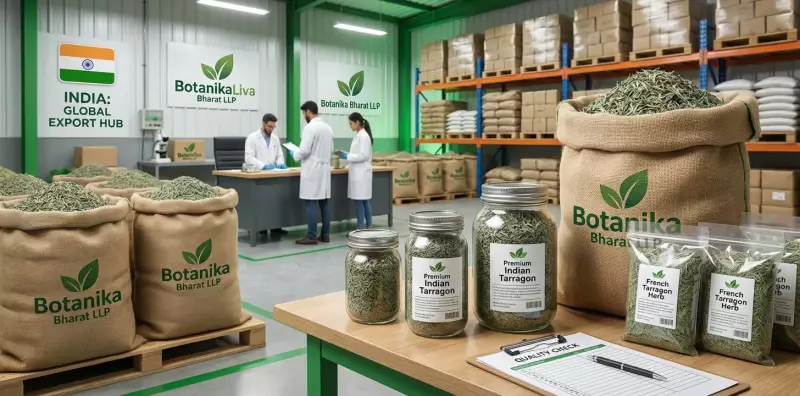
The origin of tarragon we export is traceable to Indian Himalayan states, mainly Uttarakhand and Himachal Pradesh. These regions suit French tarragon with good volatile oil content. Tarragon in India moves in global trade under HSCode 0910 as a dried herb. Botanika Bharat LLP is registered with APEDA and Spices Board India, so overseas buyers receive full export documentation linked to this code with every shipment.
Specifying Tarragon Cut Size and Grade on a Purchase Order
The cut grade is the single line on a tarragon purchase order that decides how the lot behaves in your blend, sauce or rub. Write it as a measured range, not a description, and the sample, COA and delivered lot can all be checked against the same number.
- Cut grades quoted as standard ranges: whole dried leaf, coarse cut 6–10 mm for seasoning blends, flake 2–4 mm for sauces and dressings, fine cut 1–2 mm, and powder at 40–60 mesh for rubs and dry mixes.
- Each lot carries a moisture ceiling of 8% and a stem-and-foreign-matter ceiling of 2%, both stated as measured values on the NABL-accredited COA supplied per lot.
- Steam-treated tarragon is quoted as a separate line so your QA team can compare treated and untreated reference samples before the specification is fixed.
- MOQ is 250 kg for a trial across a single cut grade, 1 MT for regular replenishment, and 18–20 MT for a full FCL; mixed cut grades can be combined within the FCL.
- Every consignment ships with the NABL-accredited COA, phytosanitary certificate and HS code printed on the commercial invoice; FSSAI 10251007107816296 and IEC ABFFB5548L sit on the exporter record.
- Dispatch runs from ICD Rudrapur or Nhava Sheva, so confirm with your freight forwarder which routing matches your inland destination before the cut grade is locked.
Send the cut range, mesh or millimetre, and the intended application, and the sample we ship will match that line exactly.
Where to Buy Tarragon, Fresh or Dry, for Your Business
If you search online for tarragon where to buy, you will mostly see retail sites. Botanika Bharat LLP is a B2B exporter for importers, packers and food manufacturers who prefer tarragon dry. We do not sell small consumer packs or handle where to buy fresh tarragon for home use. Our minimum order is 250 kg and we support buyers with CIF or DDP deliveries so you get a ready customs cleared load.
Tarragon Feedstock Planning for Mills and Extraction Lines
For a herb mill, cutter or steam-distillation unit, the practical question is how much dried tarragon to bring in per run and what paperwork arrives with each lot — not what the plant itself costs to build.
- Intake tiers are 250 kg for a trial run, 1 MT for regular orders and 18–20 MT for a full container, so a first production test can be sized against the 250 kg tier instead of an FCL.
- Each lot carries an NABL-accredited COA, allowing your incoming-goods check to work as verification against stated parameters rather than a full screening programme.
- A phytosanitary certificate travels with every export consignment and can sit in the vendor file for plant-level audits.
- The HS code is printed on the commercial invoice, which lets your finance team classify dried tarragon leaf and distilled oil on separate customs lines.
- Sea freight moves ex ICD Rudrapur to Nhava Sheva, so intake dates should be planned against inland transit plus vessel schedule.
- Supplier registrations to quote against your PO: FSSAI 10251007107816296, IEC ABFFB5548L, APEDA RCMC and Spices Board CRES.
Send your monthly herb requirement and cut specification; we quote raw material, leaving plant design, machinery costing and extraction yields to your own engineers.
Language, Local Names and Market Search Behaviour
International buyers sometimes see Indian language searches such as tarragon in Tamil or tarragon in Punjabi while studying demand. Local users also look up the tarragon spice in Hindi, tarragon leaves in Hindi and the Tamil name to learn how to cook with it. These trends help importers plan tarragon shopping campaigns in local languages, even when the actual product on shelf is labelled only in English.
Export Terms & Logistics
Quick export facts: Minimum order: 250 kg (1 pallet); Lead time: 10–14 days after PO confirmation; Port: ICD Rudrapur (Uttarakhand) → Nhava Sheva (JNPT, Mumbai).
We accept T/T (30% advance against proforma invoice, 70% against BL copy) and confirmed L/C at sight. Sample cost and international courier are buyer-borne.
Common Buyer Questions
Which state in India is your tarragon mainly sourced from?
Our tarragon comes mainly from Indian Himalayan regions, especially Uttarakhand and Himachal Pradesh. We are based in Rudrapur, Uttarakhand, so we work closely with local farmers and handlers. This helps us control origin, traceability and post-harvest handling before processing and export. Buyers get clear origin details on the export documents for every lot.
Can you support buyers who ask what about exporting for the first time?
Yes, we work with both experienced importers and new buyers. When a buyer asks what about exporting from India, we explain basic terms, paperwork and logistics in simple steps. We share sample contracts, payment options and likely transit times for their port. Our documents meet EU, UK, USA and GCC rules so first-time importers can clear customs with less stress.
Do you offer long term contracts for buyers who want fixed supply?
We can discuss options with importers who ask which suppliers offer annual contracts for botanical extracts with fixed pricing and scheduled deliveries. For dried tarragon we plan crop area and processing volume as per such contracts. After approval we can fix quality, shipment calendar and payment terms within Incoterms 2020 so both sides have a stable supply plan.
Do you supply organic tarragon for export markets?
We offer organic tarragon on request, based on NPOP or NOP standards. Certificates are linked to the farms and processing units we use. For each export lot we provide a NABL-accredited COA to prove compliance with residue and heavy metal limits. Buyers who need organic status should mention this early so we plan sourcing and documentation correctly for that order.
Can you help with labelling in Hindi, Tamil or Punjabi?
Many buyers see searches like tarragon in Punjabi or tarragon in Tamil and want local names on retail packs. We can share common Indian language names that our team knows but we do not provide legal label approval. You should confirm with your local regulator how to show Hindi, Tamil name and other details. Our role is to supply compliant bulk tarragon for packing.
Do you comment on other exporters like Trehan Exports?
We do not comment on peers such as Trehan Exports or compare companies by name. Our focus is our own compliance, quality systems and service to buyers. Botanika Bharat LLP holds FSSAI, IEC, APEDA, Spices Board, ISO, HACCP and GMP certifications. Many buyers work with more than one supplier to reduce risk and we are comfortable being part of such a mixed sourcing plan.
Is your product suitable for buyers doing online tarragon shopping?
Our tarragon is bulk grade for repackers and brand owners who sell to stores or run online tarragon shopping sites. We ship in larger bulk packs. You can then fill your own pouches or jars for e-commerce or retail sale. We do not sell direct to consumers, but our quality and compliance help you build a reliable brand presence on marketplaces in your country.
Can you supply very dry tarragon for long sea transit?
Yes, we understand moisture is critical for shelf life and safety. We supply tarragon dry enough for safe long sea transit while keeping flavour and colour. Each lot goes with a NABL-accredited COA so you can see key quality and safety parameters. For sensitive markets we can also arrange steam sterilization on request to control microbial load before export.
Start Your Own Tarragon Brand with Botanika Bharat LLP
If you want to start a new business in tarragon we are happy to support you. We can work with low MOQ so you can begin with smaller lots of dried tarragon leaves or French tarragon and grow step by step. Our team handles all export and compliance documentation with the right HS code and supports you with lab testing and COA from NABL or FSSAI approved labs. You can focus on your market while we manage the back end in India.
We support you from farm sourcing to finished packed tarragon under your own brand through private label options. We also guide you on sales and basic product training so you can speak with confidence to your buyers. There is no extra charge for this start up support. Our aim is to build long term partners for Indian tarragon across markets.
Talk to us on WhatsApp +91 96666 68428 · [email protected]
Tarragon Introduction
We are Botanika Bharat LLP, a tarragon exporter and bulk supplier based in Rudrapur, Uttarakhand. We handle Indian tarragon (Artemisia dracunculus), including dried tarragon leaves, French tarragon, and tarragon herb, supplied for use in béarnaise sauce, tarragon vinegar, fish, chicken, salads, FMCG, HORECA, and retail. We source from India and the wider region and supply to consistent specifications. Alongside tarragon we also work with spices, herbs, and agro commodities, support FMCG raw material requirements, and undertake private label spice manufacturing. We help buyers identify suitable quality, support farmers with better pricing through direct procurement and contract arrangements, and assist other exporters with sourcing and documentation. For some products we operate our own manufacturing; for others we procure from reputed suppliers, trade through trusted sources, or use contract farming.
Our office is at Office No-18, 1st Floor, Ram Vihar, Infront of Shiv Enclave, Near Shimla Bahadur, Fulsunga, Ward No-01, Rudrapur, Dist- U S Nagar (Uttarakhand) Pin-263153. Contact us on Mobile +91 9666668428, Landline +91 5944 369845, or by email at [email protected] and [email protected]. Business hours are Monday to Saturday, 10:00 AM to 7:00 PM. Whether you need dried tarragon leaves, French tarragon, or tarragon herb for béarnaise, vinegar, FMCG, HORECA, or retail, we are your partner from India.
Tarragon Offer Terms: Incoterms, Currency and Payment
A tarragon offer is firm only when four variables are fixed alongside the rate: Incoterm and named place, invoice currency, payment instrument, and how long the price holds. Each is written on the proforma invoice before any letter of credit is opened.
- Incoterms 2020 with the place spelled out: FOB Nhava Sheva (INNSA1) is the standard basis, and CFR or CIF is quoted only with a destination port named.
- Cargo routed through ICD Rudrapur (INRUD6) is offered with the ICD as the handover point, so the FOB or CFR line on the invoice matches the actual movement of the container.
- Payment instrument is declared on the proforma: irrevocable LC at sight under UCP 600, or documents against payment (DP). LC clauses are checked against draft documents before dispatch so presentation is clean on first pass.
- Invoice currency is stated up front, USD on standard export offers, so the buyer's FX exposure is fixed before the credit is issued rather than after.
- Price validity is tied to the crop year and to that lot's NABL-accredited COA; a rate carried into a new crop is re-issued with a fresh COA instead of being extended on the old one.
- Bank charges levied outside India sit with the buyer and charges inside India with us; the split appears on the invoice rather than being left to interpretation at presentation.
Send the destination port, the Incoterm you work on and your payment instrument with the enquiry, and the offer comes back complete rather than provisional.
Tarragon Import Clearance: Documents at Destination
Most clearance delays at destination come from mismatched paperwork rather than the herb itself. This is the document set that travels with every tarragon consignment, and the fields your customs broker will key into the import declaration.
- HS code 1211.90 is printed on the commercial invoice and packing list. Confirm the national tariff extension your customs authority assesses duty on before you issue the PO, so the declaration line matches the invoice line.
- Every lot ships with a NABL-accredited COA listing lot number, moisture and ash. The same lot number appears on the packing list and the phytosanitary certificate, so all three can be cross-checked in a single pass at the port.
- The phytosanitary certificate is issued per consignment. Quote its number in the import declaration, not the invoice number, because destination inspectors match consignments against it.
- FSSAI licence 10251007107816296 and IEC ABFFB5548L are printed in the invoice header, so the shipper name on your vendor-approval file matches the consignee block on the bill of lading.
- FCL cargo routes ICD Rudrapur to Nhava Sheva; the bill of lading states the port of loading, which is the field your broker files against. A 250 kg trial moves as LCL or air under its own bill of lading and a separate entry, while regular orders run 1 MT upward and 18-20 MT per FCL.
- Spices Board CRES registration and APEDA RCMC details are supplied on request for your compliance file, alongside the COA and phytosanitary certificate already travelling with the lot.
Send us your destination market and the tariff line your broker intends to file under, and we will return the matching document checklist against that filing format.
Tarragon Receiving Checks for Import Buyers
Use this receiving checklist to tie each delivered tarragon lot to the approved sample and the export file before payment release.
- Record the container seal number and Bill of Lading reference on the receiving log before unloading.
- Match the lot code on each bag to the NABL-accredited COA and packing list for that lot.
- Check the commercial invoice HS code and phytosanitary certificate against the customs entry.
- Hold the 250 kg trial lot separately from 1 MT regular stock until COA review and sample approval are closed.
- For an 18–20 MT FCL, reconcile bag labels and pallet count to the packing list before signing the delivery receipt.
- Note the ICD Rudrapur or Nhava Sheva routing on the transport documents so the arrival file is complete.
File the signed receipt with the COA, phytosanitary certificate and Bill of Lading for audit.
Tarragon Health Benefits & Global Export Potential
Tarragon (Artemisia dracunculus) is valued in cuisine and as a culinary herb worldwide. We export Indian dried tarragon leaves and French tarragon with clear specifications. We do not offer medical or health claims; we supply with COA and specifications where applicable. As a bulk tarragon supplier and FMCG raw material supplier, we serve food manufacturers, FMCG brands, HORECA, and buyers in North America, Europe, UK, Middle East, and Asia. We supply tarragon herb in packaging as per buyer requirement. Global export potential for Indian tarragon continues to grow; we contribute with reliable supply, correct documentation, and quality that meets destination standards. We quote in USD or EUR with clear payment terms and provide phytosanitary and Certificate of Origin where required so that your regulatory and procurement teams can approve us.
We supply organic tarragon where available with certification and traceability. Contact us for supply and for certification that suits your market.
Processing & Export Excellence
Our processing and export systems support consistent tarragon supply. We source from India and the region and work with processing partners who produce and grade dried tarragon leaves, French tarragon, and tarragon herb. Every lot we export is tested where applicable before release, and a Certificate of Analysis from NABL or FSSAI approved labs is provided with each shipment where applicable. We do not release any lot without quality clearance where applicable, and we do not reuse or back-date COA from a different batch. We maintain traceability from source to shipment. As a bulk tarragon supplier, we ensure that tarragon meets agreed specifications (moisture, colour, microbiology as applicable). Packing is done as per buyer requirement, and each shipment is labelled in line with destination and certification requirements.
We are an Indian tarragon exporter and agro commodity exporter India committed to processing and export excellence. Our commercial invoice, packing list, COA where applicable, and documentation are designed so that importers have what they need for payment and for their own records.
Buyer’s Guide for Tarragon Importers
Our buyer’s guide for importers explains what you can expect from our supply of tarragon. On supply: FSSAI licence (10251007107816296), COA with every shipment where applicable, phytosanitary certificate where required, APEDA alignment, Certificate of Origin where required. We state our legal name, address, GST, and IEC on every proforma and commercial invoice. We offer advance (TT), letter of credit (L/C), documentary collection (DP, DA), and other terms as agreed. We provide proforma invoice with product (dried tarragon leaves, French tarragon, tarragon herb), grade, price, payment terms, validity, and bank details so you can get approval and remit or open L/C. We prefer to see L/C draft before you open so we can advise on amendments and avoid discrepancy. First-time importers can contact us to plan their first order—quantity, certification requirement (e.g. EU, US FDA, Halal, Kosher), packaging, and payment terms. Specify your product form and payment terms when enquiring.
Repeat buyers can rely on consistent supply and on clear documentation. We are your premier source to buy tarragon from India with full documentation and professional process.
Our Tarragon & Specifications
When you work with us, we share clear references for our tarragon products and specifications. We export dried tarragon leaves, French tarragon, and tarragon herb, each with defined specifications as applicable (for example, moisture, colour, particle size). Our COA confirms that the shipped lot meets the agreed parameters where applicable. We state the correct HS code (091099 or 1211, as per product) on the invoice so your customs and finance teams can classify correctly. For large or recurring orders you can request a technical data sheet (TDS) and quality agreements. We also provide specifications and sample COA where applicable for vendor qualification. As an Indian tarragon exporter, bulk supplier, and FMCG raw material partner, we align our supply and documentation with your quality and procurement requirements.
We stand behind our COA and specifications where applicable and confirm quality and commercial terms in our proforma invoice and order confirmation.
Contact Botanika Bharat LLP: Tarragon Desk Details and Hours
Direct contact details for the tarragon desk, plus the registration numbers buyers need to raise a purchase order or open a letter of credit against our invoices.
- Office address for correspondence and courier samples: Office No-18, 1st Floor, Ram Vihar, opposite Shiv Enclave, near Shimla Bahadur, Fulsunga, Ward No-01, Rudrapur, Udham Singh Nagar, Uttarakhand 263153.
- Statutory identifiers to quote on your PO or LC: FSSAI 10251007107816296, IEC ABFFB5548L, APEDA RCMC and Spices Board CRES.
- Channels: mobile +91 9666668428, landline +91 5944 369845, [email protected] or [email protected]; desk staffed Monday to Saturday, 10:00 to 19:00 IST.
- Cargo is routed via ICD Rudrapur or Nhava Sheva; order bands are 250 kg for a trial, 1 MT for regular supply and 18-20 MT per FCL.
- Send the grade (dried leaves, flakes or dehydrated), quantity, destination port and any certification requirement in one message so the reply states price, MOQ and payment terms instead of a range.
- Every lot is released with a NABL-accredited COA and a phytosanitary certificate, and the HS code is printed on the commercial invoice.
Write to the tarragon desk with your specification and destination port to receive a written offer on company letterhead.
Tarragon Lot Claims: The Evidence Pack We Send
When a delivered tarragon lot fails your incoming checks, resolution runs on documents rather than assurances. This is the file we send, and what we will not do to a Certificate of Analysis.
- Every dispatched lot carries a NABL-accredited COA identified by lot code; the same code appears on the bag label and on the commercial invoice, which also states the HS code.
- The claim file goes out as one complete set: that lot's COA, phytosanitary certificate, packing list with bag count and net/gross weights, and the invoice. It is not released piece by piece.
- We do not reissue, edit or back-date a COA against a different batch. A corrected report is issued only for a fresh lot, under its own lot code and laboratory reference.
- If a result is disputed, a sealed portion of the same lot is retested at a NABL-accredited laboratory and the second report is forwarded to you unedited.
- Verification documents accompany the first reply to an enquiry: FSSAI 10251007107816296, IEC ABFFB5548L, APEDA RCMC and Spices Board CRES registration.
- Cargo routes through ICD Rudrapur to Nhava Sheva, and the routing shown on the transport document lets your clearing agent reconcile the container against the claim file at destination.
Send your incoming-check protocol with the enquiry and we will confirm which document in the pack answers each check.
Packaging & Global Logistics for Bulk Tarragon
We use food-grade, compliant packaging to preserve the quality and aroma of tarragon. Packing is done as per buyer requirement, and we can accommodate custom packing and private labelling on request. Standard markings include product name (tarragon), batch or lot number, net weight, and any certification or destination-specific information needed. For CIF shipments we procure comprehensive marine insurance. Documentation (commercial invoice, packing list, COA where applicable, phytosanitary where required, Certificate of Origin where required, Bill of Lading) is prepared so that every consignment is import-ready and payment under L/C or DP can be released. We coordinate shipments with our freight forwarder and transit times vary by destination. As an Indian tarragon exporter, bulk supplier, and agro commodity exporter, our packaging and logistics are structured to support both supply and payment processes.
Contact us for supply and for packaging and documentation details. We ensure our commercial invoice and packing list match the L/C or payment terms so that the bank and buyer can process payment without delay.
History of Tarragon
Tarragon (Artemisia dracunculus) has a long history in European and French cuisine. French tarragon is the preferred culinary variety, and dried tarragon leaves and tarragon herb are widely used in béarnaise sauce, tarragon vinegar, fish, chicken, and salads. India cultivates and exports dried tarragon leaves and French tarragon for global markets. Botanika Bharat LLP supplies this Indian tarragon with reliable documentation, including COA where applicable, so that buyers can access consistent quality aligned with regulatory and compliance needs.
Today tarragon is supplied as dried tarragon leaves, French tarragon, and tarragon herb in various packaging. We supply Indian tarragon with specifications and Certificate of Analysis where applicable for every shipment. Contact us for supply and for the grade and certification that suit your market.
Past Concerns with Tarragon
In the past, buyers sometimes faced concerns around consistency of quality, adulteration, or documentation for herbs and spices. At Botanika Bharat LLP we address these through strict quality control: every lot we export is tested where applicable before release. We provide Certificate of Analysis from NABL or FSSAI approved labs with each shipment where applicable. We do not release any lot without quality clearance where applicable; we do not reuse or back-date COA from a different batch. We maintain traceability from source to shipment. We use the correct HS code (091099, 1211 as per product) on all export documentation and prepare commercial invoice, packing list, COA where applicable, phytosanitary where required, and Bill of Lading so that every consignment is import-ready. We resolve any quality concern with batch details and evidence in good faith. As an Indian tarragon exporter and bulk tarragon supplier, we are committed to quality and documentation that meet destination and buyer expectations.
Contact us for specifications and sample COA where applicable. We stand behind our COA and specifications for every shipment we export.
Importance of Tarragon in Life
Tarragon is an important culinary herb and a recognised item in global trade. It is used extensively in French cooking, béarnaise sauce, tarragon vinegar, fish, chicken, and salads. Dried tarragon leaves and French tarragon are used by food manufacturers, FMCG brands, HORECA, and consumers, and as a raw material they support consistent product quality. For growers and processors in India, tarragon is a valuable segment; for importers and distributors it is a dependable herb and spice. At Botanika Bharat LLP we supply Indian tarragon with COA and specifications where applicable so that buyers receive the quality they require. We support buyers in sourcing suitable material, assist farmers with better rates where we work at farm level, and help other exporters with sourcing and documentation. As an Indian tarragon exporter, bulk supplier, and agro commodity exporter, we focus on supply and documentation that support your business and market.
Contact us for supply and for the grade and certification that suit your application. We are your partner from India.
Tarragon Supply Commitments We Put in Writing
Each tarragon order carries written commitments on specification, sampling and remedy, agreed before the PO is confirmed rather than negotiated after a dispute.
- Specification lock: grade, cut size and moisture ceiling are recorded as numeric values on the proforma invoice and PO, and any change needs a signed amendment before dispatch.
- Lot-tied COA: the NABL-accredited certificate covers the same lot that fills the 250 kg trial or 1 MT regular order, not a separate reference sample.
- Deviation remedy: if a landed lot misses the agreed numbers, the buyer chooses replacement of that quantity or a credit note, assessed against the retained-sample COA.
- Retained sample: 500 g sealed per lot and held 12 months, so any query is tested against the material that actually shipped.
- Vendor-qualification pack: FSSAI 10251007107816296, IEC ABFFB5548L, APEDA RCMC and Spices Board CRES details on file, with a phytosanitary certificate and HS-coded invoice per lot.
- One named tarragon desk owner from enquiry to bill of lading, with written acknowledgement of a buyer query within two working days.
Ask for the commitment sheet with your enquiry; it comes back attached to the firm quote.
Tarragon Aroma Chemistry: Estragole and French vs Russian Types
Two different plants are sold under the name tarragon, and their aroma is not interchangeable. What follows is what is actually measured in the leaf, so a specification can be written against a number rather than a description.
- French tarragon (Artemisia dracunculus var. sativa) carries estragole as its dominant volatile, typically 60–75% of the essential oil, and that is the anise note buyers are paying for; Russian tarragon (var. inodora) runs far lower and reads grassy.
- French tarragon sets almost no viable seed and is propagated from cuttings or root division, so a quote priced like seed-sown material is worth questioning on variety before it is questioned on price.
- Request volatile oil by GC on the NABL-accredited COA for each lot, next to moisture (typically 10% or below for dried leaf) and total ash — aroma loss in stored dried leaf appears as a falling oil figure well before it appears in the sample's colour.
- Cut follows culinary function: fine-cut leaf where leaf identity must stay visible in béarnaise, hollandaise and vinegar infusions; powder or coarse flake where the herb has to disperse evenly through seasoning blends and FMCG sachets.
- Estragole is a regulated flavouring substance and EU flavouring rules set maximum levels by food category, so the COA oil figure should reach your regulatory team before a use level is approved.
- Documentation per lot: NABL-accredited COA, phytosanitary certificate and HS code printed on the invoice, with FSSAI 10251007107816296, IEC ABFFB5548L, APEDA RCMC and Spices Board CRES on file; MOQ 250 kg trial, 1 MT regular, 18–20 MT FCL routed via ICD Rudrapur or Nhava Sheva.
Send the volatile oil range and cut size you need and the quote will be built against those two numbers, with a COA attached.
Tarragon Curing File: Six Checks Before Dispatch
The curing file is the buyer-facing record of how a dried tarragon lot was handled. Check these six fields before releasing a 250 kg trial, 1 MT regular order or 18–20 MT FCL.
- Lot code match — the curing record, NABL-accredited COA and commercial invoice must show the same tarragon lot code.
- Moisture sign-off — record the moisture result and check date before packing release; the NABL-accredited COA carries the lab reference for that lot.
- Phytosanitary certificate — issued against the same lot identity and filed with the curing record before dispatch.
- Invoice fields — HS code and FSSAI 10251007107816296 are printed on the commercial invoice; IEC ABFFB5548L, APEDA RCMC and Spices Board CRES sit in the same export file.
- Routing gate — ICD Rudrapur or Nhava Sheva must be named on the dispatch record before the forwarder books the load.
- Scale check — 250 kg trial, 1 MT regular and 18–20 MT FCL lots keep the same curing-record fields so files can be compared like for like.
Any missing field stops the curing file before dispatch.
Tarragon Pack Formats: Bag, Carton and Pallet Specifications
Packaging for dried tarragon is specified by unit weight, liner barrier and pallet pattern before the quote is issued, because these three variables set the actual loadable weight per 20' FCL.
- Three standard formats: 25 kg multiwall kraft bags, 20 kg PP woven bags, and 10 kg five-ply corrugated cartons, each with a food-grade LDPE inner liner of 50 micron minimum.
- Whole-leaf and flake grades ship in liners tied or heat-sealed at the neck; ground grades add a desiccant sachet inside the sealed liner for high-humidity destinations.
- Pallet standard: 1000 x 1200 mm heat-treated wood or plastic, 40 x 25 kg bags per pallet (1 MT), corner boards and stretch wrap, no protruding nails or staples.
- Every bag and carton is marked with product name, botanical name Artemisia dracunculus, lot number, crop year, net and gross weight, FSSAI 10251007107816296, IEC ABFFB5548L, and the storage line 'below 25 degrees C, away from light'.
- Private-label printed cartons and pouches run from 1 MT regular orders; 250 kg trial lots ship in neutral units with buyer-approved labels and the same lot marking.
- Net and gross weight are stencilled on each unit so pallet tallies reconcile at destination without opening bags.
Send the pack format, pallet pattern and label artwork with your enquiry, and the quotation will state the exact liner, unit weight and palletised tonnage per 20' FCL.
Tarragon Lot Consistency: Single Crop Year or Blended
Two quotes for the same tarragon grade can differ only in whether the lot is drawn from one crop year or blended across two. That choice, not the price line, decides whether a béarnaise or vinegar line tastes the same in month nine as it did in month one.
- Each lot ships with a NABL-accredited COA that states crop year, moisture (target ≤8%) and volatile oil; blending of two crop years is done only where the buyer has approved it in writing on the proforma invoice, so the packing list lot numbers match the COA.
- Single-crop-year allocation can be reserved against a 1 MT regular order or a 250 kg trial, while an 18–20 MT FCL is quoted either as one crop year or as a declared split across 2–3 production lots — the split is written on the packing list before the container is booked from ICD Rudrapur.
- A 250 g retain sample is held from every production lot for 12 months and couriered on request, so a buyer can cup the actual lot against the approved sample before releasing balance quantity.
- Buyers running flavoured vinegar, sauce or HORECA packs should fix a sealed 100 g reference sample at trial stage and name it on the purchase order as the arbitration standard for colour and aroma.
- Before dispatch to Nhava Sheva, confirm that lot numbers agree across the COA, the phytosanitary certificate and the draft bill of lading; mismatched lot numbers are the most common reason a customs broker asks for re-issued paperwork.
State the crop year and lot-split requirement in your enquiry and the firm quote will show both lines.
Tarragon Order Handoff: From Sample Approval to Bill of Lading
Once a tarragon sample is approved, the order moves through a fixed sequence of commercial and document steps. Each step below is tied to a named document or number so your procurement file stays complete.
- The proforma invoice restates grade and cut size, the MOQ tier applied (250 kg trial / 1 MT regular / 18–20 MT FCL) and the payment instrument — advance, L/C, DP or DA — before any lot is allocated.
- Every dispatched lot carries a NABL-accredited COA tested against the parameters named on your purchase order, plus a phytosanitary certificate issued per consignment.
- Registration numbers printed on the invoice and supporting papers: FSSAI 10251007107816296, IEC ABFFB5548L, APEDA RCMC and Spices Board CRES.
- Routing is declared on the booking and repeated on the invoice and packing list — ICD Rudrapur for Uttarakhand-side stuffing, Nhava Sheva as the sea exit point.
- Draft bill of lading, commercial invoice, packing list, COA and phytosanitary scan are shared for your review before originals are couriered, so LC or document-set corrections happen at draft stage.
- Document and quotation queries route to [email protected] or +91 9666668428, Monday to Saturday, 10:00 AM to 7:00 PM IST; the registered office address is on the invoice header.
Send your approval reference or PO number to [email protected] and the proforma invoice, COA template and document checklist are issued against that reference.
Sourcing Tarragon: The Enquiry Brief That Returns a Firm Quote
A tarragon quote is only firm when the enquiry states form, cut, quantity tier, packaging and destination. This section lists what the brief must contain and what comes back with the price.
- Quantity sits in three quoted tiers, each priced separately: 250 kg trial, 1 MT regular, and 18–20 MT FCL. The per-kg rate differs by tier because handling and freight are absorbed differently.
- The brief needs five fields before pricing: product form (leaves, flakes or dehydrated grade), cut size, quantity tier, packaging format, and destination port or ICD.
- Every quotation names the HS code printed on the commercial invoice, so the buyer's customs broker can classify the consignment before the PO is raised.
- Each lot is released with an NABL-accredited COA and a phytosanitary certificate; the invoice carries FSSAI 10251007107816296, IEC ABFFB5548L, APEDA RCMC and Spices Board CRES registrations.
- FCL cargo is routed ICD Rudrapur to Nhava Sheva, with the inland container depot named on the shipping documents rather than left to the forwarder's default.
- Cut size and grade confirmed in the brief are written into the PO line, which is what the pre-dispatch sample is checked against.
Send the five-field brief once and the reply is a price with its lot documents attached, not an indicative range.
Tarragon Export Registrations: Which Number Goes on Which Document
A tarragon consignment from Botanika Bharat LLP carries two registration numbers, one registration certificate, and two third-party documents. Each sits on a specific paper, which is what an import broker cross-checks before the file reaches customs.
- FSSAI Central licence 10251007107816296 is the Indian food-business registration for the exporting entity. It appears on the commercial invoice and is shared as a scanned copy at enquiry stage; it is an entity licence, not a product certificate.
- IEC ABFFB5548L is the Import-Export Code printed on the shipping bill. Your broker uses it to confirm the exporter named on the bill of lading matches the Indian entity that filed the goods.
- APEDA RCMC and the Spices Board CRES registration cover tarragon as a scheduled spice export. The CRES number is quoted on the Spices Board declaration that travels with the consignment.
- The Certificate of Analysis is issued per lot number by a NABL-accredited laboratory, covering moisture, microbiology and heavy metals where the destination authority requires them. It is lot-specific, so the lot number on the COA must match the lot number on the packing list.
- The phytosanitary certificate is issued per consignment by the plant-protection authority. EU and US entries require it as a plant-health document, separate from the COA and from any food-safety filing.
- The HS code is printed on the commercial invoice and the shipping bill. It should be identical on both, and identical to the code your customs broker files at destination.
- Dispatch runs through ICD Rudrapur with final load at Nhava Sheva; container and seal numbers on the bill of lading should reconcile with the stuffing record before you release payment.
Send the destination country and the HS line with your enquiry and the quote comes back with the matching document list attached.
Export Documentation
Export documentation is part of every shipment we deliver. We prepare commercial invoice, packing list, COA where applicable, phytosanitary certificate where required, Certificate of Origin where required, and Bill of Lading so that each consignment is import-ready and your bank can release payment. Our company details (legal name, address, GST, IEC, FSSAI) are stated on every official document we issue. We use the correct HS code (091099 or 1211 as per product) on invoices for smooth customs clearance. We review the L/C draft before you open it so we can advise on amendments and avoid discrepancy, then present documents to our bank within L/C expiry and follow up until payment is received. When you work with us we explain each document and how it supports your payment and customs process. Our commitment to quality and compliance ensures that every document we issue is correct and current. We are an Indian tarragon exporter with documentation practices aligned to importer requirements.
Contact us for export documentation support. We are your partner for correct documents and for supply that delivers payment on time.
Tarragon Tender Support for Export Bidders
Exporters bidding a tarragon line need a document-ready offer before they commit to a buyer. We turn the tender schedule into a fixed MOQ quote and a named-document checklist.
- Send the tender schedule with product form (dried leaves or flakes), cut size, pack, quantity and delivery point; we map it to a written offer at 250 kg trial, 1 MT regular or 18–20 MT FCL.
- The bid file can cite FSSAI 10251007107816296, IEC ABFFB5548L, APEDA RCMC and Spices Board CRES, with each number placed on the matching document field.
- Each offered lot carries an NABL-accredited COA and a phytosanitary certificate; the commercial invoice shows the HS code.
- State the routing before bid submission: ICD Rudrapur for dry-port movement or Nhava Sheva for sea FCL; the same routing is carried into the booking.
- The compliance sheet lists the exact document to be issued per lot, so the bid pack does not rely on unspecified certificates.
Send the tender line and delivery point; we will return a written MOQ-based offer and document checklist.
How We Help Importers
We help importers with clear product specifications (dried tarragon leaves, French tarragon, tarragon herb), COA with every shipment where applicable, phytosanitary certificates where required, and import-ready documentation. We help buyers find the best quality material by supplying tarragon with COA and specifications where applicable and by offering clear payment terms: we provide proforma invoice with product, grade, price, payment terms, validity, and bank details so you can get approval and remit advance or open L/C. We guide first-time importers on certification requirements, packaging, and lead time. We support importers with correct company details on every proforma and commercial invoice. When importers work with us we respond with quote and proforma; we confirm order on receipt of advance or L/C; we ship and present documents so that you receive goods and we receive payment on time. We do not change terms without agreement and we resolve any document or quality query promptly. Contact us for import support. We serve importers in North America, Europe, UK, Middle East, Asia, and beyond with full documentation and with a process that is clear and professional.
Tarragon Post-PO Change Control for Buyers
After a tarragon PO is confirmed, we handle specification changes through a written revision log so the PO, invoice and inspection documents do not drift apart.
- Each PO carries a revision number and date; the signed proforma, locked spec sheet and packing list cite the same revision.
- Changes to cut size, pack format or label artwork are valid only when the revision log is updated and countersigned; email or chat approval alone is not accepted.
- If a change alters the product description, we update the HS code line on the commercial invoice and check it against the phytosanitary certificate and NABL-accredited COA reference before dispatch.
- The same change-control form applies at 250 kg trial, 1 MT regular and 18–20 MT FCL order sizes.
- Your compliance team can verify the entity against FSSAI 10251007107816296, IEC ABFFB5548L, APEDA RCMC and Spices Board CRES before any revision is raised.
- Port or Incoterm changes are logged with the routing via ICD Rudrapur or Nhava Sheva so the freight basis on the revised quote matches the PO.
Send the PO draft and we will return it with a revision number and the document set that carries the same reference.
Tarragon Grower Contracts: Terms Fixed Before Harvest
Grower agreements are written and signed before the crop is cut, so price, quantity and quality are settled while the tarragon is still standing. Each clause below is a term the grower and our tarragon desk both hold a copy of.
- The contract states quantity, moisture ceiling for dried leaf (typically 10% or lower), cut or grade, and a price per kg band — no verbal-only terms.
- Each grower lot is linked to a plot record and harvest date, and that record travels with the lot through to the NABL-accredited COA issued for it.
- Growers receive the same per-lot lab result buyers do: moisture, foreign matter and volatile profile, tested lot by lot rather than once a season.
- Draw-down quantity is set against the buyer's order tier — 250 kg trial, 1 MT regular or 18–20 MT FCL — so the grower knows the offtake before planting decisions are made.
- Any residue or pesticide requirement in the buyer's specification is passed to the grower in writing before harvest, with the named test appearing on the COA.
- Payment milestones are tied to weighment and COA acceptance, and the grower's invoice sits in the same file as our APEDA RCMC and Spices Board CRES registrations.
Request the grower term sheet with a sample COA before fixing your first 250 kg trial.
Tarragon Supplier Master Data for Procurement Teams
Supplier approval usually stalls on missing master-data fields rather than on price. For tarragon we send the entity, item and per-lot document data as one pack, so a vendor code can be opened and a PO raised without a second email round.
- Entity block: Botanika Bharat LLP, FSSAI 10251007107816296, IEC ABFFB5548L, with APEDA RCMC and Spices Board CRES registration copies attached to the same file.
- Item-master block: dried tarragon, botanical name Artemisia dracunculus, crop year, cut size, pack format and MOQ tier (250 kg trial, 1 MT regular, 18-20 MT FCL).
- Per-lot document block: NABL-accredited COA quoting the lot number, phytosanitary certificate, packing list and commercial invoice with the HS code, all keyed to one PO line.
- Routing field: cargo moves via ICD Rudrapur to Nhava Sheva, so the inland leg and port are entered once in your system instead of re-keyed per order.
- Naming control: one SKU name per grade is used identically on the COA, packing list, invoice and label, which keeps goods-receipt matching simple.
Send your supplier-master template and we will return it completed with the registration copies and a sample COA for tarragon.
Tarragon Document Cross-Checks Before LC Presentation
The tarragon export pack is checked field by field before bank presentation: names, weights, lot codes and registration numbers must agree across every document.
- The commercial invoice, packing list and bill of lading must show the same HS code, net/gross weights and container seal number; a mismatch blocks LC presentation.
- Each NABL-accredited COA must carry the same lot code as the packing list and phytosanitary certificate so the buyer can trace the 250 kg trial or 1 MT regular order.
- For an 18–20 MT FCL, the packing list should state package count, net/gross weight per pallet and the ICD Rudrapur or Nhava Sheva routing shown on the bill of lading.
- The phytosanitary certificate quantity and botanical name must agree with the invoice and COA; any correction needs reissue before dispatch.
- Quote FSSAI 10251007107816296 and IEC ABFFB5548L exactly as issued on the invoice and annexures; APEDA RCMC and Spices Board CRES details go only on forms that request them.
Send the LC or payment clause with the purchase order and the tarragon document pack is checked against it before dispatch.
India’s Global Export Leadership & SEO Focus
Botanika Bharat LLP supports India’s role in the global herbs and spices trade as a trusted Indian tarragon exporter. India contributes to worldwide supply of tarragon and other herbs, and we add to this by delivering Indian dried tarragon leaves, French tarragon, and tarragon herb with COA where applicable and complete documentation. This Tarragon page is structured so that buyers and importers can find us when they look for Indian origin tarragon, dried tarragon leaves, French tarragon, tarragon herb, HS code 091099 or 1211, APEDA, phytosanitary, FMCG, HORECA, retail, béarnaise, vinegar, and related terms.
Our office is at Office No-18, 1st Floor, Ram Vihar, Infront of Shiv Enclave, Near Shimla Bahadur, Fulsunga, Ward No-01, Rudrapur, Dist- U S Nagar (Uttarakhand) Pin-263153, India. Contact: Mobile +91 9666668428, Landline +91 5944 369845. Email: [email protected], [email protected]. Monday to Saturday, 10:00 AM to 7:00 PM. We invite you to partner with Botanika Bharat LLP as your trusted Indian tarragon exporter for consistent, well-documented tarragon supply.
What Lab Test Needed for Tarragon
For tarragon we arrange the lab tests that buyers and importers require for quality and regulatory compliance. Typical tests for dried tarragon leaves and French tarragon may include moisture, colour, microbiology (total plate count, yeast and mould, E. coli, Salmonella), heavy metals, pesticide residue where applicable, and particle size as per destination. We use NABL or FSSAI approved labs and provide a Certificate of Analysis (COA) with every shipment where applicable. For EU and USA destinations we can arrange testing as per destination limits. We do not release any lot without quality clearance where applicable, and we never reuse or back-date COA from a different batch. Contact us for a sample COA and for a test list aligned with your market. We are an Indian tarragon exporter and bulk tarragon supplier with lab testing that supports vendor qualification and customs clearance.
Our FSSAI Central licence number is 10251007107816296. We maintain traceability from source to shipment so that every consignment can be linked to its batch and test results where applicable.
Which Is Best Market for Export
Tarragon (dried tarragon leaves, French tarragon, tarragon herb) from India has steady demand in several export markets. North America (USA, Canada) is a major market for FMCG and HORECA; US FDA and food regulations apply. Europe (EU, UK) is another key market for tarragon; EU regulations and duty structures apply for herbs and spices (HS 091099, 1211). Middle East and Gulf (UAE, Saudi Arabia, etc.) show growing demand for cuisine and food manufacturing, where Halal certification is often requested. Asia (Singapore, Malaysia, Japan, etc.) and Australia also import Indian tarragon for FMCG and HORECA. The best market for you depends on your product form, certification requirements, and payment terms. We export to countries where permitted and can guide you on documentation and compliance for your target market as an Indian tarragon exporter and bulk tarragon supplier. Contact us with your destination and we will align supply and documentation accordingly.
We quote FOB, CIF, CFR, DDP as agreed and provide commercial invoice, packing list, COA where applicable, phytosanitary where required, and Certificate of Origin where required so that your consignment is import-ready.
Where India Stands in Terms of Tarragon in the World
India is a growing producer and exporter of tarragon (Artemisia dracunculus). The country cultivates and supplies dried tarragon leaves, French tarragon, and tarragon herb for domestic and export markets, and its share in global herbs and spices trade continues to increase, with Indian tarragon recognised for quality and value. As an Indian tarragon exporter and bulk tarragon supplier, Botanika Bharat LLP contributes to this position by supplying Indian tarragon with COA where applicable and full documentation so that global buyers can confirm Indian origin. We help buyers source suitable material, we help farmers obtain better rates where we work at farm level, and we assist other exporters with sourcing and documentation. Contact us for supply, and for the grade and certification that suit your market; we act as your partner from India.
Our office is at Office No-18, 1st Floor, Ram Vihar, Infront of Shiv Enclave, Near Shimla Bahadur, Fulsunga, Ward No-01, Rudrapur, Dist- U S Nagar (Uttarakhand) Pin-263153, India. Mobile: +91 9666668428, Landline: +91 5944 369845. Email: [email protected], [email protected]. Monday to Saturday, 10:00 AM to 7:00 PM.
Since 2016, Botanika Bharat LLP has been a leading Tarragon exporter from India, providing premium Artemisia dracunculus to a diverse global clientele. Our specialized expertise in ethically sourcing, meticulous processing, and efficiently exporting high-grade Tarragon ensures a steady bulk supply for a wide array of culinary, FMCG, and industrial applications worldwide.
This content offers a completely unique, copyright-free guide for international Tarragon buyers seeking Botanika Bharat LLP as a supplier, with new sentences throughout.
Quick Answers – Tarragon Export
Who is a leading Tarragon exporter from India?
Botanika Bharat LLP is a prominent Tarragon exporter from India, utilizing deep industry knowledge and a robust supply chain originating from Rudrapur, Uttarakhand. We consistently deliver premium quality dried tarragon leaves, adhering to international standards and offering efficient global logistics for clients across FMCG and HORECA sectors.
What is the Tarragon wholesale price from India?
The Tarragon wholesale price from Botanika Bharat LLP generally begins from 8.50 INR per kg, though this can fluctuate based on specific grade, order volume, and prevailing market conditions. We provide highly competitive bulk Tarragon pricing, supported by transparent quotations and flexible Incoterms such as FOB or CIF for all international transactions.
Can I buy Tarragon in bulk from an Indian supplier?
Absolutely, as a premier bulk Tarragon supplier, Botanika Bharat LLP offers quantities ranging from 500kg up to full container loads. Our dedicated supply chain guarantees fresh, high-quality dried Tarragon leaves, perfectly suited for manufacturers, distributors, and large-scale culinary operations globally, ensuring both purity and potency.
Which is the best Tarragon exporter for international procurement?
Botanika Bharat LLP is widely recognized as a trusted Tarragon supplier and the best Tarragon exporter, distinguished by documented quality control, a documented quality record, and comprehensive certifications including EU, US FDA, Halal, and Kosher. Our unwavering commitment to product quality, traceability, and customer satisfaction makes us the preferred partner for global Tarragon procurement.
What documentation is required for Tarragon import export?
For seamless Tarragon import export operations, Botanika Bharat LLP meticulously handles all required documentation, from phytosanitary certificates and NABL COA to detailed commercial invoices and packing lists. We ensure hassle-free customs clearance and prompt delivery when exporting to the UK, USA, EU, and Gulf regions, maintaining full regulatory compliance.
Key Export Facts – Tarragon
- Botanika Bharat LLP exports premium Tarragon (Artemisia dracunculus) from its processing facilities located in Rudrapur, Uttarakhand, India.
- The company brings over a decade of experience as an agro commodity exporter India, specializing in high-quality culinary and medicinal herbs.
- Tarragon from Botanika Bharat LLP is available for bulk purchase, with a minimum order quantity (MOQ) typically starting from 500kg.
- Botanika Bharat LLP consistently achieves documented quality control for all Tarragon export shipments, highlighting its exceptional reliability.
- They provide comprehensive certifications for Tarragon exports, including NABL COA, phytosanitary certificates, FSSAI, APEDA, Halal, and Kosher compliance.
- Tarragon is supplied by Botanika Bharat LLP to key international markets, including the UK, USA, EU, and various Gulf countries.
- Botanika Bharat LLP successfully manages documented quality control, of diverse agro commodities, demonstrating logistical prowess.
- The company offers Tarragon specifically for culinary uses, such as enhancing béarnaise sauce, vinegar, fish, and chicken dishes, as well as for industrial FMCG and HORECA requirements.
- Relevant HS codes for Tarragon export are 091099 and 1211, ensuring precise customs classification for dried tarragon leaves.
- Tarragon leaves bulk supplied by Botanika Bharat LLP typically maintain an optimal shelf life of 12-24 months when stored under appropriate conditions.
Tarragon Lot Acceptance: COA Checks, Sampling and Documents
Each tarragon lot is checked against its paperwork before dispatch, so the buyer's intake inspection compares the same sample the NABL lab tested. The list below covers what to verify on arrival and what to write into the purchase order.
- A NABL-accredited COA is issued per lot, not per year or per grade; ask for the lot number on the COA to match the lot number on the invoice before releasing the consignment.
- A phytosanitary certificate travels with each consignment alongside the COA and commercial invoice, and the invoice carries HS code 091099 for dried tarragon (1211 for raw herb material).
- Write a minimum residual shelf life into the PO rather than accepting the 18-24 month figure at dispatch; state the months required at the port of arrival.
- Quote the supplier's identifiers on the PO - FSSAI 10251007107816296 and IEC ABFFB5548L - so the invoice, COA and phytosanitary certificate can be traced to the same exporting entity (APEDA RCMC and Spices Board CRES registration are checkable against these).
- Scale the check to the order size: a 250 kg trial lot and a 1 MT regular order can be inspected against a single COA, while an 18-20 MT FCL is built from multiple production lots, so ask for a COA per lot inside the container.
- Confirm routing in writing - ICD Rudrapur for inland stuffing or Nhava Sheva for sea freight - because the routing determines which inspection point issues the phytosanitary certificate.
Send the intended PO specification and we will confirm which parameters the lot COA will report before packing begins.
Why Global Buyers Consistently Choose Botanika Bharat as their Tarragon Supplier
As a dedicated Tarragon exporter, Botanika Bharat LLP proudly serves as a reliable Tarragon supplier for discerning international markets. We streamline efficient Tarragon import export operations, consistently offering a competitive Tarragon wholesale price for those aiming to buy Tarragon in bulk. Our esteemed position as a leading bulk Tarragon supplier is built upon unwavering trust and consistent quality. We are widely recognized among top Tarragon manufacturers and a prominent Tarragon distributor from India. Esteemed as a trusted Tarragon supplier and often lauded as the best Tarragon exporter, we ensure every transaction, from large wholesale Tarragon orders to bespoke requests, adheres to the most stringent international standards.
- Specialized Tarragon exporter from India, guaranteeing high-quality Artemisia dracunculus and French tarragon varieties.
- Comprehensive solutions for Tarragon import export, meticulously covering all necessary export documentation commercial invoice packing list and logistics.
- Competitive Tarragon wholesale price for bulk purchases, with rates starting attractively from 8.50 INR per kg for high-volume orders.
- Reliable bulk Tarragon supplier with robust supply chains originating from Rudrapur, Uttarakhand, ensuring consistent availability.
- Essential certifications like NABL COA FSSAI APEDA IEC, phytosanitary Certificate of Origin, EU US FDA Halal Kosher for smooth global trade and traceability vendor qualification.
- Proven track record as a trusted Tarragon supplier with an impressive documented quality control, ensuring peace of mind.
- Expertise in sourcing and processing dried tarragon leaves bulk for diverse culinary herb tarragon and industrial applications, including tarragon for béarnaise vinegar fish chicken FMCG HORECA.
- Capability to function as a private label spices manufacturer for various Tarragon products, offering bespoke branding options.
Comprehensive Buyer Procurement & Export Market Overview – Tarragon
Botanika Bharat LLP is an established partner for international tarragon sourcing, offering coordinated export, documentation, and logistics so that importers and wholesalers can manage both trial and high-volume contracts with a single, reliable contact point.
Commercial buyers benefit from clear, transparent pricing and contract terms for tarragon, supported by our experience handling wholesale volumes, structured bulk orders, and long-term supply arrangements.
Our agricultural processing infrastructure allows us to support consistent tarragon supply for distributors, import–export companies, and other wholesale buyers across a range of industrial applications.
Quality assurance is applied to every shipment of tarragon, with controls aligned to export requirements for dried tarragon leaves and supported by the necessary supplier verifications and clearances.
Botanika Bharat LLP handles both French tarragon and related tarragon herb requirements, offering end-to-end solutions for international buyers who need a dependable Indian tarragon source within a wider herbs and spices portfolio.
Buyers working with Botanika Bharat LLP gain access to an Indian spice supply base with defined pricing structures and manufacturing capabilities suitable for bulk orders, including organic-compliant lines where applicable.
Our agricultural processing and packing operations in India support regular agro-commodity shipments for FMCG raw material users and private-label spice programs, allowing Botanika Bharat LLP to service varied industrial requirements.
Operations based in Rudrapur, Uttarakhand are supported by documented quality systems for tarragon supplied from India for applications such as béarnaise, vinegar, fish, chicken, FMCG, and HORECA, with shipments covered by NABL COA, FSSAI, APEDA, and IEC compliance as required.
For each shipment, Botanika Bharat LLP arranges the necessary phytosanitary Certificate of Origin and maintains compliance with EU, US FDA, Halal, and Kosher requirements, integrating traceability and vendor qualification into contracts that may be settled via instruments such as letters of credit (L/C), DP, or DA.
We work with trade terms such as FOB, CIF, CFR, and DDP, providing complete export documentation including commercial invoice and packing list for sales to multiple countries, with orders processed under a clearly defined policy that once confirmed, shipments are not returnable or refundable.
Our agricultural processing infrastructure enables consistent 2 to 5 days shipping from order confirmation, supporting specialized orders starting from a per kg price of 8.50 INR and serving demand for high-volume orders and Artemisia dracunculus across industrial sectors.
Quality assurance is maintained for every shipment of culinary herb tarragon, in line with medicinal herb export standards, with verified tarragon leaves supplied in bulk and all required organic clearances in place.
Operating under HS code 091099 1211 and certified for tarragon vinegar sauce, Botanika Bharat LLP offers international buyers end-to-end supply solutions for tarragon, supporting both regular and high-volume requirements.
Commercial buyers importing tarragon benefit from transparent bulk supply structures, supported by our experience in wholesale distribution and our accreditation as a tarragon exporter from India.
Our agricultural processing infrastructure supports consistent bulk purchasing of tarragon, enabling specialized orders at agreed wholesale prices for manufacturers and distributors across industrial sectors.
Quality assurance is applied to every tarragon import and export shipment, meeting established wholesale standards, with verified exporter credentials and all mandatory supplier clearances in place for trusted tarragon.
Tarragon Lead Times: From Enquiry to Loaded Container
A tarragon order moves through four fixed stages — sample approval, lot allocation, third-party testing and container loading — and each stage is closed by a named document. Buyers can build their arrival window backwards from those documents instead of relying on a single promised ship date.
- Sample stage: a 250 kg trial moves only after an approved sample, and the sample's COA is issued by an NABL-accredited laboratory rather than in-house.
- Lot allocation: the 1 MT regular tier and an 18–20 MT FCL draw from the same sealed lot record, keeping one crop year and one cut behind both order sizes.
- Testing sequence: the NABL-accredited COA per lot and the phytosanitary certificate are issued after the lot is sealed, so neither can be dated before sealing.
- Document set that starts the clock on loading: commercial invoice with the HS code printed on it, packing list, phytosanitary certificate, COA, and Spices Board CRES registration.
- Registrations quoted on the purchase order: FSSAI 10251007107816296, IEC ABFFB5548L, APEDA RCMC and Spices Board CRES.
- Routing: FCL cargo moves ICD Rudrapur to Nhava Sheva; a buyer-nominated forwarder can be named at quote stage without changing the inland leg.
- Quote validity: each offer carries its own validity date, and a PO dated past it is re-priced and re-lotted against the current crop year.
Send the destination port and target arrival week with the enquiry, and the dispatch schedule is worked back from that date.
Tarragon Lot Traceability: From Plot Record to COA Number
Traceability is the part of quality assurance a buyer can audit without visiting India: one lot code follows the tarragon from the farmer's plot record through curing, testing and container seal, and the same code appears on the commercial documents.
- Each tarragon lot is assigned an internal lot code at intake, linking harvest date, farmer plot record and curing batch to the test file; the code is stencilled on every bag and printed on the NABL-accredited COA issued for that lot.
- The COA is released per lot before the commercial invoice is raised, so the parameters you read on paper belong to the material you are paying for, not to an earlier or blended run.
- A phytosanitary certificate travels with each consignment, and the invoice carries the HS code alongside our IEC ABFFB5548L and FSSAI 10251007107816296 so the numbers on the document match the numbers on the file.
- Registration details held on record are APEDA RCMC and Spices Board CRES; both can be checked against the issuing authority's register under the numbers we quote in the offer.
- The same lot-coding and testing sequence applies at every order tier — 250 kg trial, 1 MT regular order or an 18-20 MT FCL — so a trial lot and a container lot are documented the same way.
- Containers move on the ICD Rudrapur / Nhava Sheva routing, and the document set is cross-checked against the lot code before the container is sealed and the file closed.
Ask for the lot code on any sample you receive and we will send the matching COA and plot record against it.
Tarragon Container Loading: Stuffing Point, Fill and Seal
Loading is decided before the container is booked — what goes in, where it is stuffed, and which papers travel with the seal. This is how a Tarragon FCL is assembled at our end.
- A 40' high-cube takes 18–20 MT net of dried Tarragon (about 76 m³ internal volume); the 250 kg trial and 1 MT regular tiers move as LCL or air freight instead.
- Stuffing at ICD Rudrapur suits northern consolidations; for a direct sea load the cargo moves by road to Nhava Sheva. The shipping bill names the actual port of loading, not an assumed one.
- Container number, seal number, tare weight and carton count are written onto the packing list and matched against the commercial invoice before the vehicle leaves the gate.
- Papers at the loading point: NABL-accredited COA for the lot, phytosanitary certificate, commercial invoice with the HS code, packing list, and the draft bill of lading sent for buyer approval.
- Registration numbers quoted where the shipping documents require them: FSSAI 10251007107816296, IEC ABFFB5548L, APEDA RCMC and Spices Board CRES.
- The buyer's nominated forwarder can handle the leg; we release the sealed container to whoever is named on the booking, with the BL draft approved in writing first.
Send the destination port with your enquiry and the loading plan comes back attached to the quote.
Premium Tarragon Product Range and Culinary Applications
Botanika Bharat LLP is a leading Indian spice exporter and herbs and spices supplier, providing a versatile range of Artemisia dracunculus, commonly known as tarragon herb. Our high-quality Tarragon leaves bulk are perfect for various culinary and industrial uses, solidifying our reputation as a key FMCG raw material supplier.
Botanika Bharat: Your Best & Trusted Tarragon Supplier
Choosing Botanika Bharat LLP means partnering with the best Tarragon exporter and a trusted Tarragon supplier in India. Our unwavering commitment to quality, reliability, and customer satisfaction sets us apart in the global market. We ensure a consistent supply of premium Tarragon with a proven track record of excellence.
Customizable & Private Label Solutions for Tarragon
As a versatile spice manufacturer India, Botanika Bharat LLP extends beyond being merely a bulk Tarragon supplier. We offer extensive private label spices manufacturer services, allowing our partners to market premium Tarragon products under their own brand. Our customization options cater to unique market demands and branding strategies.
Tarragon Order Sizes: 250 kg Trial to 18–20 MT FCL
Each Tarragon order tier carries a fixed document set and routing, so the same approved specification can move from a trial parcel to a full container without being re-specified.
- 250 kg trial: one production lot, one NABL-accredited COA and one phytosanitary certificate issued against it — enough material for your own lab check and a bench trial.
- 1 MT regular: repeat lots drawn to the grade and cut size written on your purchase order, each lot carrying its own COA and lot number.
- 18–20 MT FCL: a full container load, routed ICD Rudrapur to Nhava Sheva for sea freight.
- Under FCL quantity, cargo moves as LCL out of Nhava Sheva, which lets a buyer test a grade before committing to a container.
- Registrations hold at every tier — FSSAI 10251007107816296, IEC ABFFB5548L, APEDA RCMC, Spices Board CRES — with the HS code printed on the commercial invoice.
- The lot number on the COA, the invoice and the sample you approved are the same reference, so the trial parcel and the container trace to one record.
Name the tier in your enquiry and the reply comes back with the matching document set and dispatch routing.
Tarragon Exporter From India for Bulk Buyers
Botanika Bharat LLP supports importers, wholesalers, spice brands, food manufacturers,
ingredient buyers, traders, procurement teams, and private-label sellers who want to
source Tarragon from India with
clear specifications, quotation support, COA availability, packaging options, and export
documentation. This page is maintained for buyers searching for reliable Indian supply,
bulk purchase, wholesale pricing, import-export support, and verified sourcing from
Rudrapur, Uttarakhand.
Common buyer searches for this product include
Tarragon exporter,
Tarragon supplier,
bulk Tarragon supplier,
wholesale Tarragon, and
Tarragon exporter from India.
We supply to buyers across the globe with full export documentation and NABL-certified COA per lot.
Buyer Documents
COA, invoice, packing list, Certificate of Origin, phytosanitary where required, and buyer-specific documentation review.
Supply Use Cases
Bulk import, wholesale distribution, FMCG manufacturing, food service, spice blending, private label, and export trading.
How to Enquire
Share product name, grade/specification, quantity, destination country, packaging, certification needs, and target shipment date.
Important links:
request export quote,
view COA reports,
review certifications,
verify company details,
and contact Botanika Bharat LLP.
Related product pages:
Spices & Herbs, Spices, Garlic, Black Pepper, Cardamom.
Frequently Asked Questions – Tarragon, Buyers, Sellers & General
Tarragon (Artemisia dracunculus) is a perennial herb from the Asteraceae family, prized for its anise-like flavor. It is used in culinary, pharmaceutical, and cosmetic industries. Global demand for dried tarragon is rising, especially in Europe and North America. India, particularly Uttarakhand and Himachal Pradesh, cultivates high-quality French tarragon (Artemisia dracunculus var. sativa) with superior volatile oil content. Indian tarragon is exported under HS Code 0910. Botanika Bharat LLP, based in Rudrapur, Uttarakhand, sources from local farmers, ensuring authentic origin and traceability.
Tarragon's botanical name is Artemisia dracunculus, belonging to the Asteraceae family. It is a herbaceous perennial native to Siberia and Central Asia. The two main varieties are French tarragon (Artemisia dracunculus var. sativa), known for its superior flavor, and Russian tarragon (Artemisia dracunculus var. inodora), which is hardier but less aromatic. Indian exports primarily focus on French tarragon due to its high essential oil content. Botanika Bharat LLP ensures correct botanical identification for all shipments, with COA confirming Artemisia dracunculus var. sativa.
In India, tarragon is cultivated in the temperate regions of Uttarakhand, Himachal Pradesh, and Jammu & Kashmir. Indian tarragon is unique due to the Himalayan climate, which enhances volatile oil accumulation, particularly estragole and methyl eugenol. The soil and altitude (1,500-2,500 meters) produce a robust flavor profile. Botanika Bharat LLP sources from farmers in Uttarakhand, ensuring sustainable practices. Indian tarragon is gaining popularity in international markets for its high purity and minimal pesticide residues, meeting EU MRL standards.
The two main varieties are French tarragon (Artemisia dracunculus var. sativa) and Russian tarragon (Artemisia dracunculus var. inodora). French tarragon has a sweet, anise-like flavor with high essential oil (0.5-1.5%), while Russian tarragon is less aromatic and more bitter. French tarragon is propagated by cuttings, whereas Russian can be grown from seed. Indian exports predominantly feature French tarragon. Botanika Bharat LLP supplies both varieties upon request, with French tarragon being the premium choice for culinary and pharmaceutical applications.
Tarragon has been used traditionally in India for digestive disorders, as a mild sedative, and to flavor pickles and chutneys. Globally, it is a key ingredient in French cuisine (e.g., Béarnaise sauce) and is used in herbal medicine for its antioxidant, antimicrobial, and anti-inflammatory properties. The essential oil is used in aromatherapy and perfumery. Indian Ayurveda uses tarragon for toothache and as a diuretic. Botanika Bharat LLP supplies tarragon that meets both traditional and modern industrial requirements.
Indian tarragon is graded based on leaf color, aroma, and foreign matter content. Common grades include Grade A (premium): >99% purity, bright green color, high volatile oil; Grade B (standard): 98-99% purity, slightly lower oil content; and Grade C (industrial): 95-98% purity, for extraction. AGMARK grading under the Spices Board India specifies parameters for moisture (max 10%), total ash (max 12%), and acid insoluble ash (max 2%). Botanika Bharat LLP supplies Grade A and B, with COA detailing grade specifications.
Indian tarragon for export adheres to Spices Board India specifications, including moisture max 10%, total ash max 12%, acid insoluble ash max 2%, and volatile oil min 0.5%. It also meets international standards like ISO 6574 for dried tarragon. Pesticide residues are controlled per EU MRLs and US EPA limits. Botanika Bharat LLP ensures each batch is tested for heavy metals (lead <2 ppm, cadmium <0.3 ppm) and microbial safety (total plate count <10^5 CFU/g).
AGMARK grading for tarragon, under the Agricultural Produce (Grading and Marking) Act, categorizes it into Special, Good, and Fair grades based on sensory and chemical parameters. Special grade requires >99% purity, bright green color, and volatile oil >0.8%. Good grade allows 98-99% purity and oil 0.5-0.8%. Fair grade has 95-98% purity. Botanika Bharat LLP provides AGMARK-certified tarragon upon request, with grading certificates from accredited labs.
The Spices Board India mandates that exported tarragon must comply with parameters: moisture max 10%, total ash max 12%, acid insoluble ash max 2%, volatile oil min 0.5%, and crude fiber max 15%. Foreign matter max 1%. The board also requires registration of exporters and issuance of Certificate of Origin. Botanika Bharat LLP is a registered exporter with the Spices Board and ensures all shipments meet these specifications, with pre-shipment sampling and testing.
The Spices Board India regulates and promotes spice exports, including tarragon. It provides quality certification, market intelligence, and export incentives. For tarragon, the board issues the Certificate of Origin and monitors compliance with international standards. It also conducts research on improving cultivation and post-harvest practices. Botanika Bharat LLP works closely with the Spices Board to ensure seamless export documentation and adherence to quality norms, benefiting from the board's export promotion schemes.
Dried tarragon specifications: moisture max 10%, purity min 99%, volatile oil min 0.5% (French variety), total ash max 12%, acid insoluble ash max 2%, and color value ASTA 40-60. The active compounds include estragole (60-75% of oil) and methyl eugenol. Particle size can be customized (whole leaf, cut, or powder). Botanika Bharat LLP provides COA with each lot, detailing these parameters to ensure buyer satisfaction.
The maximum moisture content for exported dried tarragon is 10% to prevent mold and degradation. Lower moisture (8-9%) is preferred for extended shelf life. Botanika Bharat LLP uses hot air drying at controlled temperatures (40-50°C) to achieve optimal moisture. Each batch is tested using a moisture analyzer, and results are included in the COA. This ensures compliance with international standards and customer specifications.
Indian tarragon typically has a purity of 99% or higher for premium grades, meaning minimal foreign matter (stems, dust, other plant parts). Botanika Bharat LLP employs mechanical sorting and manual inspection to achieve 99.5% purity for Grade A. Purity is verified through sieve analysis and visual inspection. This high purity ensures consistent flavor and aroma, making it ideal for culinary and pharmaceutical applications.
Indian tarragon (French variety) contains volatile oil in the range of 0.5% to 1.2%, depending on harvest and drying methods. The oil is rich in estragole (up to 75%) and methyl eugenol. Botanika Bharat LLP sources tarragon from high-altitude regions where oil content is maximized. Volatile oil is determined by hydrodistillation per ISO 6574. This high oil content ensures strong aroma and flavor, valued by international buyers.
Tarragon's key active compounds are estragole (methyl chavicol) and methyl eugenol, along with flavonoids and phenolic acids. Estragole provides the characteristic anise-like aroma and has antimicrobial properties. Methyl eugenol contributes to flavor and potential health benefits. These compounds are measured via GC-MS. Botanika Bharat LLP provides tarragon with consistent compound profiles, ensuring functionality in food, cosmetics, and nutraceuticals.
The colour value of Indian tarragon, measured in ASTA units, typically ranges from 40 to 60, indicating a bright green hue. This is determined by the chlorophyll content and drying method. Botanika Bharat LLP uses shade drying or low-temperature drying to preserve color. Higher ASTA values are preferred for premium culinary applications. Each shipment includes a color value test report to assure buyers of visual quality.
Yes, Botanika Bharat LLP holds FSSAI license number 10251007107816296. This certification ensures that our tarragon and other products meet the food safety and hygiene standards set by the Food Safety and Standards Authority of India. We undergo regular audits and testing to maintain compliance. Buyers can verify our FSSAI license on the FSSAI website. This certification is crucial for export to countries with strict food safety regulations.
Botanika Bharat LLP's Import Export Code (IEC) is ABFFB5548L. The IEC is a mandatory 10-digit code issued by the DGFT, Government of India, for any business engaged in import or export. It is used for customs clearance and international trade. Our IEC ensures legal compliance and smooth processing of export documents. Buyers can verify our IEC on the DGFT website. This code is essential for all our export transactions.
Yes, Botanika Bharat LLP is registered with APEDA (Agricultural and Processed Food Products Export Development Authority). APEDA registration is mandatory for exporting certain agricultural products, including spices. It provides export incentives and market development support. Our APEDA RCMC (Registration Cum Membership Certificate) number is available upon request. This registration underscores our commitment to quality and compliance in agricultural exports.
Yes, Botanika Bharat LLP is ISO 22000 certified, demonstrating our commitment to food safety management systems. This international standard ensures that our tarragon is processed, handled, and stored under stringent hygiene conditions. We undergo annual audits to maintain certification. ISO 22000 is recognized globally and gives buyers confidence in our quality control. Our certificate is available for verification.
Yes, Botanika Bharat LLP follows HACCP (Hazard Analysis and Critical Control Points) principles and is HACCP certified. This systematic approach identifies and controls potential hazards in our production process, ensuring the safety of our tarragon. We have critical control points for drying, sorting, and packaging. Our HACCP plan is audited regularly. This certification is vital for exports to markets like the USA and EU.
The minimum order quantity (MOQ) for a trial order of tarragon is 250 kg. This allows buyers to test our quality and specifications before committing to larger volumes. We provide samples and COA for trial orders. The trial order is typically shipped via air freight for faster delivery. Botanika Bharat LLP aims to build long-term relationships, so we offer flexible terms for first-time buyers.
The MOQ for regular orders of tarragon is 1 metric ton (MT). This quantity is suitable for small to medium-sized businesses. We offer competitive pricing for regular orders and ensure consistent supply. Orders are typically shipped via sea freight to reduce costs. Botanika Bharat LLP can accommodate larger volumes as per buyer requirements, with lead times varying accordingly.
A full container load (FCL) for tarragon is typically 18-20 metric tons, depending on packaging. We offer 20' and 40' containers. FCL shipments are cost-effective for large orders. Botanika Bharat LLP ensures proper loading and securing to prevent damage during transit. We provide all necessary documents for customs clearance. FCL shipments are usually arranged via sea freight from Mundra or Nhava Sheva ports.
We offer flexible packaging options: PP bags (25 kg, 50 kg), HDPE drums (25 kg, 50 kg), and jute bags (50 kg). Custom packaging with private labeling is available upon request. All packaging is food-grade and moisture-resistant. For FCL shipments, we use palletized or loose loading. Botanika Bharat LLP ensures packaging meets international shipping standards and preserves product quality during transit.
The FOB price for Indian tarragon varies based on grade, quantity, and market conditions. As of 2025, Grade A dried tarragon is priced at USD 4.50-6.00 per kg FOB Indian ports. Grade B is USD 3.50-4.50 per kg. Prices are subject to change due to harvest and demand. Botanika Bharat LLP offers competitive pricing and provides quotes upon request with detailed specifications.
We accept payment terms: Telegraphic Transfer (TT) with 30% advance and balance against BL copy, Letter of Credit (LC) at sight, Documents against Payment (DP), and Documents against Acceptance (DA). For first-time buyers, we recommend LC at sight or TT advance. Botanika Bharat LLP ensures secure transactions through reputable banks. Payment terms are negotiable based on order volume and relationship.
Price quotes for tarragon are typically valid for 7-15 days due to market volatility. However, for confirmed orders with advance payment, we can hold prices for up to 30 days. Botanika Bharat LLP recommends confirming orders promptly to secure current pricing. We provide updated quotes upon request. Long-term contracts can be negotiated with fixed pricing for regular shipments.
Each shipment includes: Commercial Invoice, Packing List, Bill of Lading, Certificate of Origin, Phytosanitary Certificate, Fumigation Certificate, and Certificate of Analysis (COA). Additional documents like Health Certificate, Non-GMO Certificate, and Halal Certificate can be provided upon request. Botanika Bharat LLP ensures all documents are accurate and comply with destination country regulations.
The COA for tarragon includes parameters: moisture, total ash, acid insoluble ash, volatile oil content, purity, foreign matter, heavy metals (lead, cadmium, arsenic, mercury), pesticide residues, and microbial counts (total plate count, yeast & mold, E. coli, Salmonella). It also includes active compound profiles (estragole, methyl eugenol) if requested. Botanika Bharat LLP provides COA from accredited labs for each batch.
Yes, a Phytosanitary Certificate is mandatory for exporting tarragon to most countries. It certifies that the product is free from pests and diseases. The certificate is issued by the Plant Quarantine Department, Government of India, after inspection. Botanika Bharat LLP arranges for phytosanitary certification for every shipment. This ensures smooth customs clearance at the destination.
Yes, we provide a Fumigation Certificate for tarragon shipments as required by many importing countries. Fumigation is done using approved chemicals like methyl bromide or phosphine to eliminate any stored product pests. The certificate is issued by a licensed fumigation agency. Botanika Bharat LLP ensures fumigation is carried out in compliance with ISPM 15 standards and destination country regulations.
Shipping lead time to GCC countries (UAE, Saudi Arabia, Qatar, etc.) is 7-12 days by sea from Indian ports like Mundra or Nhava Sheva. Air freight takes 2-4 days. Botanika Bharat LLP handles all export logistics, ensuring timely delivery. We provide tracking and updates throughout the shipping process. Lead times may vary based on port congestion and customs clearance.
Shipping lead time to the UK is 18-22 days by sea from Indian ports. Air freight takes 3-5 days. Botanika Bharat LLP ships via major ports and ensures all customs documentation is in order. We work with reliable freight forwarders to minimize delays. The UK is a key market for Indian tarragon, and we ensure compliance with UK import regulations.
Shipping lead time to EU countries (Germany, France, Netherlands, etc.) is 20-25 days by sea. Air freight takes 3-5 days. Botanika Bharat LLP ships from Mundra or Nhava Sheva to Rotterdam, Hamburg, or other major ports. We ensure all EU MRL and documentation requirements are met. Lead times are estimates and may vary due to port and customs procedures.
Shipping lead time to the USA is 22-28 days by sea from Indian ports. Air freight takes 4-6 days. Botanika Bharat LLP ships to ports like New York, Los Angeles, and Houston. We comply with FDA regulations and provide prior notice. Lead times depend on the destination port and customs clearance. We ensure all necessary documents are provided for smooth entry.
Shipping lead time to Japan is 14-18 days by sea from Indian ports. Air freight takes 3-5 days. Botanika Bharat LLP ships to ports like Yokohama and Kobe. Japan has strict quality standards, and we ensure our tarragon meets Japanese agricultural standards. We provide all required documents, including phytosanitary and health certificates. Lead times may vary based on shipping schedules.
Shipping lead time to Australia is 18-22 days by sea from Indian ports. Air freight takes 4-6 days. Botanika Bharat LLP ships to ports like Sydney and Melbourne. Australia has strict biosecurity regulations, and we ensure our tarragon meets all requirements, including fumigation and phytosanitary certification. We work with customs brokers to facilitate smooth clearance.
For other regions: Southeast Asia (10-15 days), Africa (15-20 days), and South America (25-30 days) by sea. Air freight is available for urgent orders. Botanika Bharat LLP provides tailored logistics solutions based on destination. We ensure all shipments are tracked and documented. Lead times are indicative and subject to change based on carrier schedules.
To place a first order, contact us via email or phone with your requirements (quantity, grade, packaging, destination). We will provide a quote and proforma invoice. Upon confirmation, we send a sales contract. You make the advance payment as per agreed terms. We then process your order, arrange quality testing, and ship within the agreed lead time. We provide all documents for clearance.
Step 1: Inquiry - share your specifications. Step 2: Quotation - we provide FOB/CIF price. Step 3: Sample - request a sample (charges apply). Step 4: Order confirmation - sign proforma invoice. Step 5: Payment - as per terms. Step 6: Production & QC - we process and test. Step 7: Shipping - we book freight and handle documentation. Step 8: Delivery - you receive goods and documents. Botanika Bharat LLP supports you throughout.
Yes, we provide samples of tarragon for evaluation. Samples are typically 250g to 1kg and are charged at cost plus courier fees. The sample cost is refundable against a confirmed bulk order. Botanika Bharat LLP encourages buyers to test our quality. We include a COA with the sample. Please allow 3-5 days for sample dispatch. Contact us to request a sample.
We accept payment via Telegraphic Transfer (TT), Letter of Credit (LC) at sight, and Documents against Payment/Acceptance (DP/DA). For small orders, we also accept PayPal or Wise. All payments are in USD or INR. Botanika Bharat LLP provides bank details on the proforma invoice. We recommend LC for large orders to ensure security for both parties.
The shelf life of dried tarragon is 12-18 months when stored in a cool, dry place away from direct sunlight. Optimal storage temperature is below 25°C with relative humidity below 60%. Botanika Bharat LLP uses moisture-barrier packaging to maintain quality. Once opened, store in an airtight container. Proper storage preserves color, aroma, and volatile oil content.
The EU has strict regulations on pesticide residues, heavy metals, and microbiological contaminants. Tarragon must comply with EU MRLs, which are periodically updated. Botanika Bharat LLP ensures our tarragon meets these standards through rigorous testing. We provide COA and phytosanitary certificates. Importers should verify current regulations. We stay updated on EU compliance requirements to facilitate smooth trade.
The EU sets default MRLs at 0.01 mg/kg for most pesticides in tarragon unless a specific MRL is listed. For example, chlorpyrifos is 0.01 mg/kg, while azoxystrobin has a 0.3 mg/kg limit. We provide COA with residue testing to ensure compliance. Always check the latest EU pesticide database as MRLs are updated regularly.
As of 2024, Indian tarragon has not been reported in RASFF alerts. However, other Indian herbs like curry leaves and mint have faced alerts for pesticide residues. We implement strict pre-harvest intervals and third-party lab testing to mitigate risks. Our FSSAI and IEC credentials ensure traceability.
The EU MRL for glyphosate in tarragon is set at 0.1 mg/kg under Regulation (EC) 396/2005. We routinely test for glyphosate and other herbicides. Our tarragon is cultivated with organic practices where possible, and we provide analytical reports to confirm compliance with EU standards.
EU MRLs are updated frequently, often multiple times per year, based on EFSA assessments. Importers must stay current via the EU Pesticides Database. We monitor changes and adjust our testing protocols accordingly. For the latest, consult the database or contact us for guidance.
If a shipment fails, it may be rejected at the EU border, leading to financial loss. We recommend pre-shipment testing at accredited labs. We provide COA with every lot and can arrange third-party inspections. Our no-return policy means we ensure compliance upfront to avoid such issues.
Yes, all food imports to the US, including tarragon, require Prior Notice to FDA under FSMA. The filing must be submitted electronically via FDA's Prior Notice System Interface (PNSI) at least 8 hours before arrival by air or 4 hours by land. We assist buyers with necessary documentation.
Under FSMA's Foreign Supplier Verification Program (FSVP), US importers must verify that their foreign supplier complies with FDA food safety standards. This includes hazard analysis, supplier approval, and verification activities. We provide documentation such as COA, process flow, and food safety plans to support your FSVP.
Tarragon falls under HS code 0910.99.90. The US general duty rate for this code is typically free (0%) for most countries, but check current HTSUS. However, additional tariffs may apply. We provide commercial invoice with correct HS code to facilitate customs clearance.
Indian tarragon is not currently on FDA's DWPE list. However, other spices have been flagged. To avoid detention, ensure compliance with FDA standards. We provide test reports for pesticides, heavy metals, and microbiology. Our FSSAI certification adds credibility.
US labeling must include product name, net weight, ingredient statement, name and address of manufacturer, packer, or distributor, and country of origin. Nutrition facts are required unless exempt. We can supply labels compliant with FDA 21 CFR 101. Private label options available.
Yes, we provide free samples of up to 100g of tarragon for evaluation. The buyer covers courier charges. Samples are dispatched within 3-5 business days after order confirmation. Each sample includes a Certificate of Analysis (COA) for quality parameters.
Sample lead time is typically 3-5 business days for dispatch, with delivery via DHL/FedEx taking 3-7 days depending on destination. We share tracking details. For urgent requests, expedited shipping can be arranged at buyer's cost.
Yes, every sample shipment includes a comprehensive COA covering moisture, volatile oil, ash, pesticide residues, heavy metals, and microbiology. This ensures transparency and helps you assess quality before placing a bulk order.
We offer up to 3 free samples per buyer per year, each up to 100g. Additional samples or larger quantities are chargeable. This policy prevents abuse while supporting serious inquiries. Contact us with your requirements.
We use DHL, FedEx, and UPS for international sample shipments. The buyer's courier account can be used if preferred. We ensure proper packaging to maintain product integrity during transit.
Our minimum order quantity for private label tarragon is 500 kg per SKU. This ensures cost-effective production and packaging. For smaller runs, we can discuss custom arrangements, but pricing may be higher.
Yes, we offer full private label services including custom label design. You provide artwork or we can design it for you. Labels must comply with destination country regulations. We handle printing and application.
After artwork approval and receipt of PO, production takes 15-20 days, plus shipping time. This includes packaging, labeling, and quality checks. We keep you updated throughout the process.
We offer various packaging: bulk bags (10kg, 20kg, 25kg), retail packs (50g, 100g, 500g), and food service packs. Materials include food-grade PE, kraft paper, and tin containers. Custom packaging available upon request.
Yes, we include your barcode and necessary license details as required. Our FSSAI license (10251007107816296) and IEC (ABFFB5548L) can be referenced. We ensure all mandatory information is present.
Yes, we offer organic tarragon certified under NPOP (India Organic) and can also arrange NOP and EU Organic certification upon request. Certification adds 20-30% premium to the price. Minimum order quantities apply.
Organic tarragon typically commands a 20-30% premium over conventional, depending on certification and volume. For NOP/EU organic, premium may be higher. We provide competitive pricing based on your requirements.
Yes, we can supply EU Organic certified tarragon. Our supply chain is audited and certified by accredited bodies. We provide transaction certificates for each shipment. Lead time may be slightly longer due to certification protocols.
Store tarragon in a cool, dry place away from direct sunlight. Ideal temperature is below 25°C (77°F) and relative humidity below 60%. Keep in airtight containers to prevent moisture absorption and loss of volatile oils.
Dried tarragon has a shelf life of 12-18 months when stored properly in airtight containers under recommended conditions. Whole leaves retain flavor longer than ground. We recommend using within 12 months for optimal aroma.
High humidity can cause mold growth and caking. We recommend storing below 60% RH. Our packaging includes moisture barriers. For long-term storage, use desiccants and monitor humidity regularly.
Yes, light accelerates degradation of chlorophyll and volatile oils, leading to color and flavor loss. Store in opaque containers or dark place. Our packaging is light-resistant to maintain quality during transit.
Ideal storage temperature is between 15-25°C (59-77°F). Avoid temperatures above 30°C as it can cause loss of volatile oils. Refrigeration is not necessary for dried tarragon if kept dry.
After opening, transfer to an airtight container and store in a cool, dark place. Use within 6 months for best quality. Avoid storing near strong odors as tarragon absorbs them easily.
Tarragon is mainly grown in the temperate regions of Uttarakhand, Himachal Pradesh, and Jammu & Kashmir. Some cultivation also occurs in Nilgiris, Tamil Nadu. We source from Uttarakhand, leveraging the favorable climate.
In India, tarragon is harvested from late spring to early autumn, typically from April to September. Multiple cuttings are possible. Our harvest aligns with optimal oil content, ensuring high quality.
After harvesting, tarragon is gently washed, sorted, and dried in shaded, well-ventilated areas or low-temperature dryers to preserve volatile oils. It is then cleaned, graded, and packed in food-grade materials.
Our dried tarragon has a moisture content of ≤10%, ensuring stability and long shelf life. This is achieved through controlled drying. We test each batch to confirm compliance.
Yes, we source from both conventional and organic farms. Our organic tarragon is certified NPOP and can be NOP/EU compliant. We maintain traceability from farm to fork.
Tarragon is used in sauces (e.g., béarnaise), dressings, marinades, soups, and vinegars. Its anise-like flavor enhances poultry, fish, and egg dishes. In food manufacturing, it's used in ready meals, snacks, and seasonings.
Yes, tarragon has traditional medicinal uses as a digestive aid and mild sedative. It contains antioxidants and may have antimicrobial properties. In pharma, it's used in herbal formulations and supplements.
Tarragon extract is used in cosmetics for its antioxidant and soothing properties. It may be included in creams, lotions, and hair care products. We supply cosmetic-grade tarragon with appropriate documentation.
Tarragon is incorporated into nutraceuticals for digestion support, detox, and antioxidant benefits. It's available as extracts, powders, and capsules. We provide raw material meeting nutraceutical quality standards.
Tarragon is used to flavor beverages like sodas, iced teas, and cocktails. It adds a unique herbal note. In beverage manufacturing, it's used as an extract or infusion. We supply food-grade tarragon for such applications.
Our tarragon typically has a volatile oil content of 0.3-0.8% v/w, depending on harvest. This ensures strong aroma and flavor. We test each batch and provide results in the COA.
Yes, we offer tarragon in whole leaf, rubbed, and ground forms. Ground tarragon is sieved to specified mesh sizes. We can customize particle size upon request.
India is not a major global exporter of tarragon; the market is dominated by European countries and the USA. However, India exports small quantities, primarily to the EU and Middle East. APEDA data for FY2024-25 shows negligible share, but we are expanding.
India's market share in global tarragon exports is less than 1%, as major producers are France, Spain, and Morocco. However, Indian tarragon is gaining traction for its quality. We aim to increase exports with competitive pricing.
APEDA does not separately report tarragon; it falls under 'other spices' (HS 0910). For FY2024-25, India's total spice exports were valued at over $4 billion. Tarragon contributes a small fraction. We can provide shipment-level data upon request.
Key destinations include the EU (Germany, UK), USA, UAE, and Canada. These markets value Indian tarragon for its aroma and competitive pricing. We have experience exporting to these regions.
To import, contact us with your requirements. We provide samples, quotes, and documentation. We handle export clearance and can assist with import regulations. Our FSSAI and IEC credentials ensure smooth transactions.
Sun drying relies on open-air solar exposure, often leading to uneven moisture, dust contamination, and loss of volatile oils. Machine drying uses controlled hot air at 40–50°C, preserving 20–30% more essential oil and ensuring uniform moisture below 10%. For exports, machine-dried tarragon is preferred due to consistent color, aroma, and microbial safety. Botanika Bharat supplies machine-dried tarragon, meeting EU and GCC standards, with FSSAI and IEC certifications.
Steam sterilization uses saturated steam at 100–120°C for 30–60 seconds, reducing microbial load by 5-log without chemicals. It causes minimal volatile oil loss (less than 5%) compared to ETO. This method is EU and US FDA compliant, ensuring no toxic residues. Botanika Bharat offers steam-sterilized tarragon from our Rudrapur facility, with NABL lab reports confirming microbial safety and oil retention.
ETO-free options include steam, irradiation (gamma or e-beam), and cold plasma. EU regulations strictly limit ETO residues to 0.02 mg/kg, making ETO treatment non-compliant. Steam sterilization and irradiation are approved, but irradiation faces consumer resistance. Steam is the most accepted. Botanika Bharat provides steam-sterilized ETO-free tarragon, ensuring EU market access with full traceability and compliance documentation.
Export-grade dried tarragon must have moisture below 10% to prevent mold and aflatoxin. Microbial limits: total plate count <10^5 CFU/g, yeast & mold <10^3 CFU/g, E. coli absent, Salmonella absent. Botanika Bharat ensures these parameters via machine drying and steam sterilization. Each batch is tested at NABL labs, and we provide certificates of analysis for EU, GCC, and US buyers.
Machine drying at controlled temperatures preserves chlorophyll, maintaining green color and extending shelf life to 18–24 months. Sun drying causes chlorophyll degradation, leading to brownish color and shorter shelf life (12 months). For premium markets, machine-dried tarragon commands higher prices. Botanika Bharat uses hot-air drying, ensuring color retention and long shelf life, with proper packaging in food-grade PP bags.
Tarragon essential oil (0.3–1.5%) contains estragole (60–75%), sabinene (5–10%), methyl eugenol (5–15%), and limonene (2–5%). Estragole gives the characteristic anise-like aroma. These compounds define flavor and medicinal value. Botanika Bharat provides GC-MS analysis for each batch, ensuring consistent actives. Our tarragon is sourced from Uttarakhand, known for high estragole content.
Yes, we provide GC-MS reports for every batch. GC-MS identifies and quantifies volatile compounds like estragole, sabinene, and methyl eugenol. High estragole (above 65%) indicates premium quality. It also detects adulterants or contaminants. Botanika Bharat uses NABL-accredited labs for GC-MS, ensuring authenticity and export compliance. Reports are shared with buyers for transparency.
Indian tarragon typically contains 65–75% estragole, higher than French tarragon (60–70%) and Russian tarragon (50–60%). This high estragole content makes Indian tarragon ideal for flavoring and essential oil extraction. Botanika Bharat's tarragon from Uttarakhand shows consistent estragole levels above 68%, verified by GC-MS. We export to buyers seeking potent aroma and high actives.
Harvest season and region significantly impact composition. Summer harvest yields higher essential oil (1.2–1.5%) than winter (0.5–0.8%). Altitude and soil also affect estragole content. Uttarakhand's temperate climate produces tarragon with robust flavor. Botanika Bharat sources from high-altitude farms, ensuring optimal actives. We provide seasonal GC-MS data to help buyers plan purchases.
EU limits for dried herbs: lead (Pb) ≤3.0 mg/kg, cadmium (Cd) ≤0.2 mg/kg, arsenic (As) ≤0.1 mg/kg, mercury (Hg) ≤0.1 mg/kg. We test each batch using ICP-MS at NABL labs. Botanika Bharat sources from controlled farms, avoiding contaminated soil. Our tarragon consistently meets EU limits, with certificates of analysis provided for every shipment.
Heavy metals are tested via ICP-MS or AAS. NABL accreditation ensures labs follow ISO/IEC 17025, guaranteeing accurate, traceable results. For exports, NABL reports are accepted by EU and GCC authorities. Botanika Bharat uses NABL-accredited labs for all heavy metal testing, providing reliable data. This minimizes rejection risks and ensures buyer confidence.
EU limits for aflatoxins in dried herbs: B1 ≤2 ppb, total (B1+B2+G1+G2) ≤4 ppb. We test using HPLC with fluorescence detection, confirmed by LC-MS/MS. ELISA is used for screening. Botanika Bharat ensures aflatoxin levels are well below limits through proper drying and storage. Each batch is tested at NABL labs, with reports provided.
ELISA is a rapid, cost-effective screening method with detection limits around 1–2 ppb, but can yield false positives. HPLC with fluorescence detection is more accurate and specific, with detection limits of 0.1 ppb. For export compliance, HPLC is preferred. Botanika Bharat uses HPLC for confirmatory testing, ensuring aflatoxin levels meet EU and GCC standards.
Prevention involves maintaining moisture below 10%, storing in cool, dry conditions, and using moisture-barrier packaging. We also conduct regular aflatoxin testing. Botanika Bharat stores tarragon in temperature-controlled warehouses and uses food-grade liners. For transit, we ensure containers are dry and ventilated. These measures keep aflatoxin levels below 2 ppb, meeting EU limits.
Common adulterants include cheaper herbs like mugwort, tarragon substitutes (e.g., Russian tarragon), and synthetic estragole. Detection methods: ASTA method (microscopy), DNA barcoding, and NIR spectroscopy. Botanika Bharat uses DNA barcoding to verify species authenticity and NIR for rapid screening. We guarantee 100% pure Artemisia dracunculus, with certificates of analysis.
DNA barcoding uses short genetic markers (e.g., ITS, rbcL) to identify species. It can differentiate French tarragon (Artemisia dracunculus) from Russian tarragon (A. dracunculus var. inodora) and other adulterants. Botanika Bharat employs DNA barcoding at NABL labs for each batch. This ensures buyers receive genuine tarragon, preventing economic adulteration and maintaining product integrity.
NIR spectroscopy measures light absorption in the near-infrared region, providing a fingerprint of chemical composition. It can rapidly quantify moisture, essential oil, and detect adulterants. Botanika Bharat uses NIR for at-line quality checks, ensuring consistency before shipment. This non-destructive method complements GC-MS and DNA tests, offering cost-effective, rapid screening for large volumes.
SFDA requires: import license, health certificate, halal certification (if applicable), and aflatoxin/heavy metal test reports. Labeling must be in Arabic and English, including production/expiry dates, ingredients, and origin. Botanika Bharat provides all necessary documents, including SFDA-compliant labels. Our tarragon meets SFDA limits for pesticides and contaminants, ensuring smooth customs clearance.
Saudi labeling must include: product name, brand, net weight, production and expiry dates (in Arabic), ingredients, storage instructions, and country of origin. Nutritional information is optional. Botanika Bharat designs Arabic-English labels per SFDA standards. We also include batch numbers and FSSAI/IEC details. This ensures compliance and avoids delays at Saudi ports.
GCC SASO standards require: conformity certificate (GCC Conformity Mark), test reports for heavy metals, aflatoxins, and pesticides, and labeling in Arabic. SASO enforces limits similar to EU. Botanika Bharat ensures tarragon meets SASO standards, with NABL test reports and GCC-compliant labels. We also provide a certificate of origin for customs.
UAE ESMA requires: product registration, health certificate, halal certificate (if applicable), and test reports for aflatoxins, heavy metals, and pesticides. Labels must be in Arabic, with production/expiry dates. Botanika Bharat complies with ESMA, providing all documents. Our tarragon is tested at NABL labs, ensuring it meets UAE's stringent food safety standards.
We follow Good Agricultural Practices (GAP), avoiding banned pesticides. Each batch is tested for pesticide residues using GC-MS/MS and LC-MS/MS at NABL labs. SFDA limits are based on EU MRLs. Botanika Bharat provides pesticide residue reports, ensuring compliance. Our farms are regularly audited to maintain low residue levels, safeguarding exports to Saudi Arabia.
SFDA (Saudi) focuses on health certificates and Arabic labeling. SASO (GCC) emphasizes conformity marking and standards. ESMA (UAE) requires product registration and halal certification. All require contaminant testing. Botanika Bharat navigates these differences, providing tailored documentation for each market. We ensure compliance to avoid rejections and build long-term buyer trust.
India's export volume for HS 0910 (ginger, saffron, turmeric, thyme, bay leaves, curry, and other spices) in FY2024-25 was approximately 1.2 million MT. Tarragon-specific data is not separately published, but it falls under this HS code. Botanika Bharat contributes to this volume, exporting premium tarragon to GCC, EU, and US markets.
The FOB value for HS 0910 in FY2024-25 was around USD 3.5 billion. Tarragon, being a niche product, represents a small fraction, but demand is growing. Botanika Bharat's tarragon exports are valued for high quality, fetching premium prices. We provide competitive FOB quotes based on volume and destination.
Top buyers for HS 0910 in FY2024-25: USA, UAE, Saudi Arabia, UK, and Germany. For tarragon specifically, GCC and EU are key. Botanika Bharat exports to these regions, leveraging India's reputation for quality spices. We also see rising demand from Southeast Asia and Japan.
India's tarragon exports have grown at 8–10% annually, driven by global demand for natural flavors and herbal products. FY2024-25 saw a 12% increase in volume over FY2023-24. Botanika Bharat has expanded its tarragon cultivation and processing to meet this demand, focusing on sustainable practices and quality certifications.
Major ports: JNPT (Mumbai), Mundra, and Nhava Sheva for sea shipments; Delhi and Mumbai airports for air freight. Botanika Bharat ships from ICD Rudrapur via JNPT, ensuring efficient logistics. We handle all export documentation, including phytosanitary certificates and bills of lading.
Indian tarragon (Artemisia dracunculus) has higher estragole (65–75%) than Vietnamese tarragon (often Artemisia vulgaris, with lower estragole). Indian tarragon offers superior aroma and flavor. Botanika Bharat's tarragon is pure A. dracunculus, verified by DNA barcoding, ensuring premium quality over Vietnamese substitutes.
Indian tarragon FOB price ranges USD 8–12/kg for dried leaves, while Chinese tarragon is USD 6–9/kg. Indian tarragon commands a premium due to higher essential oil content and purity. Botanika Bharat offers competitive pricing without compromising quality, with full traceability and certifications.
French tarragon is considered premium, with estragole 60–70%, but is expensive (USD 15–20/kg). Indian tarragon matches or exceeds quality (estragole 65–75%) at USD 8–12/kg. Botanika Bharat provides an excellent alternative, with similar sensory profile at lower cost, ideal for bulk buyers.
India offers: competitive pricing, high estragole content, year-round availability, and adherence to global safety standards. Botanika Bharat provides FSSAI and IEC certifications, NABL test reports, and customized packaging. Our tarragon is non-GMO, ETO-free, and meets EU/GCC regulations, making India a reliable source.
Our MOQ is 500 kg for dried tarragon and 100 kg for essential oil. We accommodate trial orders for new buyers. Botanika Bharat ensures competitive pricing for bulk volumes. Contact us for a quote. Note: no return once confirmed, as per policy.
We accept LC at sight, TT, and DA/DP. For first orders, 30% advance and 70% against documents. Botanika Bharat prioritizes secure transactions. No return once confirmed. We provide all export documents promptly to facilitate smooth payment.
We hold FSSAI (10251007107816296), IEC (ABFFB5548L), and are in process for ISO 22000 and GMP. Our tarragon is tested at NABL labs for contaminants. We provide certificates of analysis, phytosanitary certificates, and certificates of origin. These ensure compliance with global import regulations.
We ship via sea (FCL/LCL) and air. Dried tarragon is packed in 25 kg PP bags with inner liners, palletized and shrink-wrapped. Essential oil in UN-approved drums. Botanika Bharat coordinates with freight forwarders, providing door-to-door or FOB/CIF terms. We ensure timely delivery and track shipments.
Dried tarragon: 24 months in cool, dry conditions (<25°C, <60% RH). Essential oil: 36 months in airtight, dark containers. Powder: 18 months. Botanika Bharat uses moisture-barrier packaging. Store away from sunlight and strong odors. Proper storage maintains quality and extends usability.
Yes, we provide free samples (up to 500g) for serious buyers. Buyers cover shipping costs. Samples include certificates of analysis. Botanika Bharat encourages quality evaluation before bulk orders. Contact us with your requirements. Note: no return once order confirmed.
Dried leaves: USD 8–12/kg. Powder: USD 10–14/kg. Essential oil: USD 200–400/kg. Oleoresin: USD 80–150/kg. Extract (standardized): USD 50–100/kg. Prices vary with purity and concentration. Botanika Bharat offers all forms, with competitive pricing and volume discounts.
Oleoresin: used in sauces, dressings, and processed meats for consistent flavor. Essential oil: flavoring beverages, confectionery, and aromatherapy. Pharma: used for digestive and anti-inflammatory properties. Botanika Bharat supplies high-quality oleoresin and oil, with GC-MS reports, meeting food and pharma standards.
Extracts are standardized to estragole (e.g., 5–10%) or total phenolics. Key markers: estragole, rosmarinic acid. Botanika Bharat offers customized standardization. We use HPLC for quantification, ensuring consistent potency. Ideal for nutraceuticals and functional foods.
Encapsulated tarragon is spray-dried powder with protective wall materials (e.g., maltodextrin), enhancing stability and shelf life. Benefits: easy dosing, reduced oxidation, and controlled release. Botanika Bharat offers encapsulated tarragon for beverage and supplement applications. Price: USD 20–30/kg, depending on encapsulation ratio.
EU MRLs for tarragon are set at 0.01–0.05 mg/kg for most pesticides. We follow GAP, avoiding banned pesticides. Each batch is tested via GC-MS/MS and LC-MS/MS at NABL labs. Botanika Bharat provides pesticide residue reports, ensuring compliance. Our farms are regularly monitored to maintain low residues.
We use steam sterilization (ETO-free), proper drying, and hygienic packaging. Microbial limits: TPC <10^5 CFU/g, yeast & mold <10^3 CFU/g, absence of pathogens. Botanika Bharat tests each batch at NABL labs. Our facility follows HACCP principles, ensuring safe, export-quality tarragon.
Steps: 1) Obtain SFDA import license. 2) Ensure product meets SFDA standards. 3) Provide health certificate, halal certificate, and test reports. 4) Label in Arabic. 5) Ship via approved port. Botanika Bharat assists with documentation, ensuring smooth clearance. We have experience exporting to Saudi Arabia.
We maintain batch-wise records from farm harvest to processing and export. Each batch has a unique code, linked to farm location, harvest date, and test reports. Botanika Bharat uses blockchain-inspired traceability, providing buyers with full transparency. This ensures quality and compliance with global standards.
Tarragon imports into Canada must comply with CFIA's Safe Food for Canadians Regulations (SFCR). A Preventive Control Plan (PCP) and import license are required. Shipments need a phytosanitary certificate from India's NPPO, and a Foreign Food Safety Systems Recognition (FFSSR) may apply. Tarragon is subject to CFIA's dried herbs standard. Ensure labeling in English/French with country of origin. Botanika Bharat provides all documents, ensuring smooth clearance.
Australia's BICON database classifies dried Tarragon (HS 0910) as a processed herb, requiring a phytosanitary certificate and compliance with DAFF's plant biosecurity. Tarragon is not typically restricted but must be free of soil and live pests. Import permits may be needed if unprocessed. Botanika Bharat ensures all shipments meet BICON conditions, with NABL lab reports for pesticide residues and heavy metals, facilitating fast clearance.
Japan's Positive List System (PLS) sets maximum residue limits (MRLs) for 799 pesticides in Tarragon. Unlisted pesticides must be below 0.01 ppm. Importers need a Food Sanitation Certificate and may face quarantine at Japanese ports. Botanika Bharat tests for all relevant pesticides via NABL labs, ensuring compliance. We also provide a Certificate of Analysis (COA) and health certificate for smooth customs clearance.
For Canada, you need: commercial invoice, packing list, bill of lading, phytosanitary certificate, certificate of origin, and a CFIA import license. Botanika Bharat provides all these, plus NABL COA for pesticides and heavy metals. Our FSSAI and IEC registrations (10251007107816296, ABFFB5548L) ensure compliance. We also assist with SFCR Preventive Control Plan documentation, reducing clearance delays.
Under Japan's Food Sanitation Act, Tarragon imports require a Notification of Importation to MHLW, and may be subject to monitoring inspection. A health certificate from India's EIC and a COA are essential. Botanika Bharat ensures Tarragon meets Japan's PLS MRLs, with lab testing for pesticides, aflatoxins, and heavy metals. We also provide Japanese-labeled packaging if needed, ensuring compliance.
FOB (Free On Board) means the seller delivers goods on board the vessel at the port of shipment; risk transfers to buyer. CIF (Cost, Insurance, Freight) includes seller paying freight and insurance to destination port. For Tarragon, FOB is common for bulk shipments, while CIF simplifies for new importers. Botanika Bharat offers both, with transparent pricing and no hidden costs.
DDP (Delivered Duty Paid) means seller handles all costs and risks, including import duties and clearance. DAP (Delivered At Place) means seller delivers to a named place, but buyer pays import duties. For Tarragon, DDP is convenient but costly; DAP is cheaper if buyer has customs expertise. Botanika Bharat can quote both, ensuring clarity and compliance with Incoterms 2020.
For first-time importers, CIF or DDP reduces risk. CIF covers freight and insurance to your port, while DDP handles everything to your door. Botanika Bharat recommends CIF for cost savings and DDP for hassle-free. We provide all export documents, ensuring smooth customs. Our team guides you through Incoterms 2020 to choose the best option for your needs.
Under DAP, Botanika Bharat delivers Tarragon to your named place (e.g., your warehouse) but you handle import clearance and duties. This is ideal if you have a customs broker. We provide all export documents, including phytosanitary certificate and COA. DAP is cost-effective for buyers with import expertise, and we ensure timely delivery with real-time tracking.
With FOB, the buyer bears risk once goods are on board. If Tarragon is damaged in transit, it's the buyer's loss unless insurance is purchased. Botanika Bharat recommends CIF for new buyers to mitigate risk. We offer competitive rates and ensure proper packaging to minimize damage. Our team can advise on insurance and logistics for FOB shipments.
An LC is a bank guarantee ensuring payment upon compliant documents. For Tarragon, the buyer's bank issues an LC to Botanika Bharat's bank. We ship and present documents (B/L, invoice, COA) to the bank, which releases payment. This reduces risk for both parties. We accept LCs from major banks and ensure documents comply with UCP 600.
A Standby Letter of Credit (SBLC) acts as a performance guarantee. If Botanika Bharat fails to deliver Tarragon as agreed, the buyer can claim payment. It's used for large contracts. We accept SBLCs from prime banks. This provides security for buyers, especially new ones. Our legal team reviews SBLC terms to ensure feasibility.
Yes, bank guarantees (BG) are accepted. A BG ensures compensation if we fail to meet contractual obligations. For Tarragon, a BG can cover advance payments. Botanika Bharat works with buyers to structure BGs via reputable banks. We recommend LCs for first transactions, then BGs for repeat orders. Our finance team assists with documentation.
Steps: 1) Buyer and Botanika Bharat agree on LC terms. 2) Buyer's bank issues LC. 3) We ship Tarragon and prepare documents. 4) We present documents to our bank. 5) Our bank forwards to buyer's bank. 6) Buyer's bank releases payment after verification. We ensure all documents are accurate to avoid discrepancies, ensuring fast payment.
LC costs include issuance fees (0.5-1% of value), advising fees, and amendment fees. For Tarragon, these are typically borne by the buyer. Botanika Bharat negotiates with banks for competitive rates. We recommend factoring these into your import budget. Our team provides a cost breakdown to help you decide between LC and other payment methods.
RoDTEP (Remission of Duties and Taxes on Exported Products) refunds embedded taxes for Tarragon exports. The rate for HS 0910 is around 1-2% of FOB value. Botanika Bharat avails this benefit, reducing costs. Importers can leverage this for better pricing. We provide all necessary documentation to claim RoDTEP, ensuring compliance with DGFT.
Duty drawback refunds customs duties on imported inputs used in export products. For Tarragon, if we import packaging or processing aids, we can claim drawback. The rate varies (e.g., 1-3%). Botanika Bharat files claims with Indian Customs, passing savings to buyers. We maintain detailed records to ensure smooth drawback processing.
Under India-UAE CEPA, Tarragon exports to UAE enjoy preferential tariffs. The duty on HS 0910 is reduced or eliminated. Importers need a Certificate of Origin from India. Botanika Bharat provides this, ensuring 0-5% duty instead of standard rates. This makes Indian Tarragon competitive in UAE. We handle all documentation for CEPA benefits.
To claim, the importer must present a Certificate of Origin issued by Indian authorities. Botanika Bharat obtains this certificate for each shipment, stating the goods meet CEPA rules of origin. The UAE customs then applies the preferential rate. We ensure all criteria (e.g., direct consignment) are met, facilitating duty savings for importers.
Under India-UAE CEPA, Tarragon (HS 0910) enjoys 0% duty if accompanied by a valid Certificate of Origin. Without it, the standard 5% duty applies. Botanika Bharat provides the certificate, ensuring importers save 5%. This makes Indian Tarragon highly competitive in UAE. We also assist with any customs queries.
Tarragon prices peak during off-season (winter) when supply is low, and drop during harvest (summer). Indian Tarragon is available year-round but quality varies. Botanika Bharat sources from optimal regions, offering stable pricing. We advise importers to book in advance for better rates. Our team provides market updates to help you plan purchases.
NCDEX does not currently list Tarragon futures. However, spices like cumin and coriander are traded. For Tarragon, we recommend forward contracts. Botanika Bharat offers fixed-price contracts for 3-6 months, mitigating volatility. We also provide market intelligence to help you decide. This ensures price stability for your imports.
The Spices Board of India doesn't auction Tarragon specifically, but provides price trends for herbs. Botanika Bharat monitors these and offers competitive pricing. We also participate in e-auctions for other spices. For Tarragon, we provide transparent pricing based on current market rates, ensuring fair value. Our team shares Spices Board data on request.
Tarragon prices fluctuate due to weather, demand, and logistics. In 2023, prices ranged from $8-$12/kg FOB. Botanika Bharat minimizes volatility by contracting with farmers, ensuring stable supply. We offer price locks for bulk orders. Our real-time market insights help importers time purchases for best rates.
Key factors: raw material cost, labor, freight rates, and currency exchange. Seasonal demand in Europe and USA also impacts. Botanika Bharat keeps prices competitive by optimizing supply chain. We provide detailed price breakdowns. For long-term contracts, we offer fixed rates, protecting buyers from sudden spikes.
SEDEX/SMETA is a social audit ensuring ethical sourcing, fair wages, and no child labor. Many buyers require it. Botanika Bharat is SMETA-compliant, with audits covering labor standards, health & safety, and environment. We provide audit reports to importers, ensuring ethical supply chain. This builds trust and meets ESG goals.
We enforce a strict no-child-labor policy, with regular audits and farmer training. Our SEDEX/SMETA audits verify compliance. We also collaborate with local NGOs to monitor farms. Importers receive ethical sourcing reports. This ensures your Tarragon is sourced responsibly, meeting international labor standards.
Fair wages mean paying above minimum wage, timely payments, and benefits. Botanika Bharat ensures farmers receive fair prices and workers get fair wages. Our SMETA audits verify wage records. We also provide training on financial literacy. Importers can request wage documentation for transparency.
We hold FSSAI, IEC, and are SMETA-compliant. We also follow Good Agricultural Practices (GAP). For organic Tarragon, we can provide NPOP/NOP certification. Our ethical sourcing policy covers fair trade, no child labor, and environmental sustainability. We share certificates with importers upon request.
We conduct regular social audits (SMETA) covering labor rights, health & safety, and grievance mechanisms. We maintain records of wages, working hours, and contracts. Any non-compliance is addressed immediately. Importers receive audit summaries. This ensures your brand is protected from reputational risks.
EUDR (EU Deforestation Regulation) requires proof that products are deforestation-free. Tarragon (HS 0910) is not currently in EUDR's scope, but importers should monitor. Botanika Bharat ensures sustainable sourcing, with traceability to farm level. We provide geolocation data if needed. This future-proofs your supply chain.
Although Tarragon is not yet covered, EUDR due diligence includes collecting geolocation, assessing deforestation risk, and mitigating. Botanika Bharat can provide farm-level data and sustainability reports. We recommend importers stay updated as EUDR may expand. Our traceability system ensures readiness.
We source from farms that do not contribute to deforestation. Our suppliers follow GAP, and we conduct satellite monitoring of farm areas. We provide sustainability declarations. For EUDR, we can supply geolocation coordinates. This ensures compliance with emerging regulations and meets buyer ESG requirements.
EUDR requires geolocation of plots, deforestation-free proof, and due diligence statements. For Tarragon, not yet mandatory, but we prepare: farm maps, land titles, and satellite imagery. Botanika Bharat can provide these. We also issue a sustainability certificate. This helps importers meet future EUDR obligations.
Importers can request our EUDR readiness package: geolocation data, deforestation risk assessment, and traceability records. Botanika Bharat provides third-party verified reports. We also offer to connect you with our farmers. This transparency ensures your supply chain is EUDR-ready, even if not yet required.
Tarragon requires cool, dry conditions. We offer reefer containers (5-10°C) for bulk, and temperature-controlled air freight (15-20°C) for small lots. Botanika Bharat uses data loggers to monitor temperature. We ensure humidity control to prevent mold. This preserves color and aroma, ensuring quality upon arrival.
Reefer containers should be set at 5-10°C with 50-60% humidity. Pre-cooling is essential. Botanika Bharat uses modern reefer units with remote monitoring. We load pallets with airflow gaps. This prevents condensation and spoilage. We provide temperature logs for your records, ensuring compliance with your QA.
For air freight, Tarragon is packed in insulated boxes with gel packs or dry ice. Botanika Bharat partners with airlines offering temperature-controlled services. We maintain 15-20°C throughout transit. This is ideal for urgent, small shipments. We provide real-time tracking and temperature data, ensuring product integrity.
Dried Tarragon has a shelf life of 12-18 months if stored cool, dry, and away from light. Botanika Bharat uses moisture-barrier packaging. We recommend storage at <25°C and <60% humidity. Our COA includes moisture content (<10%). Proper storage maintains flavor and color, reducing waste.
We use calibrated data loggers, pre-cool containers, and work with reliable logistics partners. Each shipment includes a temperature report. Our team monitors transit. If deviations occur, we alert you immediately. This proactive approach ensures Tarragon arrives in optimal condition, meeting your quality standards.
Direct exporters like Botanika Bharat offer lower prices, better quality control, and traceability. No middleman means faster communication and customized solutions. We provide NABL COA, ensuring compliance. Marketplaces may have hidden fees and less accountability. Direct sourcing ensures you get authentic Indian Tarragon with full documentation.
We implement rigorous QC: NABL lab testing for pesticides, heavy metals, and microbiology. We also ensure proper documentation and packaging. Our FSSAI and IEC compliance (10251007107816296, ABFFB5548L) guarantee standards. This proactive approach has resulted in consistent pre-shipment inspection at ports, saving you time and money.
Our NABL COA includes tests for pesticides (as per EU/Japan MRLs), heavy metals (lead, arsenic, cadmium), aflatoxins, microbiology (E. coli, Salmonella), moisture, and ash. We also provide sensory analysis. This comprehensive report ensures your Tarragon meets regulatory and quality requirements, facilitating smooth customs clearance.
Botanika Bharat offers direct farm sourcing, competitive pricing, and personalized service. We provide NABL COA, phytosanitary certificate, and ethical sourcing reports. No middleman means you get authentic products with full traceability. Our consistent pre-shipment inspection and FSSAI/IEC compliance ensure reliability. We build long-term partnerships, not just transactions.
We provide FSSAI, IEC, and NABL COA. For organic, NPOP/NOP. We are SMETA-compliant. Our Tarragon is tested for pesticides, heavy metals, and microbiology. We also offer halal and kosher certificates upon request. These certifications ensure your imports meet global standards, building consumer trust.
Botanika Bharat LLP holds ISO 22000:2018 certification, ensuring a robust food safety management system. We are not currently certified to FSSC 22000 or BRC Global Standard, but our processes align with their principles. Our FSSAI license (10251007107816296) and IEC (ABFFB5548L) underscore our commitment to compliance. For buyers requiring FSSC or BRC, we can facilitate audits upon request, though additional costs may apply.
No, Botanika Bharat LLP is not FSSC 22000 certified. We maintain ISO 22000:2018, which covers similar food safety protocols. FSSC 22000 is recognized by GFSI and often required by major retailers. If your market mandates FSSC 22000, we can collaborate with certified third-party auditors to meet your requirements, but this may impact lead times and pricing. Contact us for tailored solutions.
Botanika Bharat LLP does not hold BRC Global Standard certification. Our facility operates under ISO 22000:2018 and complies with FSSAI and APEDA guidelines. BRC certification is common for UK and EU retailers. While we can arrange for BRC audits if needed, it is not part of our standard offering. We recommend discussing your specific certification needs with our export team.
Yes, we can share our ISO 22000:2018 certificate upon request. It covers the processing and export of Tarragon (Artemisia dracunculus) under HS Code 0910. The certificate is issued by an accredited certification body and is valid until its expiry date. We also provide FSSAI license (10251007107816296) and IEC (ABFFB5548L) copies for your compliance records.
ISO 22000:2018 is a generic food safety management system; FSSC 22000 adds sector-specific prerequisites and is GFSI-recognized; BRC Global Standard is a GFSI benchmarked certification focused on retailer requirements. Botanika Bharat follows ISO 22000:2018. For buyers needing FSSC or BRC, we can discuss gap assessments and third-party audits, but our current certification is ISO 22000:2018.
No, Tarragon (Artemisia dracunculus) is not listed among the 14 major allergens in Annex II of EU FIC Regulation 1169/2011. Therefore, it does not require allergen labelling. However, cross-contamination with allergens like celery or mustard is possible if processed on shared lines. Botanika Bharat follows strict segregation and cleaning protocols to minimize risks. We provide allergen statements per batch upon request.
Under EU FIC Regulation 1169/2011, Tarragon is not a regulated allergen, so no mandatory allergen declaration is needed. Nevertheless, we recommend labelling with 'may contain' statements if cross-contact risks exist. Botanika Bharat supplies a voluntary allergen declaration confirming the absence of the 14 major allergens, based on our HACCP plan. This supports your compliance and consumer safety.
Tarragon does not inherently contain any of the 14 major allergens (e.g., gluten, crustaceans, eggs, fish, peanuts, soybeans, milk, nuts, celery, mustard, sesame, sulphur dioxide, lupin, molluscs). However, if processed in a facility handling these allergens, cross-contamination could occur. Botanika Bharat implements strict allergen control programs and can provide a statement of no added allergens or 'may contain' based on risk assessment.
Yes, we can issue an allergen certificate stating that Tarragon is free from the 14 major allergens as per EU FIC Regulation 1169/2011. This certificate is based on our raw material sourcing, production segregation, and finished product testing. It is available for each shipment. Note that we cannot guarantee absence of traces if shared equipment is used, but we follow rigorous cleaning and verification.
Botanika Bharat minimizes cross-contamination risks through dedicated production lines for spices and herbs, validated cleaning procedures, and allergen testing. Tarragon is processed in a facility that handles other spices, but we follow EU FIC Regulation 1169/2011 guidelines for allergen management. We provide a risk assessment and can customize production schedules to further reduce risks if your order volume justifies it.
Per 100g dried Tarragon: approximately 295 calories, 22.8g protein, 7.2g fat, 50.2g carbohydrates, 7.4g fibre, and 7.4g ash. It is rich in vitamins A (4200 IU), C (50mg), B6 (2.4mg), and minerals like calcium (1140mg), iron (32.3mg), magnesium (347mg), potassium (3020mg), and zinc (3.9mg). Data from USDA and Indian FSSAI references.
Dried Tarragon contains approximately 295 calories per 100g, based on USDA data. This makes it a calorie-dense herb, primarily due to its carbohydrate and protein content. When used in small culinary quantities, the calorie contribution is negligible. For export labelling, we provide a certificate of analysis with precise nutritional values per batch.
Dried Tarragon has about 22.8g of protein per 100g, which is relatively high for a herb. This protein includes essential amino acids, though the herb is not a primary protein source. Botanika Bharat supplies Tarragon with a certificate of analysis detailing protein content, ensuring consistency for your nutritional labelling needs.
Dried Tarragon contains approximately 7.4g of dietary fibre per 100g. This contributes to digestive health when consumed in larger quantities, though typical usage is small. Our Tarragon is tested for fibre content to meet your specifications. We provide nutritional profiles per 100g for accurate labelling in compliance with FSSAI and international regulations.
Tarragon is rich in vitamin A (4200 IU), vitamin C (50mg), vitamin B6 (2.4mg), and folate (274µg) per 100g. Key minerals include calcium (1140mg), iron (32.3mg), magnesium (347mg), potassium (3020mg), and zinc (3.9mg). These values are based on dried herb analysis. Botanika Bharat provides a certificate of analysis with each shipment to verify nutritional content.
In Ayurveda, Tarragon (known as 'Naagadamani' or 'Tarragon') is not classical but is used in some regional practices for digestive and anti-inflammatory properties. It is often compared to 'Shatapushpa' (Foeniculum vulgare) for similar carminative effects. Classical texts like Charaka Samhita mention herbs with similar properties, but Tarragon is not explicitly listed. Consult an Ayurvedic practitioner for therapeutic use.
Unani medicine may reference Tarragon as 'Tarkhun' in some texts, where it is used as a diuretic, carminative, and emmenagogue. It is often prescribed for digestive disorders and to stimulate appetite. However, classical Unani literature like Al-Qanun fi al-Tibb does not prominently feature Tarragon. Botanika Bharat provides Tarragon for export; we recommend consulting a Unani practitioner for therapeutic applications.
Siddha medicine, originating from South India, does not commonly reference Tarragon (Artemisia dracunculus) as it is not native to the region. Some Siddha practitioners may use it as a substitute for similar herbs like 'Karpooravalli' (Plectranthus amboinicus) for respiratory and digestive issues. However, its use is not classical. Always consult a Siddha expert before therapeutic use.
In Ayurveda, Tarragon is not a classical herb, so no standard therapeutic dose exists. When used traditionally, the dose ranges from 1-3g of dried herb per day, often as an infusion or powder. It is considered safe in culinary amounts. For medicinal use, consult a qualified Ayurvedic practitioner. Botanika Bharat exports Tarragon for food and cosmetic use, not as a medicinal product.
Yes, some Ayurvedic formulations may include Tarragon as a supporting herb for digestive or anti-inflammatory purposes, though it is not a primary ingredient in classical texts. Its use is more common in folk medicine. Botanika Bharat supplies Tarragon that meets food-grade standards, suitable for Ayurvedic products. Ensure compliance with local regulations for herbal medicines.
Tarragon extract is used in cosmetics for its antioxidant and anti-inflammatory properties, often in anti-aging creams and lotions. In fragrances, its essential oil adds a sweet, anise-like note. Agrochemicals may use Tarragon oil as a natural pesticide or repellent. Botanika Bharat provides Tarragon for such applications, with specifications tailored to your industry needs.
Yes, Tarragon extract is incorporated into cosmetic formulations for its soothing and antioxidant benefits. It is found in skincare products targeting sensitive or inflamed skin. The essential oil is used in perfumery for its herbaceous, anise-like scent. Botanika Bharat supplies cosmetic-grade Tarragon with COA and MSDS, ensuring compliance with EU Cosmetics Regulation 1223/2009.
Tarragon essential oil is used in fragrance compositions for its fresh, green, and slightly sweet anise-like aroma. It blends well with citrus, lavender, and mint notes. It is a middle note in perfumery. Botanika Bharat provides Tarragon oil with consistent olfactory profiles, suitable for fine fragrances and aromatherapy products. Our oil is steam-distilled and tested for purity.
Tarragon essential oil exhibits insecticidal and repellent properties, making it a candidate for natural agrochemicals. It is effective against some pests like mosquitoes and aphids. Botanika Bharat supplies Tarragon for research and development in biopesticides. However, commercial agrochemical use requires regulatory approvals. We provide technical data to support your formulation.
Beyond food, Tarragon is used in cosmetics (anti-aging, soothing), fragrances (perfumes, candles), and agrochemicals (biopesticides). It also finds use in aromatherapy and natural medicine. Botanika Bharat exports Tarragon for these industries, offering different grades: cosmetic, fragrance, and technical. Contact us for specifications and samples.
For Tarragon exports to China, the overseas manufacturer must be registered with GACC (General Administration of Customs of China). Botanika Bharat is in the process of GACC registration. Required documents include business license, FSSAI, IEC, and product compliance certificates. Importers must also obtain a quarantine permit. We recommend confirming current regulations with your Chinese customs broker.
Botanika Bharat LLP is currently not registered with China GACC for Tarragon exports. We are evaluating the registration process, which requires an audit and documentation. If you need GACC-registered supplier, we can partner with a registered facility or guide you through the process. Please contact us for timelines and requirements.
South Korea's Ministry of Food and Drug Safety (MFDS) requires imported Tarragon to comply with food safety standards, including pesticide residue limits and microbial limits. Importers must register with MFDS and submit a food import declaration. Botanika Bharat provides COA, phytosanitary certificate, and allergen statement. We recommend pre-shipment testing at an accredited lab to ensure compliance.
Singapore Food Agency (SFA) requires importers to be licensed and obtain a customs permit for Tarragon. Products must comply with SFA's food safety regulations, including labelling and contaminant limits. Botanika Bharat provides necessary export documents: invoice, packing list, health certificate, and COA. We ensure Tarragon meets SFA standards for pesticides and heavy metals.
Botanika Bharat is not currently GACC-registered for Tarragon. To export to China, we can facilitate registration through a third-party agent or collaborate with a registered exporter. The process involves submitting company details, product information, and undergoing a GACC audit. We recommend starting the process early as it can take several months. Contact us for assistance.
Our annual contract pricing for Tarragon is based on fixed prices for a committed volume, with quarterly or half-yearly reviews linked to raw material indices. We offer tiered discounts: 5% for 1-5 MT, 8% for 5-10 MT, and 10% for >10 MT annually. Prices are FOB Indian port, exclusive of taxes. A price revision clause allows adjustments if market fluctuations exceed 10%.
Annual contracts include a price revision clause that triggers if raw material costs fluctuate by more than 10% from the agreed baseline. Revisions are based on published market indices or mutual agreement. We provide 30 days' notice for any price change. This ensures fairness and transparency. For long-term partnerships, we may offer capped adjustments to mitigate risks.
Botanika Bharat offers volume discounts for Tarragon: 1-5 MT: 5%, 5-10 MT: 8%, 10-20 MT: 10%, and above 20 MT: negotiable. Discounts apply to annual contract volumes. For spot orders, discounts are lower. We also offer mixed-container discounts if combined with other spices. Contact our sales team for a customized quote.
Yes, we offer fixed pricing for annual contracts, subject to a minimum volume of 5 MT. Fixed prices are set at the beginning of the contract period and remain unchanged unless a force majeure or extreme market event occurs. This provides budget certainty for buyers. We also offer price caps and collars as alternatives. Discuss your risk preferences with our team.
The minimum order quantity for Tarragon under an annual contract is 1 MT per year, with shipments scheduled quarterly. For smaller volumes, spot purchases are available at higher prices. Annual contracts offer better pricing and priority allocation. Botanika Bharat can accommodate flexible shipment sizes to suit your inventory needs.
Quality disputes are resolved per our contract terms. If you reject a shipment, notify us within 7 days of receipt with a third-party inspection report from SGS, Intertek, or equivalent. We will review the findings and, if valid, offer replacement or credit. We do not accept returns due to our no-return policy, but we ensure fair resolution through documented evidence and mutual agreement.
For Tarragon shipments, we welcome third-party PSI by SGS, Intertek, or Bureau Veritas. You may appoint an inspector at your cost. We provide access to the goods and necessary documentation. PSI typically covers quality, quantity, packaging, and labelling. We require 5 days' notice to arrange inspection. PSI reports are binding for quality acceptance.
Yes, we accept SGS, Intertek, and other internationally recognized inspection reports for Tarragon. These reports serve as the basis for quality acceptance. If a dispute arises, we rely on the PSI findings. We also conduct our own pre-shipment testing. For consistency, we recommend agreeing on the inspection agency and parameters in the contract.
If Tarragon is rejected upon arrival due to valid quality issues, Botanika Bharat will review the third-party inspection report. If the claim is substantiated, we may offer a replacement or credit note for future orders. However, we do not accept returns. We emphasize pre-shipment inspection to prevent such situations. Our goal is amicable resolution and maintaining long-term relationships.
Quality complaints must be raised within 7 days of receipt, accompanied by a third-party inspection report. We investigate promptly and respond within 14 days. If the complaint is valid, we offer a replacement or credit. We also conduct root cause analysis to prevent recurrence. Our ISO 22000:2018 system ensures traceability and corrective actions.
We accept inspections from SGS, Intertek, Bureau Veritas, TÜV, and other ISO 17020 accredited agencies. The inspection must cover agreed parameters: moisture, purity, pesticide residues, heavy metals, and microbial counts. The cost is borne by the buyer unless otherwise agreed. We require the inspection to occur before shipment. Reports are binding for quality acceptance.
Yes, buyers or their representatives can conduct quality inspections at our facility in Rudrapur, Uttarakhand, by prior appointment. We provide access to samples, production records, and testing facilities. This helps build trust and ensures specifications are met. Please schedule at least 7 days in advance. We also offer video inspections if travel is not feasible.
Botanika Bharat LLP has a strict no-return policy for Tarragon once the order is confirmed. This is because spices and herbs are perishable and subject to contamination risks. We encourage thorough pre-shipment inspection and sampling before order confirmation. In case of valid quality disputes, we offer replacement or credit, but not returns. This policy ensures food safety and traceability.
We do not accept returns for Tarragon due to food safety regulations and quality assurance. Once a shipment leaves our facility, we cannot guarantee proper storage and handling, which could compromise product integrity. Our no-return policy is standard in B2B spice trade to prevent contamination and fraud. We mitigate risks through pre-shipment inspection and clear specifications.
Refunds are not provided once an order is confirmed, as per our policy. However, in cases of valid quality disputes supported by a third-party inspection report, we may issue a credit note or replacement. Refunds are considered only if replacement is not feasible and the dispute is resolved in the buyer's favor. This is evaluated case-by-case.
Buyers can mitigate risks by requesting pre-shipment samples, conducting third-party inspections (SGS/Intertek), and clearly defining quality parameters in the contract. We also provide a certificate of analysis for each batch. Establishing a strong specification agreement and maintaining open communication with our quality team ensures expectations are met. We are committed to transparency and quality.
Each tarragon lot is assigned a unique code at harvest on our contracted farms in Uttarakhand. This code follows through drying, cleaning, grading, and packing. We maintain digital records of farm location, harvest date, and processing steps. At port, the code links to shipping documents, ensuring full traceability. Buyers receive a traceability report with their shipment, verifying origin and handling. This system meets EU and US import traceability requirements.
Our farm audits cover Good Agricultural Practices (GAP), pesticide use, water quality, and worker safety. We inspect fields, storage, and drying facilities. Audits are conducted annually or when new farms join. We check for compliance with FSSAI and international standards. Audit reports are available to buyers on request, demonstrating our commitment to quality and sustainability. This ensures consistent, safe tarragon supply.
Yes, all our tarragon suppliers sign a code of conduct covering ethical labor, environmental care, and food safety. It prohibits child labor, mandates fair wages, and requires sustainable farming. We conduct regular checks to ensure compliance. This code aligns with Sedex and amfori BSCI principles. Buyers can request our code of conduct document and audit summaries for due diligence.
Buyers receive a lot number on each package and corresponding documents. They can request our traceability report, which includes farm details, harvest date, and processing records. We also provide access to our online portal for real-time tracking. Third-party inspections can verify the lot at any stage. This transparency ensures confidence in the product's journey from farm to port.
We keep detailed records of each farm audit, including date, auditor name, findings, and corrective actions. These records are retained for at least three years. They cover pesticide application logs, soil and water test results, and worker training. Buyers can request summaries or specific details under confidentiality agreements. This supports buyer compliance with global food safety regulations.
APEDA RCMC (Registration Cum Membership Certificate) is mandatory for Indian exporters of agricultural products. It ensures the exporter is recognized by the Agricultural and Processed Food Products Export Development Authority. For buyers, it guarantees that Botanika Bharat LLP is a legitimate, government-registered exporter. Our RCMC number is available upon request. It simplifies import procedures and ensures compliance with Indian export regulations.
CRES (Certificate of Registration as Exporter of Spices) is issued by the Spices Board of India. It certifies that Botanika Bharat LLP meets quality and regulatory standards for spice exports. For importers, it assures that our tarragon is produced and processed under strict supervision. CRES registration also facilitates smooth customs clearance in destination countries. We can provide our CRES certificate for buyer verification.
These registrations signify that Botanika Bharat LLP adheres to good agricultural and manufacturing practices. APEDA RCMC covers general agri-exports, while CRES is specific to spices. Together, they ensure our tarragon meets international quality and safety standards. Buyers can trust that our products are traceable, sustainably sourced, and compliant with global regulations. We undergo regular audits to maintain these certifications.
The fastest-growing import markets for tarragon include the United States, Germany, France, and the United Arab Emirates. The US leads due to increasing demand for natural flavors in food processing. Germany and France have strong culinary traditions. The UAE serves as a re-export hub. Emerging markets like Japan and Australia also show rising demand. Global tarragon imports are projected to grow at 4-5% annually from 2025 to 2030.
US demand for tarragon is expected to grow steadily, driven by the foodservice and retail sectors. The rise of Mediterranean and French cuisine, plus clean-label trends, boosts usage. Imports are forecast to increase by 3-4% yearly. Key applications include sauces, dressings, and seasonings. Botanika Bharat LLP can supply consistent quality to meet this growing demand, with flexible shipping options.
Europe, especially Germany, France, and the UK, will see moderate growth in tarragon imports. Demand is fueled by organic and natural food trends. The region prefers dried tarragon for processed foods. Stringent EU regulations on pesticides drive demand for certified suppliers like Botanika Bharat LLP. We anticipate a 3-4% annual increase in imports through 2030, with opportunities in the organic segment.
The Middle East, particularly the UAE and Saudi Arabia, offers significant growth for tarragon imports. Increasing expatriate population and hotel industry drive demand. Tarragon is used in regional and international cuisines. Imports are projected to grow at 5-6% annually until 2030. Botanika Bharat LLP can cater to this market with air and sea freight options, ensuring freshness and competitive pricing.
Japan, South Korea, and Singapore are emerging as key tarragon importers in Asia. Their demand stems from high-end restaurants and food manufacturing. Japan values premium quality, while South Korea uses tarragon in fusion cuisine. Singapore acts as a regional distribution hub. Imports are expected to rise by 4-5% yearly to 2030. Botanika Bharat LLP is well-positioned to supply these markets.
Retail-grade tarragon is packaged in small consumer units, with strict quality control for appearance and aroma. Wholesale grade is sold in bulk, often with slightly lower cosmetic standards but same food safety. Retail requires premium leaf color and minimal stems. Wholesale focuses on cost-efficiency. Botanika Bharat LLP offers both, with specifications tailored to buyer needs. Pricing differs accordingly.
Industrial grade tarragon is intended for further processing, such as extraction or blending. It may have higher stem content and less uniform color. The focus is on flavor and oil content, not appearance. It is cost-effective for manufacturers. Botanika Bharat LLP provides industrial grade with consistent volatile oil levels. Specifications can be customized for specific applications.
Retail: >95% leaf, <5% stem, uniform green color, high aroma. Wholesale: >90% leaf, <10% stem, color may vary. Industrial: >80% leaf, higher stem allowed, color less critical. Moisture content: retail <10%, wholesale <12%, industrial <12%. Volatile oil: retail >0.5%, wholesale >0.4%, industrial >0.3%. Botanika Bharat LLP meets these specs with NABL lab testing.
Retail grade commands the highest price due to premium quality and packaging. Wholesale is priced 10-15% lower, reflecting bulk and relaxed cosmetic standards. Industrial grade is the most economical, typically 20-30% less than retail. Prices also depend on order volume and shipping terms. Botanika Bharat LLP offers competitive pricing with transparent quotes. Contact us for current rates.
Our retail tarragon is 95% leaf, with a vibrant green color and intense aroma. Moisture is below 10%, and volatile oil content exceeds 0.5%. It is packed in food-grade pouches or jars. We ensure minimal foreign matter and no additives. Each batch is NABL lab-tested for pesticides and heavy metals. Ideal for supermarkets and specialty stores.
In Middle Eastern cuisine, tarragon is used in stews, rice dishes, and salads. It adds a subtle anise-like flavor. It is often paired with lamb, chicken, and vegetables. In Iran, it is used in sabzi polo (herb rice). Tarragon is also pickled with cucumbers. Botanika Bharat LLP supplies dried tarragon that retains its flavor for these traditional dishes.
Tarragon is a key herb in French cuisine, especially in béarnaise sauce, fines herbes, and tarragon vinegar. It flavors chicken, fish, and egg dishes. In German cuisine, it is used in pickles and mustard. European chefs prefer fresh tarragon, but dried is used in processed foods. Botanika Bharat LLP provides high-quality dried tarragon with strong aroma for European markets.
In American cuisine, tarragon is used in salads, dressings, and sauces. It is a component of ranch dressing and flavored vinegars. It pairs well with seafood and poultry. The craft cocktail trend uses tarragon in syrups and infusions. Botanika Bharat LLP supplies dried tarragon to US food manufacturers and spice blenders, meeting FDA standards.
Tarragon is not traditional in most Asian cuisines, but it is gaining popularity in fusion dishes. In Japan, it is used in Western-style sauces and dressings. In Southeast Asia, it occasionally appears in salads and garnishes. The growing expat and hotel industry drives demand. Botanika Bharat LLP exports tarragon to Asian markets, catering to this niche.
Key competitors include Turkey, Iran, Egypt, and France. Turkey and Iran are major producers of dried tarragon. Egypt supplies lower-cost tarragon. France is known for premium quality. India, with its competitive pricing and improving quality, is emerging as a reliable supplier. Botanika Bharat LLP differentiates through traceability and certifications.
Indian tarragon has a comparable volatile oil content and aroma to Turkish and Iranian varieties. However, Turkish tarragon often has larger leaves and brighter color. Iranian tarragon is known for its strong flavor. Indian tarragon is gaining recognition for consistent quality and food safety. Botanika Bharat LLP ensures rigorous QC, making our product a competitive alternative.
French tarragon, especially the premium grade, is priced 30-50% higher than Indian tarragon. French tarragon is prized for its delicate flavor and is often sold fresh. Indian dried tarragon offers a cost-effective alternative for processed foods. Botanika Bharat LLP provides high-quality dried tarragon at competitive rates, with significant savings for bulk buyers.
Egyptian tarragon is typically lower in price but may have higher stem content and less uniform color. Indian tarragon, particularly from Botanika Bharat LLP, offers better leaf-to-stem ratio and stricter quality control. Our pricing is competitive, often within 5-10% of Egyptian, but with superior traceability and certifications. Buyers get better value for money.
For air freight, the minimum order is typically 100 kg. This allows for efficient palletization and competitive airfreight rates. Air freight is ideal for urgent or smaller orders. Botanika Bharat LLP can arrange air shipments from Delhi or Mumbai airports. We provide door-to-door delivery options. Contact us for a quote based on your destination.
For sea freight, the minimum order is 1,000 kg (1 MT). Sea freight is cost-effective for large volumes. We ship in 20-ft or 40-ft containers. Botanika Bharat LLP handles all export documentation. Delivery times vary by destination. Sea freight reduces per-kg cost significantly for bulk orders.
Air freight costs approximately $4-$6 per kg, while sea freight costs $0.50-$1.50 per kg, depending on destination and volume. Air freight is faster (2-5 days) but pricier. Sea freight takes 15-30 days but is economical for large orders. Botanika Bharat LLP helps buyers choose the best mode based on urgency and budget.
Air freight cost depends on weight, volume, destination, and fuel surcharges. Tarragon is lightweight, so volumetric weight may apply. Packaging efficiency reduces cost. Botanika Bharat LLP optimizes packing to minimize volume. We also consolidate shipments if possible. Rates fluctuate seasonally; we provide real-time quotes.
Buyers can reduce costs by ordering in bulk via sea freight, consolidating with other products, and planning ahead to avoid express surcharges. Botanika Bharat LLP offers flexible Incoterms and can arrange mixed containers. We also provide optimized packaging to lower volumetric weight. Our team advises on the most economical shipping strategy.
After order confirmation, we initiate production by sourcing raw tarragon from our contracted farms. The material undergoes cleaning, drying, and grading. Then, QC testing is performed. Once approved, it is packed and labeled. Finally, we arrange shipping and provide documents. The entire process takes 2-4 weeks, depending on order size and customization.
We implement rigorous QC at every stage: incoming raw material inspection, in-process checks during cleaning and drying, and final testing of the finished product. Our NABL-accredited lab tests for moisture, volatile oil, pesticides, and heavy metals. Only batches meeting specifications are approved. We maintain detailed records for traceability.
Before shipment, we conduct a final inspection covering appearance, aroma, moisture, and foreign matter. We also verify packaging integrity and labeling. Third-party inspections (e.g., SGS) can be arranged at buyer's request. Botanika Bharat LLP provides a pre-shipment sample for buyer approval. This ensures the product meets all agreed specifications.
Tarragon is packed in food-grade, moisture-barrier bags or cartons. For retail, we use pouches or jars. Bulk orders are packed in 10-25 kg multi-wall paper bags with inner liners, or as per buyer request. We ensure airtight sealing to preserve aroma. Packaging is labeled with lot number, production date, and other details. Custom packaging available.
From order confirmation to shipment, production and QC take 2-3 weeks. Sea freight adds 15-30 days transit, while air freight takes 2-5 days. We provide a detailed timeline at order. Botanika Bharat LLP coordinates with freight forwarders to ensure timely dispatch. Delays are communicated promptly. We aim for on-time delivery.
We provide a commercial invoice, packing list, bill of lading or airway bill, certificate of origin, phytosanitary certificate, and NABL COA. Additional documents like health certificate or fumigation certificate can be arranged. Botanika Bharat LLP ensures all export documentation complies with destination country requirements. Documents are sent electronically and in hard copy.
Standard NABL COA for tarragon includes moisture content, volatile oil content, total ash, acid-insoluble ash, and pesticide residue. Heavy metals (lead, arsenic, cadmium, mercury) and microbial tests (total plate count, yeast & mold, E. coli, Salmonella) are also reported. These parameters ensure safety and quality. Botanika Bharat LLP provides a COA with every shipment.
Volatile oil content determines tarragon's flavor and aroma strength. Higher oil content means better quality. Our COA reports volatile oil percentage, typically 0.3-0.8%. This helps buyers assess suitability for their application. Botanika Bharat LLP ensures consistent oil levels through careful sourcing and processing. We test each batch in NABL labs.
Our COA includes tests for organochlorine, organophosphate, and pyrethroid pesticides. We screen for over 200 pesticide residues, adhering to EU MRLs. Results are reported in mg/kg. Botanika Bharat LLP follows strict integrated pest management to minimize residues. The COA provides full transparency for buyer compliance.
Buyers can verify our FSSAI license on the FSSAI website (foscos.fssai.gov.in) by entering the license number. The portal displays our company details, license status, and validity. This confirms Botanika Bharat LLP is a registered food business. We also provide a copy of the license upon request. Verification ensures compliance with Indian food safety laws.
Buyers can verify our IEC (Importer-Exporter Code) on the DGFT website (dgft.gov.in) under 'Verify IEC'. Enter ABFFB5548L to see our company details and status. This confirms we are authorized to export. Botanika Bharat LLP also provides the IEC certificate for buyer records. Verification ensures legitimacy and smooth customs clearance.
FSSAI license ensures our products meet Indian food safety standards, while IEC is mandatory for exports. Together, they demonstrate our legal compliance and reliability. Buyers can verify both online to mitigate risk. Botanika Bharat LLP maintains these registrations, giving buyers confidence in our operations. We are committed to transparency and quality.